




Explain the structure of HIV.
Answer
 Verified
624k+ views
Hint: HIV stands for Human Immunodeficiency Virus. It was discovered in 1983. It is spherical in shape and 100nm in diameter approximately. It belongs to the retrovirus family.
Complete answer:
HIV is the short form of the Human immunodeficiency virus. The shape of the virus is spherical.
The virus is made up of a capsid core which consists of the genetic material that has been covered by a protein envelope. The protein envelope contains many spikes of the glycoprotein on it. The outer part of glycoprotein is known as gp120 and it is attached to the gp41 which is the inner portion of the glycoprotein. The envelope of human deficiency virus also contains other proteins including Human Leukocyte Antigen. The genome of HIV contains two strands of RNA molecules. The enzymes reverse transcriptase is present for the conversion of the RNA to form the DNA.
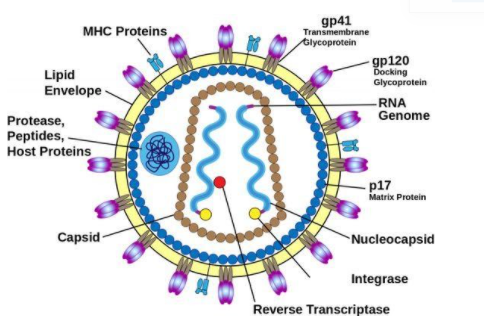
HIV originated in non-human primates and eventually spread to humans. The disease was clinically diagnosed in the 1980s. Now, it has spread all over the world, killing over 25 million people. This virus has a long incubation period like 10 years long before it starts to attack the immune system. The immune system is the human body’s natural defense system HIV makes this system weak.
Note: AIDS is caused by HIV virus. IT stands for acquired immunodeficiency syndrome. This syndrome damages our immune system and reduces our body’s ability to fight with disease. It is sexually transmitted, can pass from mother to foetus, from infected blood.
Complete answer:
HIV is the short form of the Human immunodeficiency virus. The shape of the virus is spherical.
The virus is made up of a capsid core which consists of the genetic material that has been covered by a protein envelope. The protein envelope contains many spikes of the glycoprotein on it. The outer part of glycoprotein is known as gp120 and it is attached to the gp41 which is the inner portion of the glycoprotein. The envelope of human deficiency virus also contains other proteins including Human Leukocyte Antigen. The genome of HIV contains two strands of RNA molecules. The enzymes reverse transcriptase is present for the conversion of the RNA to form the DNA.
HIV originated in non-human primates and eventually spread to humans. The disease was clinically diagnosed in the 1980s. Now, it has spread all over the world, killing over 25 million people. This virus has a long incubation period like 10 years long before it starts to attack the immune system. The immune system is the human body’s natural defense system HIV makes this system weak.
Note: AIDS is caused by HIV virus. IT stands for acquired immunodeficiency syndrome. This syndrome damages our immune system and reduces our body’s ability to fight with disease. It is sexually transmitted, can pass from mother to foetus, from infected blood.
Recently Updated Pages
Master Class 11 English: Engaging Questions & Answers for Success

Master Class 11 Social Science: Engaging Questions & Answers for Success
Master Class 11 Maths: Engaging Questions & Answers for Success
Master Class 11 Biology: Engaging Questions & Answers for Success
Master Class 11 Physics: Engaging Questions & Answers for Success
Master Class 11 Chemistry: Engaging Questions & Answers for Success
Trending doubts
One Metric ton is equal to kg A 10000 B 1000 C 100 class 11 physics CBSE
Difference Between Prokaryotic Cells and Eukaryotic Cells
1 ton equals to A 100 kg B 1000 kg C 10 kg D 10000 class 11 physics CBSE
Find the value of the expression given below sin 30circ class 11 maths CBSE
Two of the body parts which do not appear in MRI are class 11 biology CBSE
What are hard magnetic materials class 11 physics CBSE