




Explain the structure and function of the spinal cord.
Answer
 Verified
608.7k+ views
Hint: The spinal cord is an important part of our central nervous system, along with the brain. It is protected by the vertebral column, and divided into four regions – the lumbar, thoracic, cervical, and sacral part.
Complete answer:
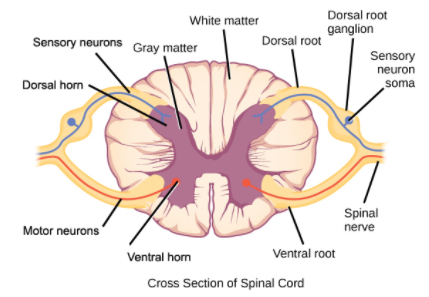
The spinal extends from the brain stem and is a link between the brain and the periphery. A cross section shows two distinct layers: white matter on the outside and grey matter on the inside. From each segment of the spinal cord pairs of nerves exit bilaterally to the periphery. In total there are 31 pairs of spinal nerves, divided into cervical, thoracic, lumbar, and sacral nerves. There are also larger bulges for innervation of the upper and lower limbs at the cervical and lumbar regions respectively.
The points where the nerve fibres enter and exit the cord are called the roots, so there are dorsal and ventral roots. Running down the middle of the spinal cord is a central canal which continues with the ventricles of the brain and contains cerebrospinal fluid. Like the brain is enclosed in three meningeal layers, so is the spinal cord. These help in protection and shock absorption.
Functionally, the spinal cord is the means by which all information from the periphery is taken to the brain, and messages given out. Reflex arcs in the spinal cord are a quick response where we can react to stimuli without needing directions from the brain. Any injury to the spinal cord will block the transmission of messages two and fro from below that level.
Note: Interestingly, while our vertebral column continues to grow as we grow, the spinal cord stops elongating in early childhood, and so in adults only two thirds of the vertebral column or spine is occupied by the main cord.
Complete answer:
The spinal extends from the brain stem and is a link between the brain and the periphery. A cross section shows two distinct layers: white matter on the outside and grey matter on the inside. From each segment of the spinal cord pairs of nerves exit bilaterally to the periphery. In total there are 31 pairs of spinal nerves, divided into cervical, thoracic, lumbar, and sacral nerves. There are also larger bulges for innervation of the upper and lower limbs at the cervical and lumbar regions respectively.
The points where the nerve fibres enter and exit the cord are called the roots, so there are dorsal and ventral roots. Running down the middle of the spinal cord is a central canal which continues with the ventricles of the brain and contains cerebrospinal fluid. Like the brain is enclosed in three meningeal layers, so is the spinal cord. These help in protection and shock absorption.
Functionally, the spinal cord is the means by which all information from the periphery is taken to the brain, and messages given out. Reflex arcs in the spinal cord are a quick response where we can react to stimuli without needing directions from the brain. Any injury to the spinal cord will block the transmission of messages two and fro from below that level.
Note: Interestingly, while our vertebral column continues to grow as we grow, the spinal cord stops elongating in early childhood, and so in adults only two thirds of the vertebral column or spine is occupied by the main cord.
Recently Updated Pages
Master Class 11 English: Engaging Questions & Answers for Success

Master Class 11 Social Science: Engaging Questions & Answers for Success
Master Class 11 Maths: Engaging Questions & Answers for Success
Master Class 11 Biology: Engaging Questions & Answers for Success
Master Class 11 Physics: Engaging Questions & Answers for Success
Master Class 11 Chemistry: Engaging Questions & Answers for Success
Trending doubts
One Metric ton is equal to kg A 10000 B 1000 C 100 class 11 physics CBSE
What is cell theory Who formulated it class 11 biology CBSE
Phyllotaxy is the arrangement of ALeaflets BLeaves class 11 biology CBSE
Difference Between Prokaryotic Cells and Eukaryotic Cells
The symbiotic association of fungi and algae is called class 11 biology CBSE
Cell theory was formulated by A Schleiden and Schwann class 11 biology CBSE