




Explain the steps involved in the formation of root nodules.
Answer
 Verified
611.4k+ views
Hint: Root nodules are commonly found in the roots of leguminous plants. Rhizobium, a nitrogen-fixing bacterium, is used to form them. Rhizobia is the general term used for diverse genera of nitrogen-fixing bacteria, e.g. Rhizobium, Bradyrhizobium, Azorhizobium, and so on.
Complete answer:
Steps in the development of root nodules:
-Root nodule formation is initiated, although a low degree of nitrogen is included in the soil. Molecular signaling for the association and increasing nodules is used by symbiotic companions. The nodulation steps are:
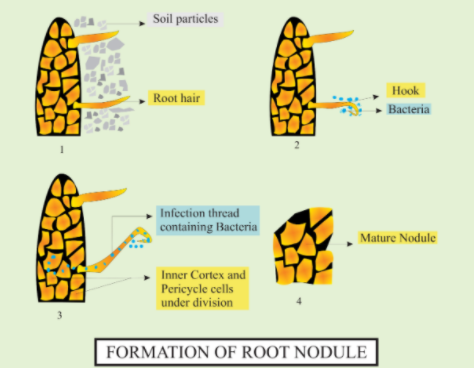
-Flavonoids are secreted by legume roots, which draw rhizobia closer to the base. Root hairs congregate around the rhizobia.
-Rhizobia secretes nod elements or elements of nodulation that cause root hairs to curl around them.
-Nod elements induce many changes in growth, such as membrane depolarization, root hair curling, within the root cortex molecular department, and intracellular calcium movement.
-The nod portion binds to the receptors present in the basement hair plasma membrane, resulting in the formation of the contamination thread. Rhizobia may also build cracks within the root cells.
-The infection thread enables the epidermal cells to migrate through the microorganism.
- Every bacterium gets surrounded by a plant-derived membrane known as symbiosome. Rhizobia then inputs cortex cells.
-The formation of nodules is initiated by means of chemical substances formed by rhizobia. It is a result of the pathway of calcium structured sign transduction, which activates mainly molecular department and nodule formation biochemical modifications.
-Cytokinin also plays an important role in the formation of nodules.
-Microorganisms are differentiated into bacteroids inside nodules, which repair nitrogen. For nodules, vascular tissues are formed for changing nutrients.
Additional Information: Each external and internal factor affects nodulation.
-External variables include heat, acidity, soil nitrate content, etc.
-If the soil is made with the content of chemical elements, it interferes with the development of nodule and based association, as plants already have enough nitrogen and do not want more.
-The fixation of nitrogen is an oxygen-sensitive process. A haemitin pigment known as leghaemoglobin is present in the base nodules, which promotes oxygen diffusion.
-The development of nodules is self-regulated by leaf tissues. To determine the virus, plants have established defensive mechanisms.
-Ethylene also internally controls nodule formation. Exogenous olefin application has shown that nodule formation has been inhibited
Note: - Plants can not directly absorb nitrogen atmospherically. These microorganisms fix ammonia with atmospheric nitrogen, which could be influenced by plants and used in the synthesis of essential amino acid-related macromolecules, nucleotides, etc.
- Some non-leguminous plants also grow root nodules, such as Rhizobia nodular Parasponia, Frankia nodulates alder, and bayberry. There are also root nodules in several genera of the Rosaceae family.
Complete answer:
Steps in the development of root nodules:
-Root nodule formation is initiated, although a low degree of nitrogen is included in the soil. Molecular signaling for the association and increasing nodules is used by symbiotic companions. The nodulation steps are:
-Flavonoids are secreted by legume roots, which draw rhizobia closer to the base. Root hairs congregate around the rhizobia.
-Rhizobia secretes nod elements or elements of nodulation that cause root hairs to curl around them.
-Nod elements induce many changes in growth, such as membrane depolarization, root hair curling, within the root cortex molecular department, and intracellular calcium movement.
-The nod portion binds to the receptors present in the basement hair plasma membrane, resulting in the formation of the contamination thread. Rhizobia may also build cracks within the root cells.
-The infection thread enables the epidermal cells to migrate through the microorganism.
- Every bacterium gets surrounded by a plant-derived membrane known as symbiosome. Rhizobia then inputs cortex cells.
-The formation of nodules is initiated by means of chemical substances formed by rhizobia. It is a result of the pathway of calcium structured sign transduction, which activates mainly molecular department and nodule formation biochemical modifications.
-Cytokinin also plays an important role in the formation of nodules.
-Microorganisms are differentiated into bacteroids inside nodules, which repair nitrogen. For nodules, vascular tissues are formed for changing nutrients.
Additional Information: Each external and internal factor affects nodulation.
-External variables include heat, acidity, soil nitrate content, etc.
-If the soil is made with the content of chemical elements, it interferes with the development of nodule and based association, as plants already have enough nitrogen and do not want more.
-The fixation of nitrogen is an oxygen-sensitive process. A haemitin pigment known as leghaemoglobin is present in the base nodules, which promotes oxygen diffusion.
-The development of nodules is self-regulated by leaf tissues. To determine the virus, plants have established defensive mechanisms.
-Ethylene also internally controls nodule formation. Exogenous olefin application has shown that nodule formation has been inhibited
Note: - Plants can not directly absorb nitrogen atmospherically. These microorganisms fix ammonia with atmospheric nitrogen, which could be influenced by plants and used in the synthesis of essential amino acid-related macromolecules, nucleotides, etc.
- Some non-leguminous plants also grow root nodules, such as Rhizobia nodular Parasponia, Frankia nodulates alder, and bayberry. There are also root nodules in several genera of the Rosaceae family.
Recently Updated Pages
Master Class 12 Economics: Engaging Questions & Answers for Success

Master Class 12 English: Engaging Questions & Answers for Success
Master Class 12 Social Science: Engaging Questions & Answers for Success
Master Class 12 Maths: Engaging Questions & Answers for Success
Master Class 12 Physics: Engaging Questions & Answers for Success
Master Class 11 Social Science: Engaging Questions & Answers for Success
Trending doubts
One Metric ton is equal to kg A 10000 B 1000 C 100 class 11 physics CBSE
Difference Between Prokaryotic Cells and Eukaryotic Cells
Two of the body parts which do not appear in MRI are class 11 biology CBSE
1 ton equals to A 100 kg B 1000 kg C 10 kg D 10000 class 11 physics CBSE
Draw a diagram of nephron and explain its structur class 11 biology CBSE
10 examples of friction in our daily life