




Explain the role of phloem in Plant transport. Use the words ‘source and sink’ in your answer.
Answer
 Verified
600.6k+ views
Hint: Xylem and phloem are conducting tissues of plants, together they form a vascular bundle and hence known as vascular tissues. Plants having vascular tissues are known as Tracheophytes. There are two main types of vascular tissues namely xylem and phloem.
Complete answer: A xylem is water and a mineral conducting tissue, whereas the phloem is the food conducting tissue. Phloem is living tissue made up of companion cells, sieve tubes, phloem parenchyma and phloem sclerenchyma. Phloem conducts photoassimilate produced in a leaf. The site where photoassimilate is synthesized is called a source. Here, leaf cells act as a source. Loading of photoassimilate occurs from the source cell. Whereas, the site where unloading of photoassimilate occurs is called a sink. Root cells act as a sink. Leaves are the source for carbohydrate synthesis and storage organs are referred to as sink. Phloem sap has multi-directional flow. The movement through the phloem tissue is carried out by positive hydrostatic pressures. This process is termed as translocation.
The number of plasmodesmata and membrane transport proteins determines the loading and unloading patterns. Plants synthesize glucose using carbon dioxide, sunlight and water, which is required for the growth and development of plants.
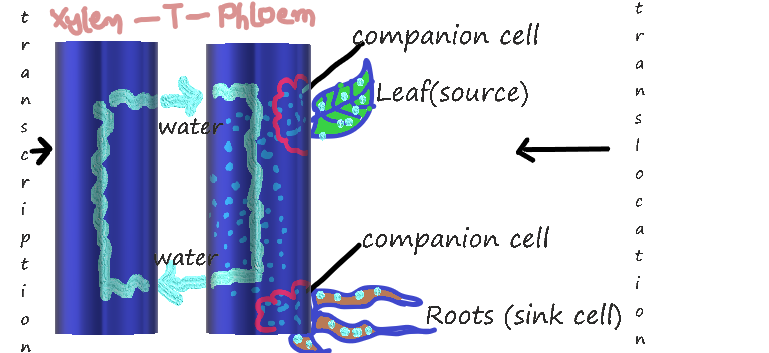
Note: Usually during the spring season or in bud condition of plant root, which is storage organ act as the source for carbohydrate and growing parts of plants act as a sink. The movement in phloem sap in phloem tissue is multidirectional.
Complete answer: A xylem is water and a mineral conducting tissue, whereas the phloem is the food conducting tissue. Phloem is living tissue made up of companion cells, sieve tubes, phloem parenchyma and phloem sclerenchyma. Phloem conducts photoassimilate produced in a leaf. The site where photoassimilate is synthesized is called a source. Here, leaf cells act as a source. Loading of photoassimilate occurs from the source cell. Whereas, the site where unloading of photoassimilate occurs is called a sink. Root cells act as a sink. Leaves are the source for carbohydrate synthesis and storage organs are referred to as sink. Phloem sap has multi-directional flow. The movement through the phloem tissue is carried out by positive hydrostatic pressures. This process is termed as translocation.
The number of plasmodesmata and membrane transport proteins determines the loading and unloading patterns. Plants synthesize glucose using carbon dioxide, sunlight and water, which is required for the growth and development of plants.
Note: Usually during the spring season or in bud condition of plant root, which is storage organ act as the source for carbohydrate and growing parts of plants act as a sink. The movement in phloem sap in phloem tissue is multidirectional.
Recently Updated Pages
Master Class 11 English: Engaging Questions & Answers for Success

Master Class 11 Social Science: Engaging Questions & Answers for Success
Master Class 11 Maths: Engaging Questions & Answers for Success
Master Class 11 Biology: Engaging Questions & Answers for Success
Master Class 11 Physics: Engaging Questions & Answers for Success
Master Class 11 Chemistry: Engaging Questions & Answers for Success
Trending doubts
One Metric ton is equal to kg A 10000 B 1000 C 100 class 11 physics CBSE
Difference Between Prokaryotic Cells and Eukaryotic Cells
Find the value of the expression given below sin 30circ class 11 maths CBSE
1 ton equals to A 100 kg B 1000 kg C 10 kg D 10000 class 11 physics CBSE
Two of the body parts which do not appear in MRI are class 11 biology CBSE
What are hard magnetic materials class 11 physics CBSE