




Explain the reflection of the transverse and the longitudinal waves from a denser medium and a rarer medium.
Answer
 Verified
603.9k+ views
Hint: When a wave is undergoing a reflection at a denser medium, then one of the things will be reflected as the opposite thing. Here the crest is the trough and vice versa. The same thing happens for the longitudinal wave when the reflection happens at a rarer medium.
Complete answer:
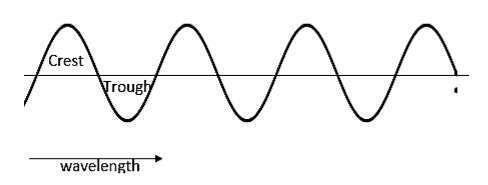
First of all let us check the characteristics of both the waves when reflected from denser and rarer medium. Generally the transverse waves are made up of crests and troughs. In a denser medium after the reflection, the phase difference happening will be $180{}^\circ $. Hence, crest will be travelling as trough and trough travels as crest after reflection. If it is in a rarer medium after reflection, phase difference will be \[0\]. Therefore, crest will be travelling as crest itself and the trough travels as trough also.
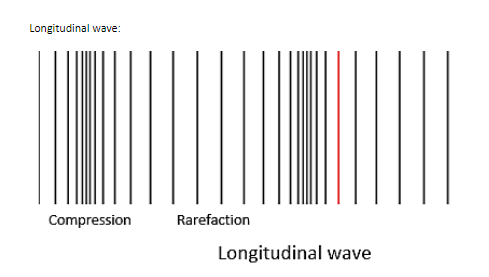
Now let us discuss the longitudinal waves. Generally the longitudinal waves are made up of compression and rarefaction. In the denser medium after reflection the phase difference will be different by $180{}^\circ $. Hence the compression will be compression and rarefaction will be rarefaction itself. In the rarer medium after reflection, the phase difference becomes \[0\]. Here the compression changes as rarefaction and rarefaction changes as compression.
Transverse wave:
Longitudinal wave:
Note:
A transverse wave is a wave which is in motion whose oscillations are perpendicular to the direction of the propagation of a wave or path of propagation. A common example can be illustrated with a horizontal length string. There the waves can be produced by fixing one end and making the other end move up and down. Longitudinal waves are defined as the waves which are in motion where the displacement of the medium is in the similar direction or in the opposite direction of the direction of propagation of the wave.
Complete answer:
First of all let us check the characteristics of both the waves when reflected from denser and rarer medium. Generally the transverse waves are made up of crests and troughs. In a denser medium after the reflection, the phase difference happening will be $180{}^\circ $. Hence, crest will be travelling as trough and trough travels as crest after reflection. If it is in a rarer medium after reflection, phase difference will be \[0\]. Therefore, crest will be travelling as crest itself and the trough travels as trough also.
Now let us discuss the longitudinal waves. Generally the longitudinal waves are made up of compression and rarefaction. In the denser medium after reflection the phase difference will be different by $180{}^\circ $. Hence the compression will be compression and rarefaction will be rarefaction itself. In the rarer medium after reflection, the phase difference becomes \[0\]. Here the compression changes as rarefaction and rarefaction changes as compression.
Transverse wave:
Longitudinal wave:
Note:
A transverse wave is a wave which is in motion whose oscillations are perpendicular to the direction of the propagation of a wave or path of propagation. A common example can be illustrated with a horizontal length string. There the waves can be produced by fixing one end and making the other end move up and down. Longitudinal waves are defined as the waves which are in motion where the displacement of the medium is in the similar direction or in the opposite direction of the direction of propagation of the wave.
Recently Updated Pages
Master Class 11 Social Science: Engaging Questions & Answers for Success

Master Class 11 Physics: Engaging Questions & Answers for Success
Master Class 11 Maths: Engaging Questions & Answers for Success
Master Class 11 Economics: Engaging Questions & Answers for Success
Master Class 11 Computer Science: Engaging Questions & Answers for Success
Master Class 11 Chemistry: Engaging Questions & Answers for Success
Trending doubts
One Metric ton is equal to kg A 10000 B 1000 C 100 class 11 physics CBSE
There are 720 permutations of the digits 1 2 3 4 5 class 11 maths CBSE
1 Quintal is equal to a 110 kg b 10 kg c 100kg d 1000 class 11 physics CBSE
State and prove Bernoullis theorem class 11 physics CBSE
Difference Between Prokaryotic Cells and Eukaryotic Cells
Which among the following are examples of coming together class 11 social science CBSE