




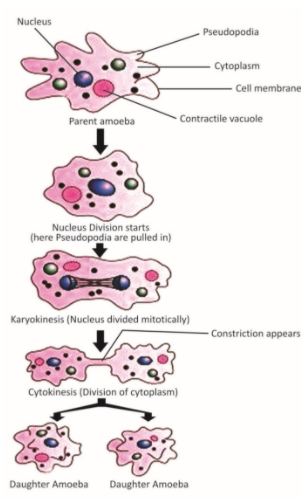
Explain the process of fission in amoeba with a diagram.
Answer
 Verified
626.7k+ views
Hint:Asexual reproduction is a type of reproduction in which a new offspring is formed without fusion of gametes. Binary fission is a type of asexual reproduction.
Complete answer:
Amoeba belongs to the kingdom protozoa. It is a eukaryotic unicellular organism. Unlike eukaryotic organisms they are anaerobic as amoeba has no mitochondria and generate ATP exclusively via anaerobic means. Amoeba are of diverse nature and so have different reproduction methods which are – spores, binary fission and even sexually (i.e. in Myxamoebae).
Amoeba reproduces by a binary fission method by which a parent amoeba will divide itself into two daughter cells which are identical to each other.
Binary fission in Amoeba:
Step 1: During binary fission, the genetic material in the nucleus replicates by mitotic division. Here the nucleus firstly divides into two daughter nuclei by the process of karyokinesis.
STEP 2: After that cytokinesis takes place in which cytoplasm of parent amoeba divides into two daughter cells.
The two daughter cells have their own nucleus and cell organelles.
STEP 3: The binary fission in amoeba is irregular binary fission as the cytokinesis may take place along any plane but it is always perpendicular to the plane of karyokinesis.
STEP 4: During cytokinesis the cell produces proteins and nutrients.
Binary fission generally occurs when conditions are favorable i.e. when there is enough food, water and suitable temperature.
Additional information: Amoeba can also reproduce by multiple fissions. In multiple fissions one parent amoeba divides to give many daughter cells in unfavorable condition.
If a segment of Amoeba is sliced off into two parts. The part with nucleus would recover and continue to function normally while the segment without nucleus will die.
Note: The advantages of binary fission are as follows,
>The reproduction rate is high as the process of binary fission is extremely fast.
>It requires only a single organism, i.e. either the mother or father is enough.
Complete answer:
Amoeba belongs to the kingdom protozoa. It is a eukaryotic unicellular organism. Unlike eukaryotic organisms they are anaerobic as amoeba has no mitochondria and generate ATP exclusively via anaerobic means. Amoeba are of diverse nature and so have different reproduction methods which are – spores, binary fission and even sexually (i.e. in Myxamoebae).
Amoeba reproduces by a binary fission method by which a parent amoeba will divide itself into two daughter cells which are identical to each other.
Binary fission in Amoeba:
Step 1: During binary fission, the genetic material in the nucleus replicates by mitotic division. Here the nucleus firstly divides into two daughter nuclei by the process of karyokinesis.
STEP 2: After that cytokinesis takes place in which cytoplasm of parent amoeba divides into two daughter cells.
The two daughter cells have their own nucleus and cell organelles.
STEP 3: The binary fission in amoeba is irregular binary fission as the cytokinesis may take place along any plane but it is always perpendicular to the plane of karyokinesis.
STEP 4: During cytokinesis the cell produces proteins and nutrients.
Binary fission generally occurs when conditions are favorable i.e. when there is enough food, water and suitable temperature.
Additional information: Amoeba can also reproduce by multiple fissions. In multiple fissions one parent amoeba divides to give many daughter cells in unfavorable condition.
If a segment of Amoeba is sliced off into two parts. The part with nucleus would recover and continue to function normally while the segment without nucleus will die.
Note: The advantages of binary fission are as follows,
>The reproduction rate is high as the process of binary fission is extremely fast.
>It requires only a single organism, i.e. either the mother or father is enough.
Recently Updated Pages
Basicity of sulphurous acid and sulphuric acid are

Master Class 11 English: Engaging Questions & Answers for Success
Master Class 11 Physics: Engaging Questions & Answers for Success
Master Class 11 Computer Science: Engaging Questions & Answers for Success
Master Class 11 Chemistry: Engaging Questions & Answers for Success
Master Class 11 Social Science: Engaging Questions & Answers for Success
Trending doubts
Difference Between Prokaryotic Cells and Eukaryotic Cells
Two of the body parts which do not appear in MRI are class 11 biology CBSE
One Metric ton is equal to kg A 10000 B 1000 C 100 class 11 physics CBSE
10 examples of friction in our daily life
Draw a diagram of nephron and explain its structur class 11 biology CBSE
What will happen if the mucus is not secreted by the class 11 biology CBSE