




Explain the nucleophilic substitution reaction of chlorobenzene.
Answer
 Verified
614.1k+ views
Hint: Chlorobenzene doesn’t give nucleophilic substitution reaction. But under very adverse conditions and specific reagents, chlorobenzene can give nucleophilic substitution reactions.
Complete answer:
We have studied about the basic named reactions as well as some of the related reactions in our chapters of chemistry.
Let us recollect these and approach the required answer.
Chlorobenzene is very less reactive towards nucleophilic substitution reactions. This is mainly because of two reasons:
- Resonance effect: Chlorine has a lone pair of electrons which are in conjugation with the π electrons of the benzene ring. This delocalisation of lone pairs of chlorine develops a partial double bond character in the C-Cl bond which makes it difficult for the nucleophile to cleave the C-Cl bond.
- Less polar C-Cl bond: The hybridisation of carbons in chlorobenzene is . carbons are more electronegative than the hybridised carbons. So, the carbons have a less tendency to release electrons to the chlorine atom. Thus, the C-Cl bond has less polarity, and hence less reactivity.
However, in some adverse conditions and reagents, chlorobenzene can give nucleophilic substitution reactions.
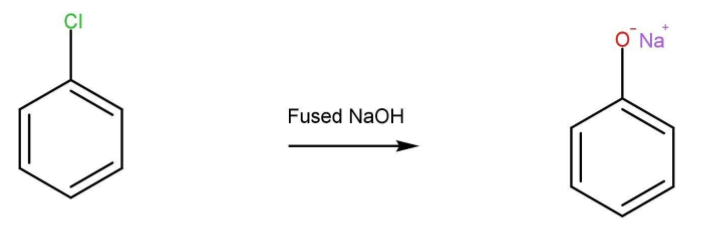
- Chlorobenzene when reacted with fused NaOH gives phenol. The reaction takes place at a high temperature. Phenol then again reacts with NaOH to give its salt.
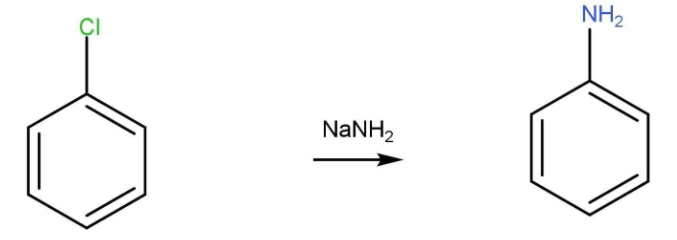
- Chlorobenzene reacts with sodium amide to give aniline.
Note:
Note that nucleophilic reactions are identified by the presence of both the electron pair donor and electron pair acceptor in the reaction and an $s{{p}^{3}}$ hybridised electrophile must have a leaving group in order for the reaction to take place.
Complete answer:
We have studied about the basic named reactions as well as some of the related reactions in our chapters of chemistry.
Let us recollect these and approach the required answer.
Chlorobenzene is very less reactive towards nucleophilic substitution reactions. This is mainly because of two reasons:
- Resonance effect: Chlorine has a lone pair of electrons which are in conjugation with the π electrons of the benzene ring. This delocalisation of lone pairs of chlorine develops a partial double bond character in the C-Cl bond which makes it difficult for the nucleophile to cleave the C-Cl bond.
- Less polar C-Cl bond: The hybridisation of carbons in chlorobenzene is . carbons are more electronegative than the hybridised carbons. So, the carbons have a less tendency to release electrons to the chlorine atom. Thus, the C-Cl bond has less polarity, and hence less reactivity.
However, in some adverse conditions and reagents, chlorobenzene can give nucleophilic substitution reactions.
- Chlorobenzene when reacted with fused NaOH gives phenol. The reaction takes place at a high temperature. Phenol then again reacts with NaOH to give its salt.
- Chlorobenzene reacts with sodium amide to give aniline.
Note:
Note that nucleophilic reactions are identified by the presence of both the electron pair donor and electron pair acceptor in the reaction and an $s{{p}^{3}}$ hybridised electrophile must have a leaving group in order for the reaction to take place.
Recently Updated Pages
If x a + bt + ct2 where x is in meters and t is in class 11 physics CBSE

A car covers the first half distance between two places class 11 physics CBSE
The resultant of two vectors overrightarrow P and overrightarrow class 11 physics CBSE
Find the value of cos 135 class 11 maths CBSE
A mass M is held in place by an applied force F and class 11 physics CBSE
A solution of glucose in water is labelled as 10 dfracwv class 11 chemistry CBSE
Trending doubts
One Metric ton is equal to kg A 10000 B 1000 C 100 class 11 physics CBSE
Find the value of the expression given below sin 30circ class 11 maths CBSE
What do you mean by retardation What is its SI uni class 11 physics CBSE
Draw a diagram of nephron and explain its structur class 11 biology CBSE
10 examples of friction in our daily life
Difference between physical and chemical change class 11 chemistry CBSE