




Explain the menstrual cycle in human females.
Answer
 Verified
585k+ views
Hint: A woman's body goes through several changes per month during the years between puberty and menopause to get it ready for a potential pregnancy. The menstrual cycle in simple terms is what this sequence of hormone-driven events is called.
Complete answer:
In human females, menstruation is repeated at an average interval of about 28/29 days, and therefore the cycle of events ranging from one menstruation till successive one is termed the menstrual cycle.
- One ovum is released (ovulation) during the middle of every cycle.
- The cycle starts with the menstrual phase when menstrual blood flow occurs and it lasts for 3-5 days. The menstrual flow takes place because of the breakdown of the endometrial lining present in the uterus and its blood vessels which forms a liquid that comes out through the vagina.
- Menstruation only occurs if the released ovum isn't fertilized.
The menstrual phase is then followed by another phase known as the follicular phase.
- During this follicular phase, the first follicles which are formed within the ovary grow to become a totally mature follicle known as Graafian follicle, and simultaneously the endometrium of the uterus regenerates through proliferation.
- These changes within the ovary and therefore the uterus are induced by changes within the levels of pituitary and ovarian hormones.
- The secretion of the hormone i.e gonadotropins (LH and FSH) increases gradually during the follicular phase and stimulates follicular development also as secretion of estrogens by the growing follicles.
- Both LH and FSH attain a peak level within the middle of the cycle (about the ${ 14 }^{ th }$ day).
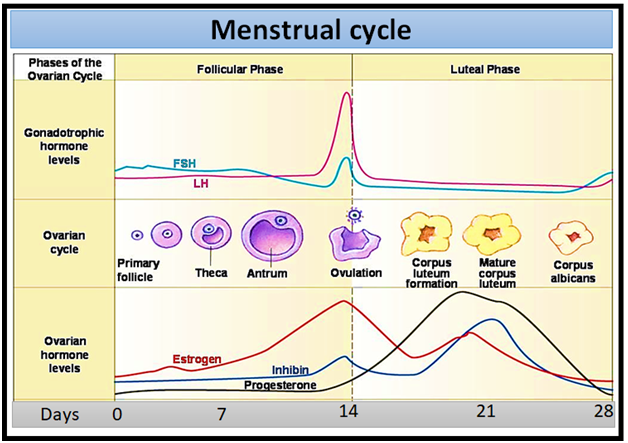
-The rapid secretion of the hormone i.e LH results in its maximum level during the mid of the cycle called LH surge induces rupture of the Graafian follicle and thereby the discharge of an ovum, a process known as ovulation) [ovulatory phase].
- The ovulation or in another term, the ovulatory phase is followed by the luteal phase during which the remaining parts of the Graafian follicle transform as the corpus luteum. The corpus luteum secretes large amounts of progesterone which is known to be essential for the maintenance of the endometrium.
- In the absence of fertilization, the corpus luteum was found to degenerate. This leads to the disintegration of the endometrium resulting in menstruation, marking a new cycle. In humans, menstrual cycles cease around 50 years of age; that's termed menopause.
- Cyclic menstruation gives the hint of a normal reproductive phase and extends between menarche and menopause.
Note:
- Negative feedback on pulse release of gonadotropin-releasing hormone (GnRH) and luteinizing hormone ( LH) is triggered by breastfeeding.
- Breastfeeding women can experience complete suppression of follicular development which is depending on the frequency of the negative feedback.
Complete answer:
In human females, menstruation is repeated at an average interval of about 28/29 days, and therefore the cycle of events ranging from one menstruation till successive one is termed the menstrual cycle.
- One ovum is released (ovulation) during the middle of every cycle.
- The cycle starts with the menstrual phase when menstrual blood flow occurs and it lasts for 3-5 days. The menstrual flow takes place because of the breakdown of the endometrial lining present in the uterus and its blood vessels which forms a liquid that comes out through the vagina.
- Menstruation only occurs if the released ovum isn't fertilized.
The menstrual phase is then followed by another phase known as the follicular phase.
- During this follicular phase, the first follicles which are formed within the ovary grow to become a totally mature follicle known as Graafian follicle, and simultaneously the endometrium of the uterus regenerates through proliferation.
- These changes within the ovary and therefore the uterus are induced by changes within the levels of pituitary and ovarian hormones.
- The secretion of the hormone i.e gonadotropins (LH and FSH) increases gradually during the follicular phase and stimulates follicular development also as secretion of estrogens by the growing follicles.
- Both LH and FSH attain a peak level within the middle of the cycle (about the ${ 14 }^{ th }$ day).
-The rapid secretion of the hormone i.e LH results in its maximum level during the mid of the cycle called LH surge induces rupture of the Graafian follicle and thereby the discharge of an ovum, a process known as ovulation) [ovulatory phase].
- The ovulation or in another term, the ovulatory phase is followed by the luteal phase during which the remaining parts of the Graafian follicle transform as the corpus luteum. The corpus luteum secretes large amounts of progesterone which is known to be essential for the maintenance of the endometrium.
- In the absence of fertilization, the corpus luteum was found to degenerate. This leads to the disintegration of the endometrium resulting in menstruation, marking a new cycle. In humans, menstrual cycles cease around 50 years of age; that's termed menopause.
- Cyclic menstruation gives the hint of a normal reproductive phase and extends between menarche and menopause.
Note:
- Negative feedback on pulse release of gonadotropin-releasing hormone (GnRH) and luteinizing hormone ( LH) is triggered by breastfeeding.
- Breastfeeding women can experience complete suppression of follicular development which is depending on the frequency of the negative feedback.
Recently Updated Pages
Master Class 11 English: Engaging Questions & Answers for Success

Master Class 11 Social Science: Engaging Questions & Answers for Success
Master Class 11 Maths: Engaging Questions & Answers for Success
Master Class 11 Biology: Engaging Questions & Answers for Success
Master Class 11 Physics: Engaging Questions & Answers for Success
Master Class 11 Chemistry: Engaging Questions & Answers for Success
Trending doubts
First Cotton Mill of India
In which year voting age was reduced from 21 to 18?
What planets have no moons Which one has only one moon class 10 physics CBSE
In cricket, which Indian bowler is known as the "Yorker King"?
Who was the first Indian ruler to enter into the Subsidiary class 10 social science CBSE
Digdarshan the first monthly magazine in Marathi was class 10 social science CBSE