




Explain the mechanism of reflex action with the help of a suitable diagram
Answer
 Verified
578.1k+ views
Hint: Reflex action is a form of behavior in which the stimulation of a sensory organ results in the activity of some organ without any intervention of will. In general terms it is a spontaneous automatic mechanical response to a stimulus without the will of the human being.
Complete answer:
The reflex action of our body is controlled by the spinal cord
It is also known as spinal reflex action. Some reflections are controlled by our brain and also known as cerebral reflex action. Mechanism of reflex action can understand by five things and are consider essential:
- Receptor
- Sensory nerve fibers
- Part of the central nervous system
- Motor nerve fibers and
- Effectors organs such as muscles and glands.
The working of mechanism reflex action - The sensory nerve fibers bring sensory impulses from the receptor organ or sensory organ to the central nervous system. The motor nerve fibers relay the motor impulses from the nervous system to the effectors organs like muscles or glands. Resulting into an impulse travels path during reflex action which is called reflex arc.
Main Examples of reflex action are,
i) Closing of eyes when strong light is flashed into them.
ii) Withdrawal of hands when they are touched by hot things.
iii) Watering of mouth on seeing your favorite food item.
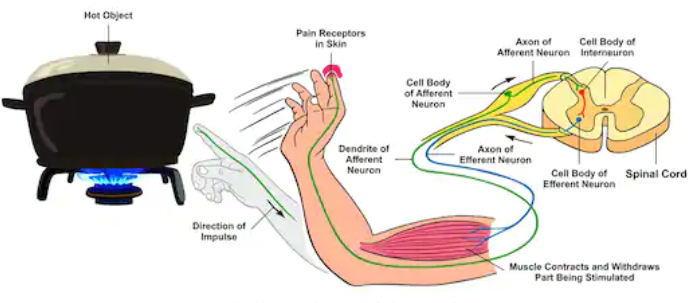
Note: The main point to be kept in mind is that we all have our instincts differently. They depend on our past experiences as well as understanding the environment. A reflex is a reaction triggered by our instinct. At times, we have no prior knowledge or we are not aware of the situation such as if the pan is hot or not.
Complete answer:
The reflex action of our body is controlled by the spinal cord
It is also known as spinal reflex action. Some reflections are controlled by our brain and also known as cerebral reflex action. Mechanism of reflex action can understand by five things and are consider essential:
- Receptor
- Sensory nerve fibers
- Part of the central nervous system
- Motor nerve fibers and
- Effectors organs such as muscles and glands.
The working of mechanism reflex action - The sensory nerve fibers bring sensory impulses from the receptor organ or sensory organ to the central nervous system. The motor nerve fibers relay the motor impulses from the nervous system to the effectors organs like muscles or glands. Resulting into an impulse travels path during reflex action which is called reflex arc.
Main Examples of reflex action are,
i) Closing of eyes when strong light is flashed into them.
ii) Withdrawal of hands when they are touched by hot things.
iii) Watering of mouth on seeing your favorite food item.
Note: The main point to be kept in mind is that we all have our instincts differently. They depend on our past experiences as well as understanding the environment. A reflex is a reaction triggered by our instinct. At times, we have no prior knowledge or we are not aware of the situation such as if the pan is hot or not.
Recently Updated Pages
Basicity of sulphurous acid and sulphuric acid are

Master Class 11 English: Engaging Questions & Answers for Success
Master Class 11 Physics: Engaging Questions & Answers for Success
Master Class 11 Computer Science: Engaging Questions & Answers for Success
Master Class 11 Chemistry: Engaging Questions & Answers for Success
Master Class 11 Social Science: Engaging Questions & Answers for Success
Trending doubts
Difference Between Prokaryotic Cells and Eukaryotic Cells
Two of the body parts which do not appear in MRI are class 11 biology CBSE
One Metric ton is equal to kg A 10000 B 1000 C 100 class 11 physics CBSE
10 examples of friction in our daily life
Draw a diagram of nephron and explain its structur class 11 biology CBSE
What will happen if the mucus is not secreted by the class 11 biology CBSE