




Explain the mechanism of addition of HCN to a carbonyl group in presence of a base.
Answer
 Verified
598.2k+ views
Hint: The addition of HCN to a carbonyl group in the presence of base is a nucleophilic addition reaction where the cyanide ion acts as a nucleophile which attacks at the double bond of carbon and oxygen and forms an addition product.
Complete answer:
In carbonyl compounds, the electron density is higher near the oxygen atom as it is more electronegative. This leads to the generation of a partial negative charge on the oxygen atom and a partial positive charge on the carbon atom.
Since the carbonyl carbon holds a partial positive charge, it behaves as an electrophile. And the partial negative charge on the oxygen atom is neutralized via the proton of an acidic group.
The reaction of HCN with carbonyl compounds is an example of the nucleophilic addition reaction. The mechanism involved is discussed below:
Step – 1: Attack of nucleophile from HCN to the slightly positive carbon atom.
The base is used as a catalyst and it deprotonates the HCN molecule to produce a stronger nucleophile – cyanide ion.
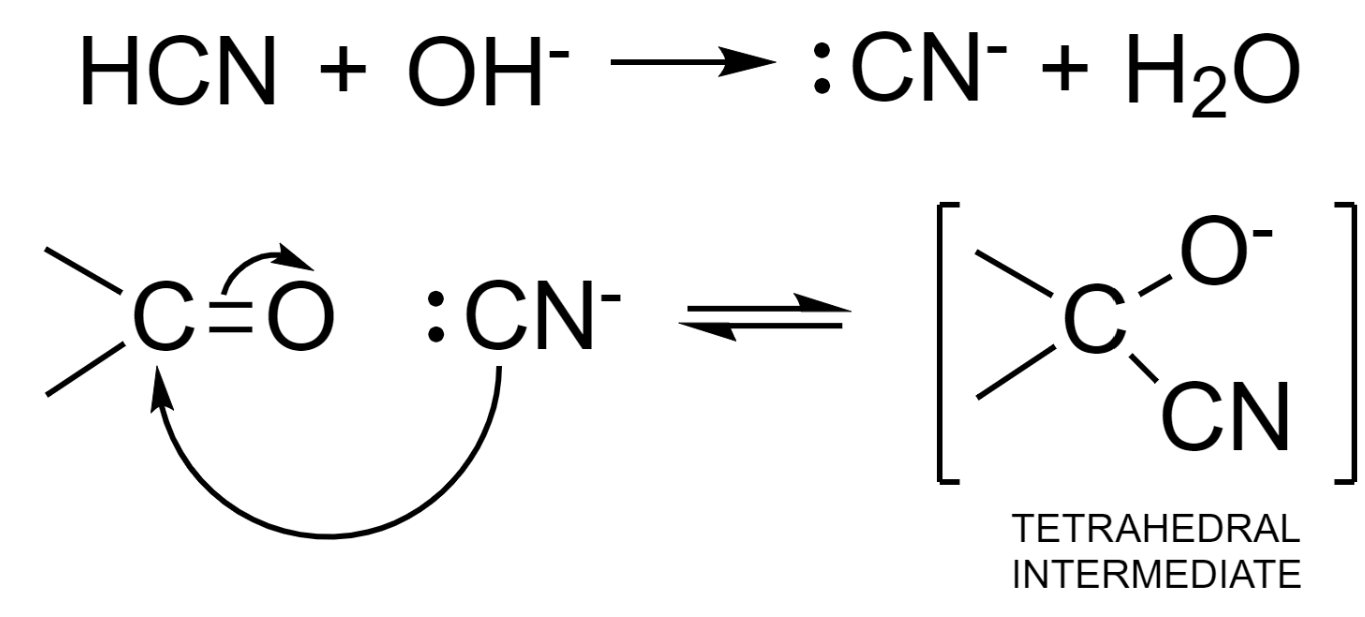
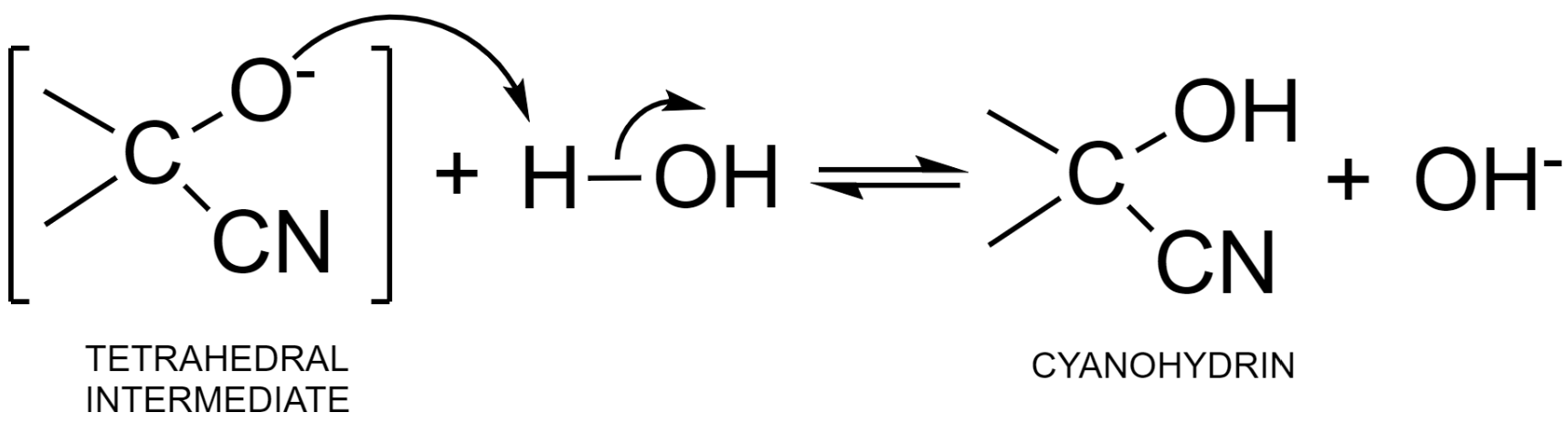
Step – 2: The negative charge in the tetrahedral intermediate is then neutralized by accepting a proton from a water molecule. This results in the formation of cyanohydrin – an additional product and hydroxyl ion. This hydroxyl ion can further be used up in the formation of the nucleophile.
Additional information:
HCN is not directly used in this reaction as it is highly poisonous. The reagent is prepared by adding dilute acid to sodium or potassium cyanide.
Note:
Aldehydes are relatively more reactive towards nucleophilic addition reactions than ketones. This is because the secondary carbocations formed by ketones are stabilized by the adjacent alkyl groups while the primary carbocations formed by aldehydes are less stable and are, therefore, more susceptible to nucleophilic attacks.
Complete answer:
In carbonyl compounds, the electron density is higher near the oxygen atom as it is more electronegative. This leads to the generation of a partial negative charge on the oxygen atom and a partial positive charge on the carbon atom.
Since the carbonyl carbon holds a partial positive charge, it behaves as an electrophile. And the partial negative charge on the oxygen atom is neutralized via the proton of an acidic group.
The reaction of HCN with carbonyl compounds is an example of the nucleophilic addition reaction. The mechanism involved is discussed below:
Step – 1: Attack of nucleophile from HCN to the slightly positive carbon atom.
The base is used as a catalyst and it deprotonates the HCN molecule to produce a stronger nucleophile – cyanide ion.
Step – 2: The negative charge in the tetrahedral intermediate is then neutralized by accepting a proton from a water molecule. This results in the formation of cyanohydrin – an additional product and hydroxyl ion. This hydroxyl ion can further be used up in the formation of the nucleophile.
Additional information:
HCN is not directly used in this reaction as it is highly poisonous. The reagent is prepared by adding dilute acid to sodium or potassium cyanide.
Note:
Aldehydes are relatively more reactive towards nucleophilic addition reactions than ketones. This is because the secondary carbocations formed by ketones are stabilized by the adjacent alkyl groups while the primary carbocations formed by aldehydes are less stable and are, therefore, more susceptible to nucleophilic attacks.
Recently Updated Pages
If x a + bt + ct2 where x is in meters and t is in class 11 physics CBSE

A car covers the first half distance between two places class 11 physics CBSE
The resultant of two vectors overrightarrow P and overrightarrow class 11 physics CBSE
Find the value of cos 135 class 11 maths CBSE
A mass M is held in place by an applied force F and class 11 physics CBSE
A solution of glucose in water is labelled as 10 dfracwv class 11 chemistry CBSE
Trending doubts
One Metric ton is equal to kg A 10000 B 1000 C 100 class 11 physics CBSE
Find the value of the expression given below sin 30circ class 11 maths CBSE
Draw a diagram of nephron and explain its structur class 11 biology CBSE
10 examples of friction in our daily life
Proton was discovered by A Thomson B Rutherford C Chadwick class 11 chemistry CBSE
Bond order ofO2 O2+ O2 and O22 is in order A O2 langle class 11 chemistry CBSE