




Explain the mechanism for nitration of benzene.
Answer
 Verified
633.6k+ views
Hint: In electrophilic aromatic substitution reaction, the benzene ring acts as a nucleophile. It donates a pair of pi electrons to suitable electrophile. In the next step, deprotonation occurs.
Complete Step by step answer: Explain the mechanism for nitration of benzene.
Benzene reacts with nitric acid and sulphuric acid to form nitrobenzene. It is an example of electrophilic aromatic substitution reaction. One hydrogen atom of benzene ring is replaced with nitro group. Nitric acid reacts with sulphuric acid to form nitronium ions.
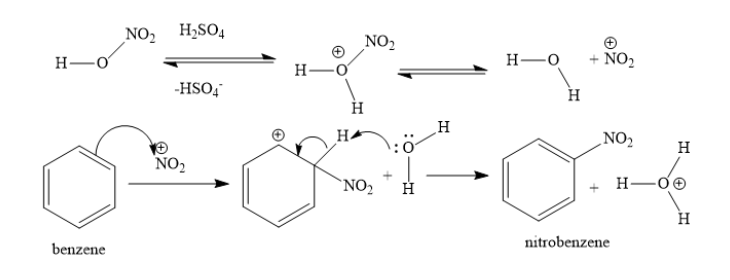
The pi electrons of benzene are donated to nitronium ions. A carbon-nitrogen bond is formed and the neighboring carbon atom gains unit positive charge. In this step, the aromaticity of the ring is broken. In the next step, this intermediate loses a proton to the water molecule. In this step, the aromaticity of the ring is regenerated.
Additional information: Some other examples of electrophilic aromatic substitution reaction include sulphation, Friedel craft alkylation and Friedel craft acylation reactions.
Note: Aromatic compounds do not undergo addition reactions. Instead they undergo substitution reactions. If an additional reaction is carried out for the aromatic compounds, then the aromaticity of the benzene ring will be lost. This will decrease the stability. However, for substitution reactions, the aromaticity of benzene rings is restored. Hence, substitution is preferred over addition for aromatic compounds.
Complete Step by step answer: Explain the mechanism for nitration of benzene.
Benzene reacts with nitric acid and sulphuric acid to form nitrobenzene. It is an example of electrophilic aromatic substitution reaction. One hydrogen atom of benzene ring is replaced with nitro group. Nitric acid reacts with sulphuric acid to form nitronium ions.
The pi electrons of benzene are donated to nitronium ions. A carbon-nitrogen bond is formed and the neighboring carbon atom gains unit positive charge. In this step, the aromaticity of the ring is broken. In the next step, this intermediate loses a proton to the water molecule. In this step, the aromaticity of the ring is regenerated.
Additional information: Some other examples of electrophilic aromatic substitution reaction include sulphation, Friedel craft alkylation and Friedel craft acylation reactions.
Note: Aromatic compounds do not undergo addition reactions. Instead they undergo substitution reactions. If an additional reaction is carried out for the aromatic compounds, then the aromaticity of the benzene ring will be lost. This will decrease the stability. However, for substitution reactions, the aromaticity of benzene rings is restored. Hence, substitution is preferred over addition for aromatic compounds.
Recently Updated Pages
Explain the structure of megasporangium class 12 biology CBSE

Why is chloroform kept in dark coloured bottles class 12 chemistry CBSE
Derive the balancing condition of a Wheatstone bri class 12 physics CBSE
Draw VI characteristics of a pn junction diode Explain class 12 physics CBSE
Is it possible to carry pride in ones language too class 12 english CBSE
In a population at Hardy Weinberg equilibrium the allele class 12 biology CBSE
Trending doubts
Draw a labelled sketch of the human eye class 12 physics CBSE
Which are the Top 10 Largest Countries of the World?
Draw ray diagrams each showing i myopic eye and ii class 12 physics CBSE
Which is the correct genotypic ratio of mendel dihybrid class 12 biology CBSE
Differentiate between homogeneous and heterogeneous class 12 chemistry CBSE
Give 10 examples of unisexual and bisexual flowers