




Explain the life cycle of silk moths.
Answer
 Verified
542.7k+ views
Hint The domestic silk moth, Bombyx mori, belongs to the Bombycidae family of moths. Bombyx mandarina, the wild silk moth, is its closest relative. A silk moth's larva or caterpillar is known as a silkworm. It is a significant economic insect because it is the principal producer of silk.
Complete answer:
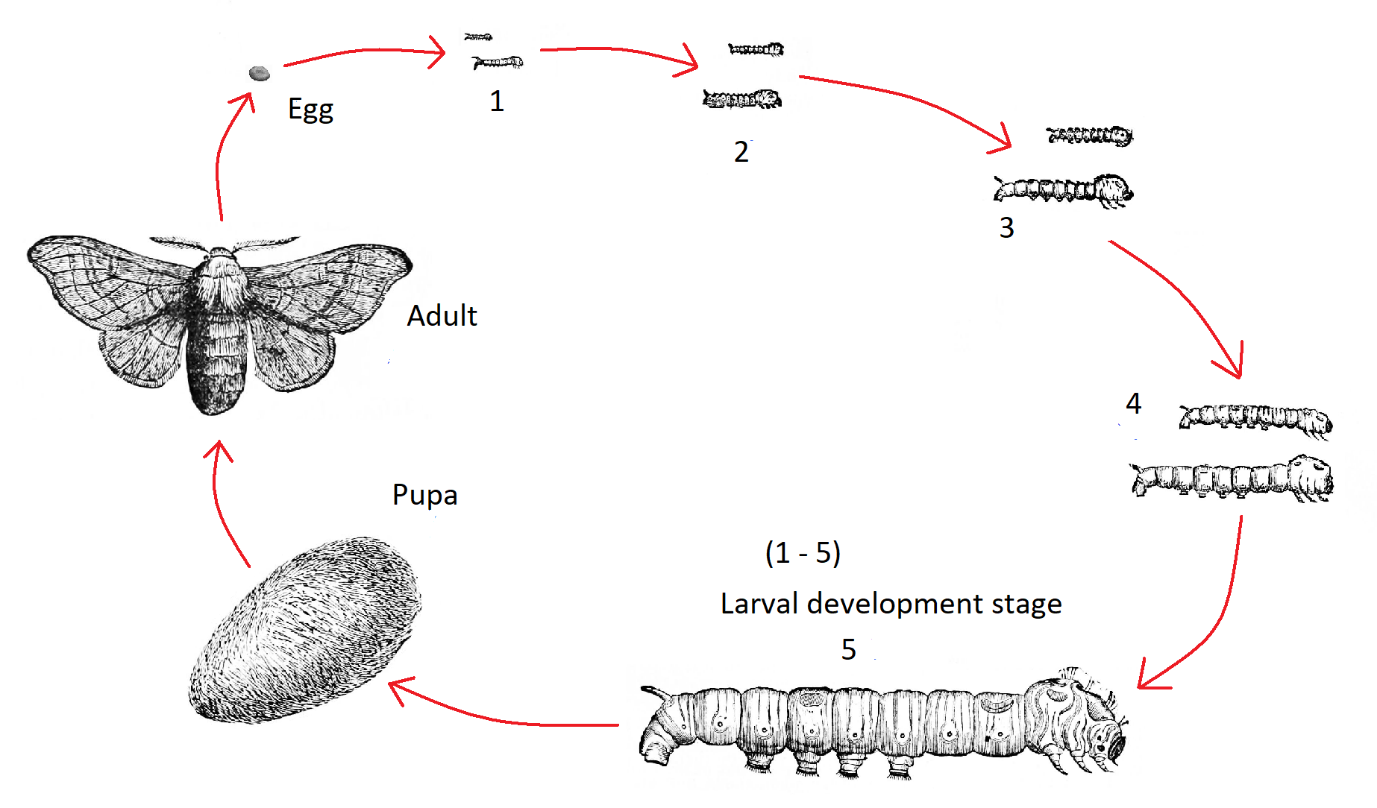
When a female silk moth lays eggs, the life cycle of the silk moth begins. The caterpillars or larvae of the silk moth are hatched from the silk moth's eggs. Silkworms produce pupa by feeding on mulberry leaves. To keep itself alive during the pupa stage, the silkworm weaves a net around itself. After that, it swings its head, spinning a protein fibre that eventually turns into silk. The cocoon is a protective layer formed by many caterpillars that surrounds the pupa. The silk thread (yarn) is made from the cocoon of the silk moth. The silkworm's life cycle is described in detail below.
Stage One: The Egg
The egg is the initial stage in the silkworm's life cycle. A female moth lays the egg, which is generally the size of a little dot. At any given time, a female moth can deposit more than 350 eggs.
Stage two: Silkworm
After the eggs hatch, a hairy silkworm emerges. The growth of silkworms occurs at this stage. They feed on mulberry leaves and eat a lot of them for around 30 days before moving on to the next stage.
Cocooning is the third stage.
Silkworms spin a protective cocoon around themselves at this stage. It's about the size of a little cotton ball and is constructed with a single silk thread. The eggs hatch in the spring because the air is warmer. This surgery takes place once a year.
Pupa is the fourth stage.
The pupa stage is characterised by its lack of movement. People kill the pupa at this stage by immersing the cocoon in boiling water and unwinding the silk thread.
Stage five: Adult:
The pupa transforms into an adult moth at this stage. After mating, the female moth lays eggs, and the silkworm's life cycle begins all over again.
Note: Silk processing is the process of extracting silk from the cocoon. Exposure to sunshine separates the silk from the cocoon. The process of unwinding silk from a cocoon begins once the reeling of silk is completed. After that, the silk thread is bleached. After that, the silk fibre is spun into silk threads.
Complete answer:
When a female silk moth lays eggs, the life cycle of the silk moth begins. The caterpillars or larvae of the silk moth are hatched from the silk moth's eggs. Silkworms produce pupa by feeding on mulberry leaves. To keep itself alive during the pupa stage, the silkworm weaves a net around itself. After that, it swings its head, spinning a protein fibre that eventually turns into silk. The cocoon is a protective layer formed by many caterpillars that surrounds the pupa. The silk thread (yarn) is made from the cocoon of the silk moth. The silkworm's life cycle is described in detail below.
Stage One: The Egg
The egg is the initial stage in the silkworm's life cycle. A female moth lays the egg, which is generally the size of a little dot. At any given time, a female moth can deposit more than 350 eggs.
Stage two: Silkworm
After the eggs hatch, a hairy silkworm emerges. The growth of silkworms occurs at this stage. They feed on mulberry leaves and eat a lot of them for around 30 days before moving on to the next stage.
Cocooning is the third stage.
Silkworms spin a protective cocoon around themselves at this stage. It's about the size of a little cotton ball and is constructed with a single silk thread. The eggs hatch in the spring because the air is warmer. This surgery takes place once a year.
Pupa is the fourth stage.
The pupa stage is characterised by its lack of movement. People kill the pupa at this stage by immersing the cocoon in boiling water and unwinding the silk thread.
Stage five: Adult:
The pupa transforms into an adult moth at this stage. After mating, the female moth lays eggs, and the silkworm's life cycle begins all over again.
Note: Silk processing is the process of extracting silk from the cocoon. Exposure to sunshine separates the silk from the cocoon. The process of unwinding silk from a cocoon begins once the reeling of silk is completed. After that, the silk thread is bleached. After that, the silk fibre is spun into silk threads.
Recently Updated Pages
Master Class 11 English: Engaging Questions & Answers for Success

Master Class 11 Social Science: Engaging Questions & Answers for Success
Master Class 11 Maths: Engaging Questions & Answers for Success
Master Class 11 Biology: Engaging Questions & Answers for Success
Master Class 11 Physics: Engaging Questions & Answers for Success
Master Class 11 Chemistry: Engaging Questions & Answers for Success
Trending doubts
One Metric ton is equal to kg A 10000 B 1000 C 100 class 11 physics CBSE
Difference Between Prokaryotic Cells and Eukaryotic Cells
1 ton equals to A 100 kg B 1000 kg C 10 kg D 10000 class 11 physics CBSE
Find the value of the expression given below sin 30circ class 11 maths CBSE
Two of the body parts which do not appear in MRI are class 11 biology CBSE
What are hard magnetic materials class 11 physics CBSE