




Explain the importance of homologous organs in the process of evolution.
Answer
 Verified
536.1k+ views
Hint: Homologous organs are considered to be evidence from comparative anatomy in the evolutionary process. If any similarity is found in organisms belonging to different groups, it is considered that there is a relationship between those organisms. These relationships can be understood from studying homologous structures.
Complete explanation:
Homologous organs are organs that are similar in structure but different in function. Let us consider the following example- forelimbs of man, cheetah, whale and bat. The forelimbs of the mentioned organisms possess similar anatomical structures and have similar bones. But, their function differs. The forelimb of a human is used to hold things, write; that of a cheetah is used to run and walk; a whale uses its forelimbs to swim and a bat uses its forelimbs to fly.
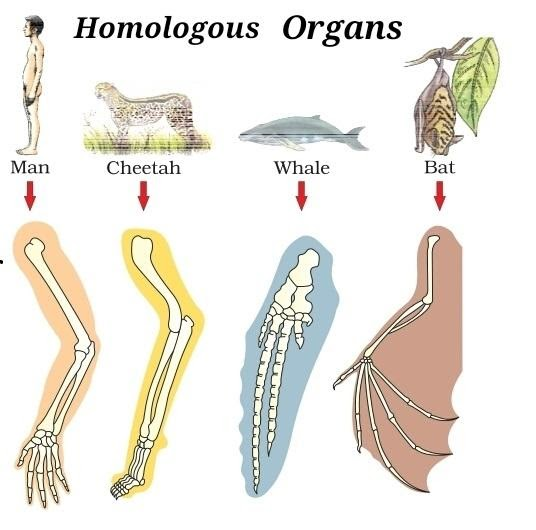
Homologous organs are an important example in the evolutionary process because it leads to divergent evolution. Organisms having homologous organs are thought to come from the same ancestor. These organs also help in knowing the phylogenetic relationship between different organisms.
Additional information:
Analogous organs are opposite of homologous organs. Analogous organs are organs that are different in structure but perform similar function. For example, wings of birds, bats and butterflies have different anatomical structures, but all perform the same function of flying.
Note:
The importance of homologous organs in the evolutionary process is to show the relationship between different organisms and prove they all had a common ancestor. The process through which interbreeding species split into two or more evolutionary groups is referred to as divergent evolution. Divergent evolution results from homologous organs.
Complete explanation:
Homologous organs are organs that are similar in structure but different in function. Let us consider the following example- forelimbs of man, cheetah, whale and bat. The forelimbs of the mentioned organisms possess similar anatomical structures and have similar bones. But, their function differs. The forelimb of a human is used to hold things, write; that of a cheetah is used to run and walk; a whale uses its forelimbs to swim and a bat uses its forelimbs to fly.
Homologous organs are an important example in the evolutionary process because it leads to divergent evolution. Organisms having homologous organs are thought to come from the same ancestor. These organs also help in knowing the phylogenetic relationship between different organisms.
Additional information:
Analogous organs are opposite of homologous organs. Analogous organs are organs that are different in structure but perform similar function. For example, wings of birds, bats and butterflies have different anatomical structures, but all perform the same function of flying.
Note:
The importance of homologous organs in the evolutionary process is to show the relationship between different organisms and prove they all had a common ancestor. The process through which interbreeding species split into two or more evolutionary groups is referred to as divergent evolution. Divergent evolution results from homologous organs.
Recently Updated Pages
Master Class 12 Business Studies: Engaging Questions & Answers for Success

Master Class 12 Chemistry: Engaging Questions & Answers for Success
Master Class 12 Biology: Engaging Questions & Answers for Success
Class 12 Question and Answer - Your Ultimate Solutions Guide
Master Class 11 English: Engaging Questions & Answers for Success
Master Class 11 Social Science: Engaging Questions & Answers for Success
Trending doubts
Which are the Top 10 Largest Countries of the World?
Draw a labelled sketch of the human eye class 12 physics CBSE
The end of compass needle which points towards north class 12 physics CBSE
Differentiate between homogeneous and heterogeneous class 12 chemistry CBSE
In order to find out the different types of gametes class 12 biology NEET_UG
Why is the cell called the structural and functional class 12 biology CBSE