




Explain the formation of nitrogen molecules.
Answer
 Verified
645k+ views
Hint – Here we will proceed by explaining the electronic configuration of nitrogen that is ‘N’ atoms. By explaining the structural formula of a nitrogen molecule.
Nitrogen is a non-metal and it has 5 electrons in its outer shell. Nitrogen is in a group 5 of the periodic table.
Complete answer:
Both the nitrogen atoms will each share three electrons and thus, form three covalent bonds and make a nitrogen molecule $\left( {{N_2}} \right)$.
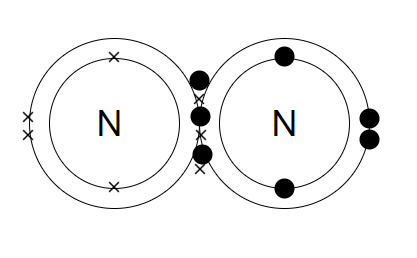
By sharing 6 electrons where the shells touch each nitrogen atom can count 8 electrons in its outer shell. The full outer shells with their shared electrons are stable as shown in the diagram.
Further the ${N_2}$ molecule will not react with other nitrogen atoms.
Now the 3 pairs i.e. (6 electrons) shared between the N-atoms. Each electron pair is one bond. Nitrogen has three bonds between its atoms. This is called a triple bond. This triple bond is very strong and thus makes the nitrogen so unreactive (i.e. stable).
The structural formula of a nitrogen molecule is written
$N \equiv N$
In this no ions are present (no + or – charges) in nitrogen gas because here the electrons are shared, not transferred from one atom to another.
Note – Whenever we come up with this type of question, one must know that molecular nitrogen $\left( {{N_2}} \right)$is a very common chemical compound in which two nitrogen atoms are tightly bound together. Molecular nitrogen is a colourless, odourless, tasteless, and inert gas at normal temperatures and pressures. About 78% of Earth’s atmosphere is nitrogen. One can easily solve this question by using these basics.
Nitrogen is a non-metal and it has 5 electrons in its outer shell. Nitrogen is in a group 5 of the periodic table.
Complete answer:
Both the nitrogen atoms will each share three electrons and thus, form three covalent bonds and make a nitrogen molecule $\left( {{N_2}} \right)$.
By sharing 6 electrons where the shells touch each nitrogen atom can count 8 electrons in its outer shell. The full outer shells with their shared electrons are stable as shown in the diagram.
Further the ${N_2}$ molecule will not react with other nitrogen atoms.
Now the 3 pairs i.e. (6 electrons) shared between the N-atoms. Each electron pair is one bond. Nitrogen has three bonds between its atoms. This is called a triple bond. This triple bond is very strong and thus makes the nitrogen so unreactive (i.e. stable).
The structural formula of a nitrogen molecule is written
$N \equiv N$
In this no ions are present (no + or – charges) in nitrogen gas because here the electrons are shared, not transferred from one atom to another.
Note – Whenever we come up with this type of question, one must know that molecular nitrogen $\left( {{N_2}} \right)$is a very common chemical compound in which two nitrogen atoms are tightly bound together. Molecular nitrogen is a colourless, odourless, tasteless, and inert gas at normal temperatures and pressures. About 78% of Earth’s atmosphere is nitrogen. One can easily solve this question by using these basics.
Recently Updated Pages
Master Class 11 English: Engaging Questions & Answers for Success

Master Class 11 Social Science: Engaging Questions & Answers for Success
Master Class 11 Maths: Engaging Questions & Answers for Success
Master Class 11 Biology: Engaging Questions & Answers for Success
Master Class 11 Physics: Engaging Questions & Answers for Success
Master Class 11 Chemistry: Engaging Questions & Answers for Success
Trending doubts
One Metric ton is equal to kg A 10000 B 1000 C 100 class 11 physics CBSE
Difference Between Prokaryotic Cells and Eukaryotic Cells
1 ton equals to A 100 kg B 1000 kg C 10 kg D 10000 class 11 physics CBSE
Find the value of the expression given below sin 30circ class 11 maths CBSE
Two of the body parts which do not appear in MRI are class 11 biology CBSE
What are hard magnetic materials class 11 physics CBSE