




Explain the cleansing action of soap. Why does soap not work in hard water?
Answer
 Verified
633k+ views
Hint: Soaps are salts of naturally occurring fatty acids. They are formed by treating animal fats with sodium hydroxide, known as caustic lye.
Complete step-by-step answer:
> The cleansing action of soap:
The soap works with the mechanism of micelle formation. Actually the Soap is a sodium(Na) or potassium(K) salt of a long-chain fatty acid in which the fatty acid ion is made of a polar head group, also called hydrophilic (water-loving) group, and a long zig-zag non-polar hydrocarbon chain which is insoluble in water called as a hydrophobic end.
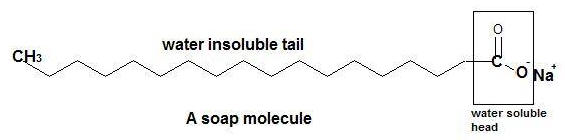
Figure: Structure of a common soap
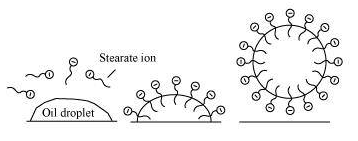
> When soap molecules are available in the water, the molecules organize themselves in the form of a cluster in such a way that their hydrophobic ends are away from the water particles and their hydrophilic or ionic ends are towards the water particles. This process is called micelle formation and the cluster that is formed is called a micelle.
At the point, when a piece of cloth is put in this soap solution, the hydrophobic ends of the soap particles adhere to the dirt whereas the hydrophilic end remains suspended in water. Thus when the cloth is rinsed and taken out of the water, it is free from dirt.
> Soap doesn't work properly in hard water (it forms scum with the calcium and magnesium impurities) Hard water contains calcium and magnesium ions. These ions form insoluble magnesium and calcium soaps respectively when potassium or sodium soaps are dissolved in hard water. That is why soaps do not work in water.
Note: The possibility to make a mistake is that you may confuse between soap and detergent. Detergent works properly in hard water but soap doesn’t work properly in hard water.
Complete step-by-step answer:
> The cleansing action of soap:
The soap works with the mechanism of micelle formation. Actually the Soap is a sodium(Na) or potassium(K) salt of a long-chain fatty acid in which the fatty acid ion is made of a polar head group, also called hydrophilic (water-loving) group, and a long zig-zag non-polar hydrocarbon chain which is insoluble in water called as a hydrophobic end.
Figure: Structure of a common soap
> When soap molecules are available in the water, the molecules organize themselves in the form of a cluster in such a way that their hydrophobic ends are away from the water particles and their hydrophilic or ionic ends are towards the water particles. This process is called micelle formation and the cluster that is formed is called a micelle.
At the point, when a piece of cloth is put in this soap solution, the hydrophobic ends of the soap particles adhere to the dirt whereas the hydrophilic end remains suspended in water. Thus when the cloth is rinsed and taken out of the water, it is free from dirt.
> Soap doesn't work properly in hard water (it forms scum with the calcium and magnesium impurities) Hard water contains calcium and magnesium ions. These ions form insoluble magnesium and calcium soaps respectively when potassium or sodium soaps are dissolved in hard water. That is why soaps do not work in water.
Note: The possibility to make a mistake is that you may confuse between soap and detergent. Detergent works properly in hard water but soap doesn’t work properly in hard water.
Recently Updated Pages
Master Class 11 English: Engaging Questions & Answers for Success

Master Class 11 Social Science: Engaging Questions & Answers for Success
Master Class 11 Maths: Engaging Questions & Answers for Success
Master Class 11 Chemistry: Engaging Questions & Answers for Success
Master Class 11 Biology: Engaging Questions & Answers for Success
Master Class 11 Physics: Engaging Questions & Answers for Success
Trending doubts
Explain the Treaty of Vienna of 1815 class 10 social science CBSE
Why is it 530 pm in india when it is 1200 afternoon class 10 social science CBSE
What is the full form of CNG A Complete Natural Gas class 10 social science CBSE
In cricket, what is a "Yorker" designed to do?
What is the full form of POSCO class 10 social science CBSE
Define Potential, Developed, Stock and Reserved resources