




Explain symbiotic nitrogen fixation.
Answer
 Verified
637.8k+ views
Hint: Some prokaryotes help the plants in converting the inert nitrogen in the atmosphere into usable forms. They do so by forming a type of association which will be useful for both the partners involved in it.
Complete step by step answer:
The reduction of nitrogen to ammonia by living organisms living in a mutualistic relationship in the roots of plants is known as symbiotic nitrogen fixation. Examples of symbiotic nitrogen fixation include that of Rhizobia and Frankia.
Species of rod- shaped bacteria Rhizobium form an endosymbiotic nitrogen- fixing association with roots of the leguminous plants such as sweet pea, and lentils. The microbe Frankia also produces such nitrogen- fixing nodules on the roots of non- leguminous plants like Alnus.
Rhizobium is a symbiotic genus of Gram- negative soil bacteria that fix nitrogen with the aid of the nitrogenase enzymes that are exclusively present in prokaryotes.
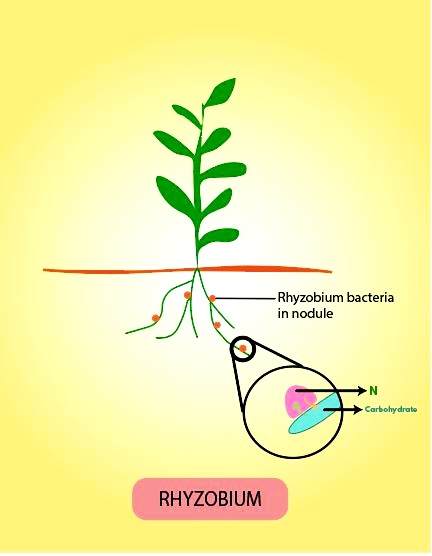
The process of symbiotic nitrogen fixation proceed this way:
- Rhizobia multiply and colonize the root hair cells of legumes. The bacteria invade the root hair and enter the cortex via an infection thread.
- In the cortex region of the plant, nodule formation begins. The nodule, thus formed, establishes a direct vascular connection with the host for the exchange of nutrients.
- The enzyme nitrogenase complex performs the important task of catalyzing the conversion of atmospheric nitrogen to ammonia.
- The ammonia is protonated to form ammonium ion, which is used by the plants to synthesize amino acids.
Note:
- The nitrogenase enzyme is highly sensitive to oxygen and thus requires an anaerobic condition for it to properly function.
- This requirement is ensured by an oxygen scavenger called leghaemoglobin. Its presence makes the nodules pink in color.
Complete step by step answer:
The reduction of nitrogen to ammonia by living organisms living in a mutualistic relationship in the roots of plants is known as symbiotic nitrogen fixation. Examples of symbiotic nitrogen fixation include that of Rhizobia and Frankia.
Species of rod- shaped bacteria Rhizobium form an endosymbiotic nitrogen- fixing association with roots of the leguminous plants such as sweet pea, and lentils. The microbe Frankia also produces such nitrogen- fixing nodules on the roots of non- leguminous plants like Alnus.
Rhizobium is a symbiotic genus of Gram- negative soil bacteria that fix nitrogen with the aid of the nitrogenase enzymes that are exclusively present in prokaryotes.
The process of symbiotic nitrogen fixation proceed this way:
- Rhizobia multiply and colonize the root hair cells of legumes. The bacteria invade the root hair and enter the cortex via an infection thread.
- In the cortex region of the plant, nodule formation begins. The nodule, thus formed, establishes a direct vascular connection with the host for the exchange of nutrients.
- The enzyme nitrogenase complex performs the important task of catalyzing the conversion of atmospheric nitrogen to ammonia.
- The ammonia is protonated to form ammonium ion, which is used by the plants to synthesize amino acids.
Note:
- The nitrogenase enzyme is highly sensitive to oxygen and thus requires an anaerobic condition for it to properly function.
- This requirement is ensured by an oxygen scavenger called leghaemoglobin. Its presence makes the nodules pink in color.
Recently Updated Pages
Basicity of sulphurous acid and sulphuric acid are

Master Class 11 English: Engaging Questions & Answers for Success
Master Class 11 Physics: Engaging Questions & Answers for Success
Master Class 11 Computer Science: Engaging Questions & Answers for Success
Master Class 11 Chemistry: Engaging Questions & Answers for Success
Master Class 11 Social Science: Engaging Questions & Answers for Success
Trending doubts
Difference Between Prokaryotic Cells and Eukaryotic Cells
Two of the body parts which do not appear in MRI are class 11 biology CBSE
One Metric ton is equal to kg A 10000 B 1000 C 100 class 11 physics CBSE
10 examples of friction in our daily life
Draw a diagram of nephron and explain its structur class 11 biology CBSE
What will happen if the mucus is not secreted by the class 11 biology CBSE