




Explain industrial melanism.
Answer
 Verified
614.1k+ views
Hint: - Melanism is the property of having darker features like feathers, fur, or skin. Industrial melanism refers to the darkening of these features due to the influence of industries due to their activities and the substances released from them.
Complete answer:
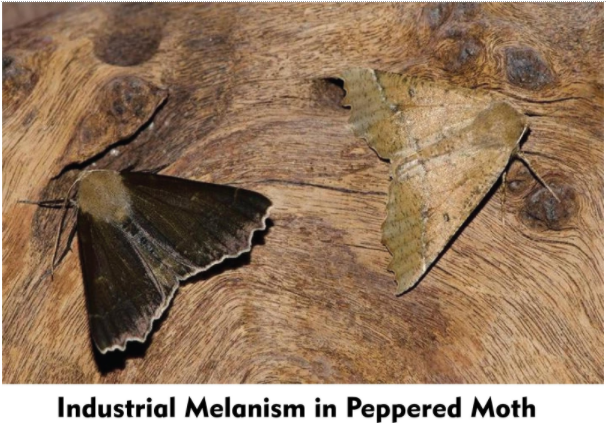
- Industrial melanism is a feature acquired by species living in a particular area where the environment is subjected to industrial pollution, where the creature becomes darkened in the case of their feathers, fur, or skin. This has been particularly noticed in some arthropods. The feature acquired helps in camouflaging the species from their predators.
- In an environment where the species gain a darker color due to the pollution, their lighter counterparts are subject to predation. The darker species gain camouflage by blending into dark surfaces like tree barks and pollutant-covered walls.
- The most important example of this phenomenon is the melanism observed by Kettlewell in the peppered moth (Biston betularia), during the Industrial Revolution. Kettlewell observed that white-colored peppered moths inhabited tree barks of various places in England during the 1800s. The dark or melanic forms were the rare mutants and could not camouflage well in the lichen on the tree barks, thus being a target for predators. But as the pollution due to the increase in industries increased, the pollutants like sulfur dioxide got deposited on surfaces of the surrounding trees, giving the barks a darker color. This would lead to the predation of the white-colored moths. Thus, in the next generations, more melanic moths were observed which could camouflage in the darker surfaces and be protected from being eaten.
- In the 1970s after the reduction of pollution, white-colored moths reappeared, proving that the change in color is in response to the surroundings.
- The phenomenon is thus a process of natural selection.
Additional Information:
- Industrial melanism is also observed in other species, mostly lepidopterans.
- The phenomenon has been observed for adaptation to other processes such as thermal advantages, immunity, etc.
Note: - Industrial melanism is observed in around 70 species of moths, some species of beetles, and pigeons.
- The peppered moth is a species of the nocturnal moth. The caterpillar of these moths is also well equipped to display mimicry of plant twigs.
Complete answer:
- Industrial melanism is a feature acquired by species living in a particular area where the environment is subjected to industrial pollution, where the creature becomes darkened in the case of their feathers, fur, or skin. This has been particularly noticed in some arthropods. The feature acquired helps in camouflaging the species from their predators.
- In an environment where the species gain a darker color due to the pollution, their lighter counterparts are subject to predation. The darker species gain camouflage by blending into dark surfaces like tree barks and pollutant-covered walls.
- The most important example of this phenomenon is the melanism observed by Kettlewell in the peppered moth (Biston betularia), during the Industrial Revolution. Kettlewell observed that white-colored peppered moths inhabited tree barks of various places in England during the 1800s. The dark or melanic forms were the rare mutants and could not camouflage well in the lichen on the tree barks, thus being a target for predators. But as the pollution due to the increase in industries increased, the pollutants like sulfur dioxide got deposited on surfaces of the surrounding trees, giving the barks a darker color. This would lead to the predation of the white-colored moths. Thus, in the next generations, more melanic moths were observed which could camouflage in the darker surfaces and be protected from being eaten.
- In the 1970s after the reduction of pollution, white-colored moths reappeared, proving that the change in color is in response to the surroundings.
- The phenomenon is thus a process of natural selection.
Additional Information:
- Industrial melanism is also observed in other species, mostly lepidopterans.
- The phenomenon has been observed for adaptation to other processes such as thermal advantages, immunity, etc.
Note: - Industrial melanism is observed in around 70 species of moths, some species of beetles, and pigeons.
- The peppered moth is a species of the nocturnal moth. The caterpillar of these moths is also well equipped to display mimicry of plant twigs.
Recently Updated Pages
Master Class 11 English: Engaging Questions & Answers for Success

Master Class 11 Social Science: Engaging Questions & Answers for Success
Master Class 11 Maths: Engaging Questions & Answers for Success
Master Class 11 Biology: Engaging Questions & Answers for Success
Master Class 11 Physics: Engaging Questions & Answers for Success
Master Class 11 Chemistry: Engaging Questions & Answers for Success
Trending doubts
Explain the Treaty of Vienna of 1815 class 10 social science CBSE
First Cotton Mill of India
In which year voting age was reduced from 21 to 18?
What planets have no moons Which one has only one moon class 10 physics CBSE
What is the full form of POSCO class 10 social science CBSE
Define Potential, Developed, Stock and Reserved resources