




Explain hydroponics (soilless culture) with diagrams. Write its two advantages.
Answer
 Verified
591k+ views
Hint: Hydroponics is a type of horticulture which is used to grow plants or crops without using soil. Hydroponicum is an agricultural space dedicated to hydroponics or soil-less culture and the nutrients to these kinds of crops can be provided using artificial nutrient solutions, chemical fertilizers and duck manure.
Complete answer:
Cultivation of plants by placing the roots in the nutrient solution without any soil is called hydroponics. It is also known as soilless culture/ water culture/ solution culture. The solution is aerated at regular intervals by means of an inlet tube. Strawberries, tomatoes, lettuces, pepper, marijuana, and etc. are plants that are usually grown using the soilless culture.
There are two major distinctions for each one of the mediums, which are sub-irrigation and top irrigation. For all methods, almost all hydroponic reservoirs are made up of plastic, but other things are also being used. These include wood, metal, concrete, glass, etc. Light-resistant containers should be used for storage, to prevent it from growth of fungi and other microorganisms.
There are various techniques of horticulture:
- Static solution culture
- Continuous-flow solution culture
- Aeroponics
- Fogponics
- Passive sub-irrigation
- Ebb and flow (flood and drain) sub-irrigation
- Deep water culture
- Run-to-waste
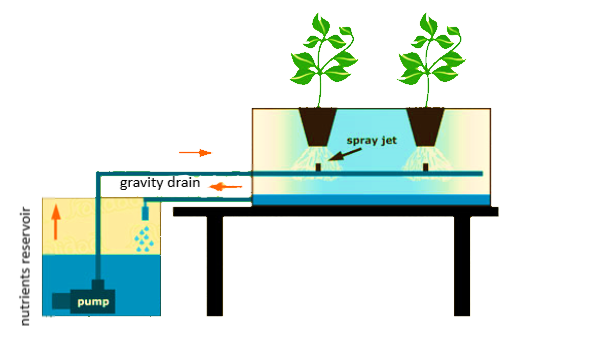
Advantages of hydroponics:
- Hydroponics or soil-less culture has readily been used for determination of elements which are important for growth of plants.
- Due to the lack or insufficiency of essential elements, the symptoms are formed.
Note: Hydroponics or soil-less culture is also known as water less culture. The hydroponic nutrient solution comprises minerals in the freshwater and nutrients as well as with other fertilizers. Minerals, for example, calcium, sulfur, magnesium along with trace elements such as iron, manganese, and zinc might be existent in the source water.
Complete answer:
Cultivation of plants by placing the roots in the nutrient solution without any soil is called hydroponics. It is also known as soilless culture/ water culture/ solution culture. The solution is aerated at regular intervals by means of an inlet tube. Strawberries, tomatoes, lettuces, pepper, marijuana, and etc. are plants that are usually grown using the soilless culture.
There are two major distinctions for each one of the mediums, which are sub-irrigation and top irrigation. For all methods, almost all hydroponic reservoirs are made up of plastic, but other things are also being used. These include wood, metal, concrete, glass, etc. Light-resistant containers should be used for storage, to prevent it from growth of fungi and other microorganisms.
There are various techniques of horticulture:
- Static solution culture
- Continuous-flow solution culture
- Aeroponics
- Fogponics
- Passive sub-irrigation
- Ebb and flow (flood and drain) sub-irrigation
- Deep water culture
- Run-to-waste
Advantages of hydroponics:
- Hydroponics or soil-less culture has readily been used for determination of elements which are important for growth of plants.
- Due to the lack or insufficiency of essential elements, the symptoms are formed.
Note: Hydroponics or soil-less culture is also known as water less culture. The hydroponic nutrient solution comprises minerals in the freshwater and nutrients as well as with other fertilizers. Minerals, for example, calcium, sulfur, magnesium along with trace elements such as iron, manganese, and zinc might be existent in the source water.
Recently Updated Pages
Master Class 11 Social Science: Engaging Questions & Answers for Success

Master Class 11 Physics: Engaging Questions & Answers for Success
Master Class 11 Maths: Engaging Questions & Answers for Success
Master Class 11 Economics: Engaging Questions & Answers for Success
Master Class 11 Computer Science: Engaging Questions & Answers for Success
Master Class 11 Chemistry: Engaging Questions & Answers for Success
Trending doubts
One Metric ton is equal to kg A 10000 B 1000 C 100 class 11 physics CBSE
How many bones are in the spine class 11 biology CBSE
1 Quintal is equal to a 110 kg b 10 kg c 100kg d 1000 class 11 physics CBSE
There are 720 permutations of the digits 1 2 3 4 5 class 11 maths CBSE
State and prove Bernoullis theorem class 11 physics CBSE
Difference Between Prokaryotic Cells and Eukaryotic Cells