




Explain how you will convert a galvanometer into voltmeter.
Answer
 Verified
596.3k+ views
Hint: First we know about galvanometer and voltmeter. A galvanometer is a device which is used to detect small electric current flowing in the circuit and Voltmeter is an instrument used to measure the potential difference across the two ends of a circuit element.
Complete step by step answer:
A galvanometer can be converted into a voltmeter by connecting a large resistance in series to the galvanometer which is shown in diagram.
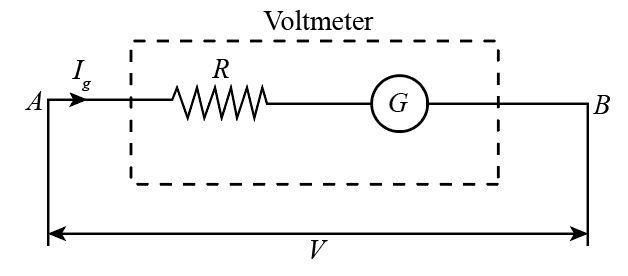
Let G and R be the resistance of a galvanometer and a conductor connected in series with it respectively.
Let V volt be the potential difference to be measured by the voltmeter and Ig, be the current.
Now potential difference between point A and B :
$\eqalign{
& V = {I_g}R + {I_g}G = {I_g}(R + G) \cr
& \cr
& \therefore R + G = \dfrac{V}{{{I_g}}} \cr} $
$R = \dfrac{V}{{{I_g}}} - G$
This is the required value of resistance which must be connected in series to the galvanometer to convert it into a voltmeter of range 0-V volt.
Additional information: Voltmeter is a high resistance device. Resistance of an ideal voltmeter is infinite. A voltmeter is always connected in parallel to the circuit component across which voltage is to be measured.
Note: If we connect a simple galvanometer in parallel to the circuit, it will draw some current and hence the potential difference of the circuit will change and the measurement will not be accurate. For accurate measurement of the potential difference, it is essential that current between the two points should remain the same after connecting a measuring device. This is possible if the resistance of the device is infinite.
Complete step by step answer:
A galvanometer can be converted into a voltmeter by connecting a large resistance in series to the galvanometer which is shown in diagram.
Let G and R be the resistance of a galvanometer and a conductor connected in series with it respectively.
Let V volt be the potential difference to be measured by the voltmeter and Ig, be the current.
Now potential difference between point A and B :
$\eqalign{
& V = {I_g}R + {I_g}G = {I_g}(R + G) \cr
& \cr
& \therefore R + G = \dfrac{V}{{{I_g}}} \cr} $
$R = \dfrac{V}{{{I_g}}} - G$
This is the required value of resistance which must be connected in series to the galvanometer to convert it into a voltmeter of range 0-V volt.
Additional information: Voltmeter is a high resistance device. Resistance of an ideal voltmeter is infinite. A voltmeter is always connected in parallel to the circuit component across which voltage is to be measured.
Note: If we connect a simple galvanometer in parallel to the circuit, it will draw some current and hence the potential difference of the circuit will change and the measurement will not be accurate. For accurate measurement of the potential difference, it is essential that current between the two points should remain the same after connecting a measuring device. This is possible if the resistance of the device is infinite.
Recently Updated Pages
Which of the following graphs shows the variation of class 12 physics CBSE

Draw a labelled diagram of the human male reproductive class 12 biology CBSE
Describe the experiment to compare the emf of two cells class 12 physics CBSE
What is standard hydrogen electrode
What is conventional current and electric current class 12 physics CBSE
2Bromopentane is treated with an alcoholic KOH solution class 12 chemistry CBSE
Trending doubts
Draw a labelled sketch of the human eye class 12 physics CBSE
Which are the Top 10 Largest Countries of the World?
Draw ray diagrams each showing i myopic eye and ii class 12 physics CBSE
Which is the correct genotypic ratio of mendel dihybrid class 12 biology CBSE
Which is the strongest oxidising agent out of the following class 12 chemistry CBSE
Differentiate between homogeneous and heterogeneous class 12 chemistry CBSE