




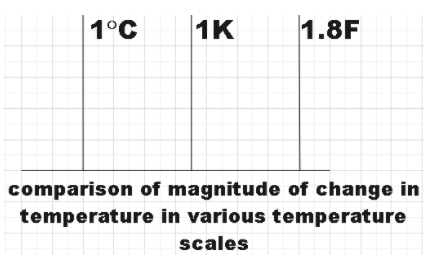
Explain how this 1.8F came in the below given comparison of magnitude change in temperature in various temperature scales.
Answer
 Verified
597k+ views
Hint: As a first step, one could clearly understand the given diagram by carefully analyzing it. Then you could recall the expressions for conversion of temperatures between the three commonly used temperature scales. You could thus find the temperature change in Fahrenheit scale that is equivalent to $1K/1{}^\circ C$ temperature change.
Formula used:
Celsius – Fahrenheit,
$\dfrac{F-32}{C}=\dfrac{9}{5}$
Complete answer:
In the question, we are given a very simple diagram
Representing the comparison of the commonly used temperature scales- Celsius scale, Fahrenheit scale and Kelvin scale. We are supposed to explain how 1.8F came in the given figure.
The figure actually depicts the comparison of magnitude of change in temperature in various temperature scales. That is, in words we could explain the figure as, $1{}^\circ C$ temperature change in Celsius scale is equivalent to $1{}^\circ $ change in Kelvin scale and the same change in Fahrenheit scale would be$1.8F$.
In order to answer this, we have to recall the expression for conversion between different scales. In order to convert the temperature from centigrade scale to Fahrenheit scale we could use the following expression,
$\dfrac{F-32}{C}=\dfrac{9}{5}$ ……………………………………………. (1)
We know that the Fahrenheit scale ranges from $32{}^\circ F$ to $212{}^\circ F$ and the centigrade scale is known to range from $0{}^\circ C$ to$100{}^\circ C$. So, we could say that,
$\left( 212-32 \right){}^\circ F=\left( 100-0 \right){}^\circ C$
$\Rightarrow 180{}^\circ F=100{}^\circ C$
$\therefore 1{}^\circ C=\dfrac{180}{100}=1.8{}^\circ F$
Therefore, we found that $1{}^\circ C$ change in temperature is equivalent to$1.8{}^\circ F$. This is how 1.8F came in the given diagram.
Note:
We have simply found the difference between the upper limit and lower limit and then equated them to find the answer. You could now easily find the temperature on one scale when the other is known. Though the temperature change is the same in Kelvin and Celsius scales, the upper and lower limits are different in both.
Formula used:
Celsius – Fahrenheit,
$\dfrac{F-32}{C}=\dfrac{9}{5}$
Complete answer:
In the question, we are given a very simple diagram
Representing the comparison of the commonly used temperature scales- Celsius scale, Fahrenheit scale and Kelvin scale. We are supposed to explain how 1.8F came in the given figure.
The figure actually depicts the comparison of magnitude of change in temperature in various temperature scales. That is, in words we could explain the figure as, $1{}^\circ C$ temperature change in Celsius scale is equivalent to $1{}^\circ $ change in Kelvin scale and the same change in Fahrenheit scale would be$1.8F$.
In order to answer this, we have to recall the expression for conversion between different scales. In order to convert the temperature from centigrade scale to Fahrenheit scale we could use the following expression,
$\dfrac{F-32}{C}=\dfrac{9}{5}$ ……………………………………………. (1)
We know that the Fahrenheit scale ranges from $32{}^\circ F$ to $212{}^\circ F$ and the centigrade scale is known to range from $0{}^\circ C$ to$100{}^\circ C$. So, we could say that,
$\left( 212-32 \right){}^\circ F=\left( 100-0 \right){}^\circ C$
$\Rightarrow 180{}^\circ F=100{}^\circ C$
$\therefore 1{}^\circ C=\dfrac{180}{100}=1.8{}^\circ F$
Therefore, we found that $1{}^\circ C$ change in temperature is equivalent to$1.8{}^\circ F$. This is how 1.8F came in the given diagram.
Note:
We have simply found the difference between the upper limit and lower limit and then equated them to find the answer. You could now easily find the temperature on one scale when the other is known. Though the temperature change is the same in Kelvin and Celsius scales, the upper and lower limits are different in both.
Recently Updated Pages
Class 10 Question and Answer - Your Ultimate Solutions Guide

Master Class 12 Economics: Engaging Questions & Answers for Success
Master Class 12 Social Science: Engaging Questions & Answers for Success
Master Class 12 English: Engaging Questions & Answers for Success
Master Class 12 Maths: Engaging Questions & Answers for Success
Master Class 12 Physics: Engaging Questions & Answers for Success
Trending doubts
Explain the Treaty of Vienna of 1815 class 10 social science CBSE
The slogan Jai Hind was given by A Lal Bahadur Shastri class 10 social science CBSE
10 examples of evaporation in daily life with explanations
What is the full form of POSCO class 10 social science CBSE
Identify the feminine form of noun nephew a shenephew class 10 english CBSE
CSIR full form?