




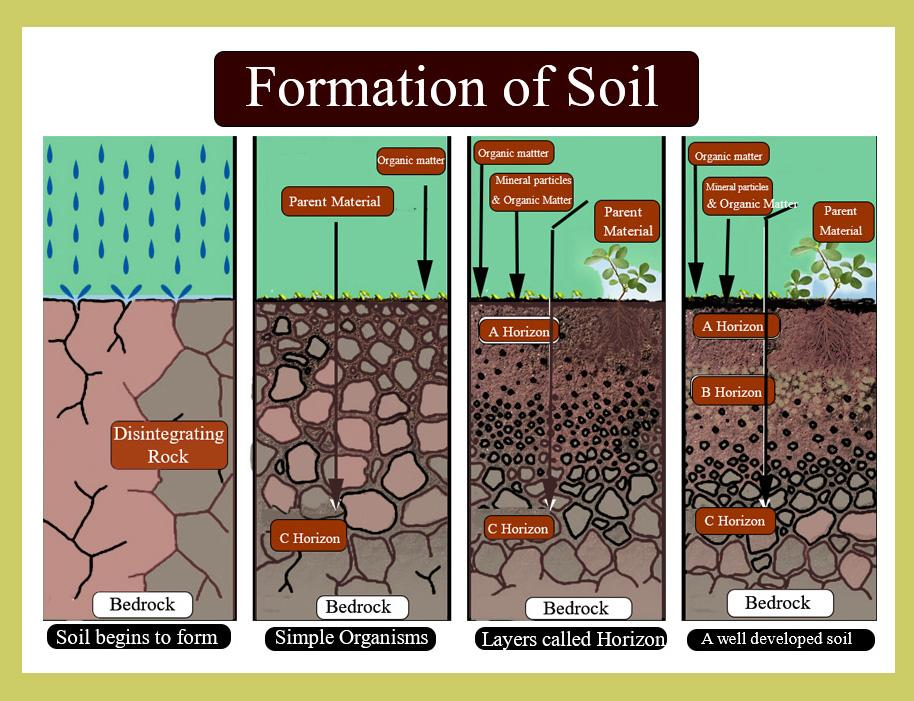
Explain how soil is formed.
Answer
 Verified
577.2k+ views
Hint: Soil is a mixture of organic and mineral compounds that are formed over a very long period of time. It contains air, water, both living and dead organisms, and elements that are from disintegrated entities.
Complete answer:
- Soil is a thin layer of materials that covers the surface of the planet’s crust that supports a significant part of life. It is mainly composed of weathered rock, humus, and other weathered substances.
- The main processes of the formation of soil are collectively known as weathering.
- Weathering is the process of breakdown and decomposition of rocks and minerals into smaller particles till they become soil particles. Weathering occurs physically, chemically, biologically.
- Physical weathering is the disintegration of rocks from mechanical actions. The molecular structure of the particles does not change from the parent rocks. The agents of physical weathering are wind, temperature, and water. Wind blowing on rocks, torrential rains, tidal waves against rocks, extreme changes in temperature, frost, etc. Even abrasions of rocks against each other cause physical disintegration. The sun heats rocks during the day so they expand and these rocks cool down at night and contract. Constant and unequal expansion and contraction cause cracking and breakdown.
- Chemical weathering of rocks occurs due to chemical processes that change the composition of the disintegrated particles. This occurs when the minerals in the rock react with water, compounds in the air, or other chemicals around it. Examples of the processes or reactions include hydrolysis, carbonation, oxidation, and hydration.
- Biological weathering involves organisms that facilitate rock fragmentation. The roots of plants and trees burrow through rock, which cracks it and causes fragmentation. Lichens release chemicals that disintegrate mineral compounds in rocks. Animals also scratch and burrow through rocks, causing breakdown.
- The types of soil are loam, clay, silt, sand, gravel, peat, and chalky.
- Soil is a mixture of air, water, rock and mineral particles, and humus.
- The formation of soil depends on factors such as the parent rock material, the climate and topography of the area, the organisms found in the soil, and the time over which the soil has been developing.
Note:
- The components of the soil interact with each other at a slow pace but constantly.
- The interaction of soil with wind or water may cause erosion. Soil erosion is the process of carrying away the upper fertile layer of soil through air and wind.
Complete answer:
- Soil is a thin layer of materials that covers the surface of the planet’s crust that supports a significant part of life. It is mainly composed of weathered rock, humus, and other weathered substances.
- The main processes of the formation of soil are collectively known as weathering.
- Weathering is the process of breakdown and decomposition of rocks and minerals into smaller particles till they become soil particles. Weathering occurs physically, chemically, biologically.
- Physical weathering is the disintegration of rocks from mechanical actions. The molecular structure of the particles does not change from the parent rocks. The agents of physical weathering are wind, temperature, and water. Wind blowing on rocks, torrential rains, tidal waves against rocks, extreme changes in temperature, frost, etc. Even abrasions of rocks against each other cause physical disintegration. The sun heats rocks during the day so they expand and these rocks cool down at night and contract. Constant and unequal expansion and contraction cause cracking and breakdown.
- Chemical weathering of rocks occurs due to chemical processes that change the composition of the disintegrated particles. This occurs when the minerals in the rock react with water, compounds in the air, or other chemicals around it. Examples of the processes or reactions include hydrolysis, carbonation, oxidation, and hydration.
- Biological weathering involves organisms that facilitate rock fragmentation. The roots of plants and trees burrow through rock, which cracks it and causes fragmentation. Lichens release chemicals that disintegrate mineral compounds in rocks. Animals also scratch and burrow through rocks, causing breakdown.
- The types of soil are loam, clay, silt, sand, gravel, peat, and chalky.
- Soil is a mixture of air, water, rock and mineral particles, and humus.
- The formation of soil depends on factors such as the parent rock material, the climate and topography of the area, the organisms found in the soil, and the time over which the soil has been developing.
Note:
- The components of the soil interact with each other at a slow pace but constantly.
- The interaction of soil with wind or water may cause erosion. Soil erosion is the process of carrying away the upper fertile layer of soil through air and wind.
Recently Updated Pages
Master Class 11 English: Engaging Questions & Answers for Success

Master Class 11 Social Science: Engaging Questions & Answers for Success
Master Class 11 Maths: Engaging Questions & Answers for Success
Master Class 11 Biology: Engaging Questions & Answers for Success
Master Class 11 Physics: Engaging Questions & Answers for Success
Master Class 11 Chemistry: Engaging Questions & Answers for Success
Trending doubts
Explain the Treaty of Vienna of 1815 class 10 social science CBSE
What is the full form of CNG A Complete Natural Gas class 10 social science CBSE
In cricket, what is a "Yorker" designed to do?
What is the full form of POSCO class 10 social science CBSE
Define Potential, Developed, Stock and Reserved resources
What were the majoritarian measures taken in Sri Lanka class 10 social science CBSE