




Explain how friction helps us to walk?
Answer
 Verified
655.8k+ views
Hint: As you all know, the frictional force arises from the contact between two surfaces. So, a normal reaction by the foot on to the ground gives rise to frictional force, which pushes us forward.
Complete step by step solution:
First Example:
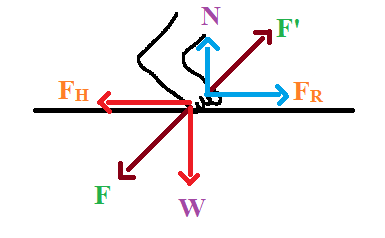
When you try to walk, you will apply a downward force \[\text{F}\] onto the ground, a resultant force \[\text{F }\!\!'\!\!\text{ }\] will be produced which is equal and opposite to the applied force \[\text{F}\] according to Newton's third law of motion. So we can write, \[\text{F}=-\text{F}'\].
If we resolve the force \[\text{F}\], that we apply to the ground to different components, we will get a component called the weight $\text{(W)}$ acting on the foot acting downwards and the effective horizontal force $\text{(}{{\text{F}}_{\text{H}}}\text{)}$ acting on the foot which is directed to the left side of the foot.
If we try to resolve the resultant force \[\text{F }\!\!'\!\!\text{ }\] into components, we will get a component called the normal component which is acting upwards $\text{(N)}$ (opposite to the weight) and horizontal component of friction $\text{(}{{\text{F}}_{\text{R}}}\text{)}$ which is directed to the right side of the foot (opposite to the effective horizontal force).
The horizontal frictional force acting towards the right, which acts opposite to the effective horizontal force applied by our foot prevents us from slipping while walking.
Second Example:
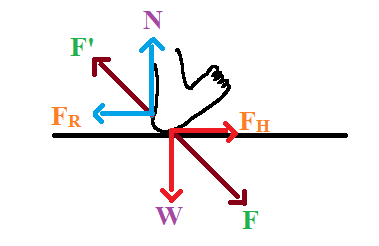
When you try to walk, you will apply a downward force \[\text{F}\] onto the ground, a resultant force \[\text{F }\!\!'\!\!\text{ }\] will be produced which is equal and opposite to the applied force \[\text{F}\] according to Newton's third law of motion. So we can write, \[\text{F}=-\text{F}'\].
If we resolve the force \[\text{F}\], that we apply to the ground to different components, we will get a component called the weight $\text{(W)}$ acting on the foot acting downwards and the effective horizontal force $\left( {{\text{F}}_{\text{H}}} \right)$ acting on the foot which is directed to the right side of the foot in this case.
If we try to resolve the resultant force \[\text{F }\!\!'\!\!\text{ }\] into components, we will get a component called the normal component $\text{(N)}$ which is acting upwards (opposite to the weight) and horizontal component of friction $\text{(}{{\text{F}}_{\text{R}}}\text{)}$ which is directed to the left side of the foot in this case(opposite to the effective horizontal force).
The horizontal frictional force acting towards the left, which acts opposite to the effective horizontal force applied by our foot prevents us from slipping while walking.
Note: Even if friction is considered as a dissipative force, it helps in many circumstances, one which is mentioned in the answer. We can refer to frictional force as a necessary evil.
There are two types of friction,
Static Friction: It is the friction associated with a body at rest. So if we want to move a body by applying a force on it, we need to overcome the force of friction first in order to do it.
Kinetic Friction: It is the friction associated with the bodies in motion. It acts against the motion of a body in a particular direction.
Complete step by step solution:
First Example:
When you try to walk, you will apply a downward force \[\text{F}\] onto the ground, a resultant force \[\text{F }\!\!'\!\!\text{ }\] will be produced which is equal and opposite to the applied force \[\text{F}\] according to Newton's third law of motion. So we can write, \[\text{F}=-\text{F}'\].
If we resolve the force \[\text{F}\], that we apply to the ground to different components, we will get a component called the weight $\text{(W)}$ acting on the foot acting downwards and the effective horizontal force $\text{(}{{\text{F}}_{\text{H}}}\text{)}$ acting on the foot which is directed to the left side of the foot.
If we try to resolve the resultant force \[\text{F }\!\!'\!\!\text{ }\] into components, we will get a component called the normal component which is acting upwards $\text{(N)}$ (opposite to the weight) and horizontal component of friction $\text{(}{{\text{F}}_{\text{R}}}\text{)}$ which is directed to the right side of the foot (opposite to the effective horizontal force).
The horizontal frictional force acting towards the right, which acts opposite to the effective horizontal force applied by our foot prevents us from slipping while walking.
Second Example:
When you try to walk, you will apply a downward force \[\text{F}\] onto the ground, a resultant force \[\text{F }\!\!'\!\!\text{ }\] will be produced which is equal and opposite to the applied force \[\text{F}\] according to Newton's third law of motion. So we can write, \[\text{F}=-\text{F}'\].
If we resolve the force \[\text{F}\], that we apply to the ground to different components, we will get a component called the weight $\text{(W)}$ acting on the foot acting downwards and the effective horizontal force $\left( {{\text{F}}_{\text{H}}} \right)$ acting on the foot which is directed to the right side of the foot in this case.
If we try to resolve the resultant force \[\text{F }\!\!'\!\!\text{ }\] into components, we will get a component called the normal component $\text{(N)}$ which is acting upwards (opposite to the weight) and horizontal component of friction $\text{(}{{\text{F}}_{\text{R}}}\text{)}$ which is directed to the left side of the foot in this case(opposite to the effective horizontal force).
The horizontal frictional force acting towards the left, which acts opposite to the effective horizontal force applied by our foot prevents us from slipping while walking.
Note: Even if friction is considered as a dissipative force, it helps in many circumstances, one which is mentioned in the answer. We can refer to frictional force as a necessary evil.
There are two types of friction,
Static Friction: It is the friction associated with a body at rest. So if we want to move a body by applying a force on it, we need to overcome the force of friction first in order to do it.
Kinetic Friction: It is the friction associated with the bodies in motion. It acts against the motion of a body in a particular direction.
Recently Updated Pages
Which will be the least stable resonating structure class 11 chemistry CBSE

How many 5 digit telephone numbers can be construc-class-11-maths-CBSE
How do you find the angle of the resultant vector class 11 physics CBSE
Draw labelled diagram of the following i Gram seed class 11 biology CBSE
What is the need and importance of classification class 11 biology CBSE
The way in which the sparrows expressed their sorrow class 11 english CBSE
Trending doubts
One Metric ton is equal to kg A 10000 B 1000 C 100 class 11 physics CBSE
Find the value of the expression given below sin 30circ class 11 maths CBSE
1 Quintal is equal to a 110 kg b 10 kg c 100kg d 1000 class 11 physics CBSE
Draw a diagram of nephron and explain its structur class 11 biology CBSE
10 examples of friction in our daily life
Proton was discovered by A Thomson B Rutherford C Chadwick class 11 chemistry CBSE