




Explain Gomberg reaction with mechanism.
Answer
 Verified
629.4k+ views
Hint: Gomberg reaction is known by the name of Gomberg-Bachmann reaction as this reaction is discovered by two scientists known as Gomberg and Bachmann. It is an aryl-aryl coupling reaction with the help of diazonium salt.
Complete answer: Gomberg reaction is basically start with the starting reactant diazonium salt and diazonium salt can be explained as a group of organic compounds which shares a common functional group represented by $R-{{N}_{2}}^{+}{{X}^{-}}$ where R can be any organic group may be alkyl or aryl and X is halogen.
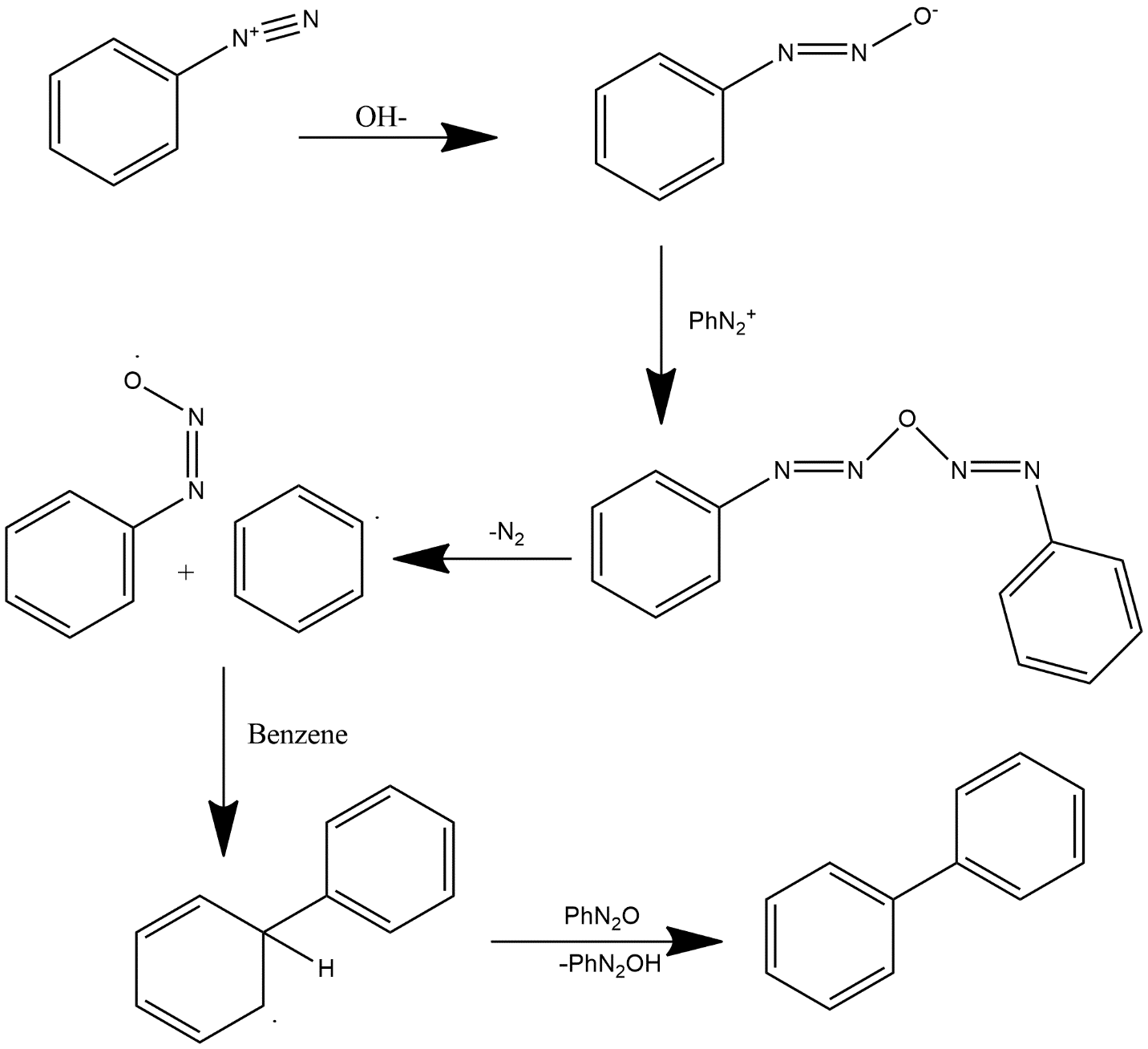
The mechanism of Gomberg-Bachmann reaction can be explained as follows:
1. In the first step diazonium salt derivative is reacted with hydroxide ion and forms diazonium oxide which further reacts with $Ph{{N}_{2}}^{+}$ and forms a double ring compound.
2. After this loss of nitrogen gas is there which dissociates the molecule into two fragments out of which one is in the form of diazonium oxide and other one is a radical form of benzene.
3. After that diazonium gets reacted with benzene group and forms a biaryl group with the presence of aryl intermediate in this product i.e. H ion is present in this compound.
4. This H atom firstly gets reacted with $Ph{{N}_{2}}O$ which immediately form $Ph{{N}_{2}}OH$ which readily get lost from the compound and it forms biaryl product.
Mechanism can be shown as follows:
Note: Gomberg reaction is generally classified as coupling reaction; these are those reactions in which two fragments are joined together with the help of a metal catalyst. The most common coupling reaction is the cross coupling reaction.
Complete answer: Gomberg reaction is basically start with the starting reactant diazonium salt and diazonium salt can be explained as a group of organic compounds which shares a common functional group represented by $R-{{N}_{2}}^{+}{{X}^{-}}$ where R can be any organic group may be alkyl or aryl and X is halogen.
The mechanism of Gomberg-Bachmann reaction can be explained as follows:
1. In the first step diazonium salt derivative is reacted with hydroxide ion and forms diazonium oxide which further reacts with $Ph{{N}_{2}}^{+}$ and forms a double ring compound.
2. After this loss of nitrogen gas is there which dissociates the molecule into two fragments out of which one is in the form of diazonium oxide and other one is a radical form of benzene.
3. After that diazonium gets reacted with benzene group and forms a biaryl group with the presence of aryl intermediate in this product i.e. H ion is present in this compound.
4. This H atom firstly gets reacted with $Ph{{N}_{2}}O$ which immediately form $Ph{{N}_{2}}OH$ which readily get lost from the compound and it forms biaryl product.
Mechanism can be shown as follows:
Note: Gomberg reaction is generally classified as coupling reaction; these are those reactions in which two fragments are joined together with the help of a metal catalyst. The most common coupling reaction is the cross coupling reaction.
Recently Updated Pages
Explain the structure of megasporangium class 12 biology CBSE

Why is chloroform kept in dark coloured bottles class 12 chemistry CBSE
Derive the balancing condition of a Wheatstone bri class 12 physics CBSE
Draw VI characteristics of a pn junction diode Explain class 12 physics CBSE
Is it possible to carry pride in ones language too class 12 english CBSE
In a population at Hardy Weinberg equilibrium the allele class 12 biology CBSE
Trending doubts
Draw a labelled sketch of the human eye class 12 physics CBSE
Which are the Top 10 Largest Countries of the World?
Draw ray diagrams each showing i myopic eye and ii class 12 physics CBSE
Which is the correct genotypic ratio of mendel dihybrid class 12 biology CBSE
Differentiate between homogeneous and heterogeneous class 12 chemistry CBSE
Give 10 examples of unisexual and bisexual flowers