




What is an example of an object that has balanced forces acting on it?
Answer
 Verified
530.7k+ views
Hint:To address the question, review the idea of balanced force. A balanced force is one in which two equal-sized forces act in opposite directions on a body. A body remains in its position in Balanced Force.
Complete step by step answer:
Balanced forces are created when two forces acting on a body are equal in magnitude but opposite in direction. A stationary body remains motionless in the event of balanced force, while a moving object continues to move at the same pace and in the same direction. Examples are as follows:
1. The two teams pull the rope with equal effort in a tug-of-war; the rope does not move in any direction. This is due to the fact that the pressures exerted by the two teams are equal and opposite, resulting in a balanced situation.
2. Consider the case of a wooden block on a table with threads linked to its two opposite faces, as illustrated in the diagram.
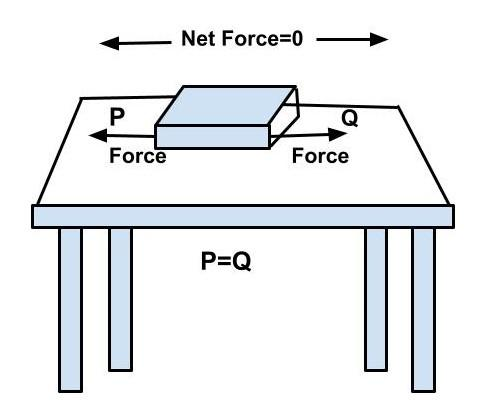
When we pull at point \[P\] , it starts to move left. When we pull at point \[Q\] , it starts to go right. The block, however, does not move if we pull from both sides with equal power. The two forces have now reached a point of equilibrium.
Note:To see if the forces acting on the thing are balanced, you must first figure out what forces are operating on the object and in which direction they are acting. A force is considered to be balanced when two independent forces are of equal magnitude and opposite direction.
Complete step by step answer:
Balanced forces are created when two forces acting on a body are equal in magnitude but opposite in direction. A stationary body remains motionless in the event of balanced force, while a moving object continues to move at the same pace and in the same direction. Examples are as follows:
1. The two teams pull the rope with equal effort in a tug-of-war; the rope does not move in any direction. This is due to the fact that the pressures exerted by the two teams are equal and opposite, resulting in a balanced situation.
2. Consider the case of a wooden block on a table with threads linked to its two opposite faces, as illustrated in the diagram.
When we pull at point \[P\] , it starts to move left. When we pull at point \[Q\] , it starts to go right. The block, however, does not move if we pull from both sides with equal power. The two forces have now reached a point of equilibrium.
Note:To see if the forces acting on the thing are balanced, you must first figure out what forces are operating on the object and in which direction they are acting. A force is considered to be balanced when two independent forces are of equal magnitude and opposite direction.
Recently Updated Pages
Master Class 11 English: Engaging Questions & Answers for Success

Master Class 11 Social Science: Engaging Questions & Answers for Success
Master Class 11 Maths: Engaging Questions & Answers for Success
Master Class 11 Biology: Engaging Questions & Answers for Success
Master Class 11 Physics: Engaging Questions & Answers for Success
Master Class 11 Chemistry: Engaging Questions & Answers for Success
Trending doubts
One Metric ton is equal to kg A 10000 B 1000 C 100 class 11 physics CBSE
Difference Between Prokaryotic Cells and Eukaryotic Cells
Find the value of the expression given below sin 30circ class 11 maths CBSE
Difference between physical and chemical change class 11 chemistry CBSE
Two of the body parts which do not appear in MRI are class 11 biology CBSE
Draw a diagram of a plant cell and label at least eight class 11 biology CBSE