




What is an example of a decomposer? What would happen if natural decomposers were absent from a forest ecosystem?
Answer
 Verified
540.6k+ views
Hint: Decomposers are the organisms that depend on the dead for their nutritional requirements. They play one of the most important roles in an entire ecosystem, that is, management of the organic wastes.
Complete Answer
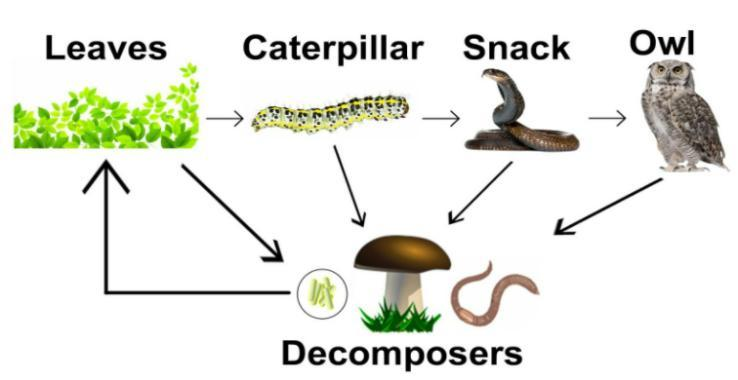
Every ecosystem has some organisms that are concerned with breaking down nitrogenous wastes and dead remains of organisms into simpler form in order to restore atmospheric components called decomposers.
Bacillus subtilis, a soil bacteria, is the most common example of decomposers. It dwells completely on fowl organic products released by any organism such as human sweat, feet, etc. It is also referred to as grass bacillus as its presence in soil is as common as grasses. It is also found in the digestive tracts of ruminant organisms. They are very efficient decomposers as they are highly tolerant to adverse environmental conditions.
Natural decomposers are concerned with maintenance and restoration of nutrient content in both ecosystems and the environment. Their absence can cause nutritional imbalance, space shortage and an unfavourable environment for organisms of an ecosystem. This is the reason for them being considered so important for efficient functioning of the ecosystem.
They digest all the organic wastes, produced by different individuals, to extract energy for conduction of metabolic processes. This eventually leads to removal of nitrogenous wastes in any area thus, preventing any kind of useless collection or piling up.
Note:
Bacillus subtilis is a bacteria that is good for both the environment and humans. It boosts the immune capability of our body. Also, it removes many harmful pathogens by digesting them. It improves the gut life thus improving digestive capabilities of our body.
Complete Answer
Every ecosystem has some organisms that are concerned with breaking down nitrogenous wastes and dead remains of organisms into simpler form in order to restore atmospheric components called decomposers.
Bacillus subtilis, a soil bacteria, is the most common example of decomposers. It dwells completely on fowl organic products released by any organism such as human sweat, feet, etc. It is also referred to as grass bacillus as its presence in soil is as common as grasses. It is also found in the digestive tracts of ruminant organisms. They are very efficient decomposers as they are highly tolerant to adverse environmental conditions.
Natural decomposers are concerned with maintenance and restoration of nutrient content in both ecosystems and the environment. Their absence can cause nutritional imbalance, space shortage and an unfavourable environment for organisms of an ecosystem. This is the reason for them being considered so important for efficient functioning of the ecosystem.
They digest all the organic wastes, produced by different individuals, to extract energy for conduction of metabolic processes. This eventually leads to removal of nitrogenous wastes in any area thus, preventing any kind of useless collection or piling up.
Note:
Bacillus subtilis is a bacteria that is good for both the environment and humans. It boosts the immune capability of our body. Also, it removes many harmful pathogens by digesting them. It improves the gut life thus improving digestive capabilities of our body.
Recently Updated Pages
Master Class 11 English: Engaging Questions & Answers for Success

Master Class 11 Social Science: Engaging Questions & Answers for Success
Master Class 11 Maths: Engaging Questions & Answers for Success
Master Class 11 Biology: Engaging Questions & Answers for Success
Master Class 11 Physics: Engaging Questions & Answers for Success
Master Class 11 Chemistry: Engaging Questions & Answers for Success
Trending doubts
Explain the Treaty of Vienna of 1815 class 10 social science CBSE
What is the full form of CNG A Complete Natural Gas class 10 social science CBSE
In cricket, what is a "Yorker" designed to do?
What is the full form of POSCO class 10 social science CBSE
Define Potential, Developed, Stock and Reserved resources
What were the majoritarian measures taken in Sri Lanka class 10 social science CBSE