




Where exactly is the Carotid artery located?
Answer
 Verified
512.4k+ views
Hint: An artery is a type of blood vessel that transports blood from the heart to one or more parts of the body (tissues, lungs, brain, etc.). The pulmonary and umbilical arteries, which carry deoxygenated blood to the organs that oxygenate it, are the two exceptions to this rule (lungs and placenta, respectively). The extracellular fluid that fills the arterial system is referred to as the effective arterial blood volume.
Complete answer:
The arteries are part of the circulatory system, which is in charge of delivering oxygen and nutrients to all cells, as well as removing carbon dioxide and waste products, maintaining optimal blood pH, and circulating proteins and immune system cells.
The common carotid arteries can be found on both the left and right sides of the body. These arteries branch off from other arteries but take symmetrical paths. The right common carotid begins in the neck from the brachiocephalic trunk, while the left begins in the thorax from the aortic arch. At the upper border of the thyroid cartilage, around the fourth cervical vertebra, these split into the external and internal carotid arteries.
The common carotid artery is frequently used in pulse measurement, particularly in patients who are in shock and have no detectable pulse in the more peripheral arteries of the body. Palpating the artery just deep to the anterior border of the sternocleidomastoid muscle at the level of the superior border of the thyroid cartilage yields the pulse.
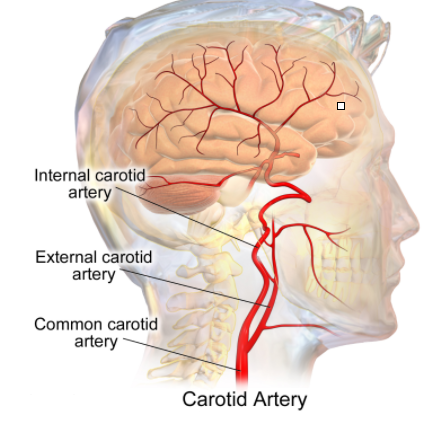
Thus, The carotid arteries are blood vessels found on both the left and right sides of the neck. The carotid arteries transport blood to the brain and head.
Note: The common carotid artery is frequently used in pulse measurement, particularly in patients who are in shock and have no detectable pulse in the more peripheral arteries of the body. Palpating the artery just deep to the anterior border of the sternocleidomastoid muscle at the level of the superior border of the thyroid cartilage yields the pulse.
Complete answer:
The arteries are part of the circulatory system, which is in charge of delivering oxygen and nutrients to all cells, as well as removing carbon dioxide and waste products, maintaining optimal blood pH, and circulating proteins and immune system cells.
The common carotid arteries can be found on both the left and right sides of the body. These arteries branch off from other arteries but take symmetrical paths. The right common carotid begins in the neck from the brachiocephalic trunk, while the left begins in the thorax from the aortic arch. At the upper border of the thyroid cartilage, around the fourth cervical vertebra, these split into the external and internal carotid arteries.
The common carotid artery is frequently used in pulse measurement, particularly in patients who are in shock and have no detectable pulse in the more peripheral arteries of the body. Palpating the artery just deep to the anterior border of the sternocleidomastoid muscle at the level of the superior border of the thyroid cartilage yields the pulse.
Thus, The carotid arteries are blood vessels found on both the left and right sides of the neck. The carotid arteries transport blood to the brain and head.
Note: The common carotid artery is frequently used in pulse measurement, particularly in patients who are in shock and have no detectable pulse in the more peripheral arteries of the body. Palpating the artery just deep to the anterior border of the sternocleidomastoid muscle at the level of the superior border of the thyroid cartilage yields the pulse.
Recently Updated Pages
Master Class 12 Economics: Engaging Questions & Answers for Success

Master Class 12 English: Engaging Questions & Answers for Success
Master Class 12 Social Science: Engaging Questions & Answers for Success
Master Class 12 Maths: Engaging Questions & Answers for Success
Master Class 12 Physics: Engaging Questions & Answers for Success
Master Class 9 General Knowledge: Engaging Questions & Answers for Success
Trending doubts
One Metric ton is equal to kg A 10000 B 1000 C 100 class 11 physics CBSE
Difference Between Prokaryotic Cells and Eukaryotic Cells
Find the value of the expression given below sin 30circ class 11 maths CBSE
Two of the body parts which do not appear in MRI are class 11 biology CBSE
Draw a diagram of nephron and explain its structur class 11 biology CBSE
10 examples of friction in our daily life