




Where exactly is DNA found in the body? What are the biggest differences between DNA and RNA?
Answer
 Verified
516.6k+ views
Hint: DNA and RNA are both genetic material which is present in all organisms. Both are nucleic acids and in advanced organisms, DNA gets transcribed into RNA which is used for the synthesis of proteins. RNA can easily be converted back into DNA by reverse transcription.
Complete answer:
Most of the DNA is found in the cell nucleus (here it is called nuclear DNA), but on the other hand, a small amount of DNA is also found to be present in the mitochondria (here it is called mitochondrial DNA).
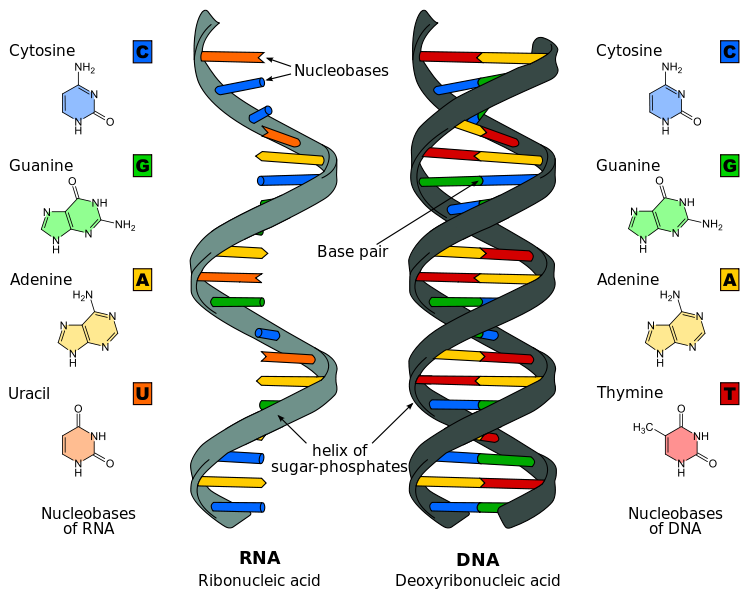
The major differences between DNA and RNA are:
Note:
DNA is basically the blueprint of any form of life which is to be passed between generations whereas the genetic information is transmitted with the help of RNA. In biology, these are two of the most significant molecules which are responsible for storing as well as reading genetic information that underpins all life.
Complete answer:
Most of the DNA is found in the cell nucleus (here it is called nuclear DNA), but on the other hand, a small amount of DNA is also found to be present in the mitochondria (here it is called mitochondrial DNA).
The major differences between DNA and RNA are:
| DNA | RNA |
| DNA is basically found in the nucleus of the cell. | Majority of the RNA is found in the cytoplasm. |
| The full form of the DNA is deoxyribonucleic acid. | The full form of the RNA is ribonucleic acid. |
| Deoxyribose is basically a pentose sugar which is lacking oxygen in the 3rd carbon atom. | Ribose is basically a pentose sugar which has a hydroxyl (OH) group at the 3rd carbon atom. |
| DNA is made up of adenine (A), cytosine (C), guanine (G), thymine (T), these are basically the nitrogen bases. | RNA is made up of adenine (A), cytosine (C), guanine (G), uracil (U), these are also nitrogen bases. |
| DNA is a very long polymer. | RNA is very much shorter than DNA. |
| Adenine pairs with thymine with the help of two hydrogen bonds whereas cytosine always pairs with guanine with the help of three hydrogen bonds. | Adenine pairs with uracil with the help of two hydrogen bonds whereas cytosine always pairs with guanine with the help of three hydrogen bonds. |
| DNA is a double-stranded structure which consists of antiparallel strands and it also exhibits a double-helix structure. | RNA is basically a single-stranded structure and more often than not, it forms the secondary and tertiary structure. |
| DNA is of different types which include A-form, B-form, and Z-form. | RNA is also of different types like mRNA (messenger RNA), rRNA (ribosomal RNA), tRNA (Transfer RNA). |
| DNA is more susceptible to UV damage. | RNA is much less susceptible to UV damage when compared to DNA. |
Note:
DNA is basically the blueprint of any form of life which is to be passed between generations whereas the genetic information is transmitted with the help of RNA. In biology, these are two of the most significant molecules which are responsible for storing as well as reading genetic information that underpins all life.
Recently Updated Pages
Master Class 11 English: Engaging Questions & Answers for Success

Master Class 11 Social Science: Engaging Questions & Answers for Success
Master Class 11 Maths: Engaging Questions & Answers for Success
Master Class 11 Chemistry: Engaging Questions & Answers for Success
Master Class 11 Biology: Engaging Questions & Answers for Success
Master Class 11 Physics: Engaging Questions & Answers for Success
Trending doubts
One Metric ton is equal to kg A 10000 B 1000 C 100 class 11 physics CBSE
Difference Between Prokaryotic Cells and Eukaryotic Cells
Find the value of the expression given below sin 30circ class 11 maths CBSE
1 ton equals to A 100 kg B 1000 kg C 10 kg D 10000 class 11 physics CBSE
Two of the body parts which do not appear in MRI are class 11 biology CBSE
What are hard magnetic materials class 11 physics CBSE