




Evaluate the following: $\sin 60{}^\circ \cos 30{}^\circ +\cos 60{}^\circ \sin 30{}^\circ $ .
Answer
 Verified
618.9k+ views
Hint: Try to simplify the expression given in the question using the formula $\sin (x+y)=\sin x\cos y+cox\sin y$ followed by putting the value of $\sin 90{}^\circ $ .
Complete step-by-step answer:
Before moving to the solution, let us discuss the periodicity of sine and cosine function, which we would be using in the solution. All the trigonometric ratios, including sine and cosine, are periodic functions. We can better understand this using the graph of sine and cosine.
First, let us start with the graph of sinx.

Next, let us see the graph of cosx.
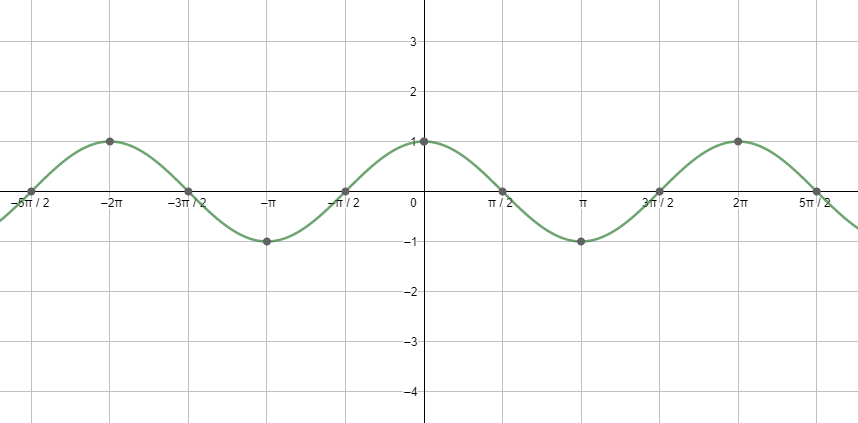
Looking at both the graphs, we can say that the graphs are repeating after a fixed period i.e. $2{{\pi }^{c}}$ . So, we can say that the fundamental period of the cosine function and the sine function is $2{{\pi }^{c}}=360{}^\circ $
Now to start with the solution to the above question, we will try to simplify the expression given in the question using the formula $\sin (x+y)=\sin x\cos y+cosx\sin y$ . On doing so, we get
$\sin 60{}^\circ \cos 30{}^\circ +\cos 60{}^\circ \sin 30{}^\circ $
$=\sin \left( 60{}^\circ +30{}^\circ \right)$
$=\sin 90{}^\circ $
Now we know that the value of $\sin 90{}^\circ $ is equal to 1. So, if we put the value of $\sin 90{}^\circ $ in our expression, we get
$\sin 90{}^\circ =1$
Therefore, we can say that the value of $\sin 60{}^\circ \cos 30{}^\circ +\cos 60{}^\circ \sin 30{}^\circ $ is equal to 1.
Note: Be careful about the calculation and the signs of the formulas you use as the signs in the formulas are very confusing and are very important for solving the problems. Also, it would help if you remember the properties related to complementary angles and trigonometric ratios.
Complete step-by-step answer:
Before moving to the solution, let us discuss the periodicity of sine and cosine function, which we would be using in the solution. All the trigonometric ratios, including sine and cosine, are periodic functions. We can better understand this using the graph of sine and cosine.
First, let us start with the graph of sinx.
Next, let us see the graph of cosx.
Looking at both the graphs, we can say that the graphs are repeating after a fixed period i.e. $2{{\pi }^{c}}$ . So, we can say that the fundamental period of the cosine function and the sine function is $2{{\pi }^{c}}=360{}^\circ $
Now to start with the solution to the above question, we will try to simplify the expression given in the question using the formula $\sin (x+y)=\sin x\cos y+cosx\sin y$ . On doing so, we get
$\sin 60{}^\circ \cos 30{}^\circ +\cos 60{}^\circ \sin 30{}^\circ $
$=\sin \left( 60{}^\circ +30{}^\circ \right)$
$=\sin 90{}^\circ $
Now we know that the value of $\sin 90{}^\circ $ is equal to 1. So, if we put the value of $\sin 90{}^\circ $ in our expression, we get
$\sin 90{}^\circ =1$
Therefore, we can say that the value of $\sin 60{}^\circ \cos 30{}^\circ +\cos 60{}^\circ \sin 30{}^\circ $ is equal to 1.
Note: Be careful about the calculation and the signs of the formulas you use as the signs in the formulas are very confusing and are very important for solving the problems. Also, it would help if you remember the properties related to complementary angles and trigonometric ratios.
Recently Updated Pages
Basicity of sulphurous acid and sulphuric acid are

Master Class 10 English: Engaging Questions & Answers for Success
Master Class 10 Social Science: Engaging Questions & Answers for Success
Master Class 10 Computer Science: Engaging Questions & Answers for Success
Class 10 Question and Answer - Your Ultimate Solutions Guide
Master Class 10 General Knowledge: Engaging Questions & Answers for Success
Trending doubts
Which country won the ICC Men's ODI World Cup in 2023?
In cricket, how many legal balls are there in a standard over?
Explain the Treaty of Vienna of 1815 class 10 social science CBSE
A boat goes 24 km upstream and 28 km downstream in class 10 maths CBSE
What does "powerplay" mean in limited-overs cricket?
What is the "Powerplay" in T20 cricket?