




Evaluate the area of the ellipse $\dfrac{{{x}^{2}}}{4}+\dfrac{{{y}^{2}}}{9}=1$ above the x-axis.
Answer
 Verified
614.4k+ views
Hint: Plot the curve on a graph. Observe that the curve is symmetrical in all the four quadrants. Hence find the area in the first quadrant, and hence the area of the ellipse will be two times the area in the first quadrant(Because only the first quadrant and the second quadrant are above x-axis). For finding the area in the first curve quadrant express y in terms of x. Note that y>0 and hence take only the positive sign. Then use the fact that the area under the curve is given by $\int_{a}^{b}{ydx}$. Substitute suitable values of a and b and integrate and hence find the area.
Complete step-by-step answer:
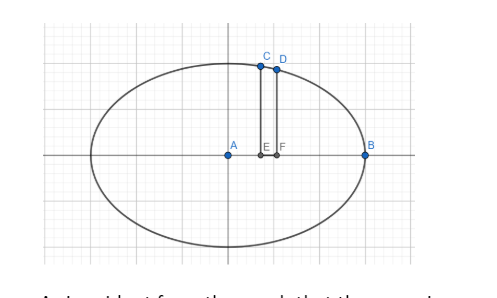
As is evident from the graph that the curve is symmetrical in the four quadrants. Hence, we will find the area in the first quadrant, and then the total area will be two times the area in the first quadrant.
Now, we have
$\dfrac{{{x}^{2}}}{4}+\dfrac{{{y}^{2}}}{9}=1$
Subtracting $\dfrac{{{x}^{2}}}{4}$ from both sides, we get
$\dfrac{{{y}^{2}}}{9}=1-\dfrac{{{x}^{2}}}{4}$
Multiplying both sides by 9, we get
${{y}^{2}}=9\left( 1-\dfrac{{{x}^{2}}}{4} \right)$
Hence, we have
$y=\pm 3\sqrt{1-\dfrac{{{x}^{2}}}{4}}=\pm \dfrac{3}{2}\sqrt{4-{{x}^{2}}}$
Now since in the first quadrant, y>0.
Hence, we have
$y=\dfrac{3}{2}\sqrt{4-{{x}^{2}}}$
Now consider the vertical strip CDEF.
Here CE = y and EF = dx
Hence the area of the strip will be ydx.
The area in the first quadrant will be the sum of the area of these vertical strips from A to B.
Now at point B, we have y = 0
Hence $\dfrac{{{x}^{2}}}{4}=1\Rightarrow {{x}^{2}}=4\Rightarrow x=\pm 2$
Since the abscissa of point B is positive, we have $x=2$.
Hence the area in the first quadrant will be $\int_{0}^{2}{ydx}$
Substituting the value of y, we get
The area in the first quadrant is $\int_{0}^{2}{\dfrac{3}{2}\sqrt{4-{{x}^{2}}}dx}$
Let $I=\int_{0}^{2}{\dfrac{3}{2}\sqrt{4-{{x}^{2}}}dx}$
Finding the value of I:
Put x = 2sint.
Differentiating both sides with respect to t, we get
$\dfrac{dx}{dt}=2\cos tdt\Rightarrow dx=2\cos tdt$
When x = 0, we have $2\sin t=0\Rightarrow \sin t=0\Rightarrow t=0$
When x = 2, we have $2\sin t=2\Rightarrow \sin t=1\Rightarrow t=\dfrac{\pi }{2}$
Hence we have
$I=\dfrac{3}{2}\int_{0}^{\dfrac{\pi }{2}}{\sqrt{4-4{{\sin }^{2}}t}2\cos tdt}=6\int_{0}^{\dfrac{\pi }{2}}{\sqrt{1-{{\sin }^{2}}t}\cos tdt}$
Now, we know that $1-{{\sin }^{2}}t={{\cos }^{2}}t$
Hence, we have
$I=6\int_{0}^{\dfrac{\pi }{2}}{\sqrt{{{\cos }^{2}}t}\cos tdt}=6\int_{0}^{\dfrac{\pi }{2}}{\left| \cos t \right|\cos tdt}$
Since in the interval $\left( 0,\dfrac{\pi }{2} \right)$ cost is positive, we have $\left| \cos t \right|=\cos t$
Hence, we have
$I=6\int_{0}^{\dfrac{\pi }{2}}{{{\cos }^{2}}tdt}\text{ }\left( i \right)$
We know that $\int_{a}^{b}{f\left( x \right)dx}=\int_{a}^{b}{f\left( a+b-x \right)dx}$
Hence, we have
$I=6\int_{0}^{\dfrac{\pi }{2}}{{{\cos }^{2}}\left( \dfrac{\pi }{2}-x \right)dx}$
We know that $\cos \left( \dfrac{\pi }{2}-x \right)=\sin x$
Hence, we have
$I=6\int_{0}^{\dfrac{\pi }{2}}{{{\sin }^{2}}x}dx\text{ }\left( ii \right)$
Adding equation (i) and equation (ii), we get
$2I=6\int_{0}^{\dfrac{\pi }{2}}{\left( {{\sin }^{2}}t+{{\cos }^{2}}t \right)dt}$
We know that ${{\sin }^{2}}t+{{\cos }^{2}}t=1$
Hence, we have
$2I=6\int_{0}^{\dfrac{\pi }{2}}{1dt}=6\left. t \right|_{0}^{\dfrac{\pi }{2}}=6\left( \dfrac{\pi }{2}-0 \right)=3\pi $
Dividing both sides by 2, we get
$I=\dfrac{3\pi }{2}$
Hence the area in the first quadrant is $\dfrac{3\pi }{2}$
Hence the total area of the ellipse is $2\times \dfrac{3\pi }{2}=3\pi $
Note: [1] We can directly solve I using the fact that $\int{\sqrt{{{a}^{2}}-{{x}^{2}}}=\dfrac{x}{2}\sqrt{{{a}^{2}}-{{x}^{2}}}+\dfrac{{{a}^{2}}}{2}{{\sin }^{-1}}\dfrac{x}{a}}$
Hence, we have
$\begin{align}
& I=\dfrac{3}{2}\left( \left. \dfrac{x}{2}\sqrt{4-{{x}^{2}}}+\dfrac{4}{2}{{\sin }^{-1}}\dfrac{x}{2} \right|_{0}^{a} \right)=\dfrac{3}{2}\left[ \left( \dfrac{2}{2}\sqrt{4-4}+\dfrac{4}{2}{{\sin }^{-1}}\dfrac{2}{2} \right)-\left( \dfrac{0}{2}\sqrt{4-{{0}^{2}}}+\dfrac{4}{2}{{\sin }^{-1}}\dfrac{0}{2} \right) \right] \\
& =\dfrac{3\pi }{2} \\
\end{align}$
Which is the same as obtained above.
[2] Alternatively, we have
Area of ellipse $=\pi ab$
Hence the total area of the ellipse $\pi \left( 3 \right)\left( 2 \right)=6\pi $
Hence the area above the x-axis $=\dfrac{6\pi }{2}=3\pi $
Complete step-by-step answer:
As is evident from the graph that the curve is symmetrical in the four quadrants. Hence, we will find the area in the first quadrant, and then the total area will be two times the area in the first quadrant.
Now, we have
$\dfrac{{{x}^{2}}}{4}+\dfrac{{{y}^{2}}}{9}=1$
Subtracting $\dfrac{{{x}^{2}}}{4}$ from both sides, we get
$\dfrac{{{y}^{2}}}{9}=1-\dfrac{{{x}^{2}}}{4}$
Multiplying both sides by 9, we get
${{y}^{2}}=9\left( 1-\dfrac{{{x}^{2}}}{4} \right)$
Hence, we have
$y=\pm 3\sqrt{1-\dfrac{{{x}^{2}}}{4}}=\pm \dfrac{3}{2}\sqrt{4-{{x}^{2}}}$
Now since in the first quadrant, y>0.
Hence, we have
$y=\dfrac{3}{2}\sqrt{4-{{x}^{2}}}$
Now consider the vertical strip CDEF.
Here CE = y and EF = dx
Hence the area of the strip will be ydx.
The area in the first quadrant will be the sum of the area of these vertical strips from A to B.
Now at point B, we have y = 0
Hence $\dfrac{{{x}^{2}}}{4}=1\Rightarrow {{x}^{2}}=4\Rightarrow x=\pm 2$
Since the abscissa of point B is positive, we have $x=2$.
Hence the area in the first quadrant will be $\int_{0}^{2}{ydx}$
Substituting the value of y, we get
The area in the first quadrant is $\int_{0}^{2}{\dfrac{3}{2}\sqrt{4-{{x}^{2}}}dx}$
Let $I=\int_{0}^{2}{\dfrac{3}{2}\sqrt{4-{{x}^{2}}}dx}$
Finding the value of I:
Put x = 2sint.
Differentiating both sides with respect to t, we get
$\dfrac{dx}{dt}=2\cos tdt\Rightarrow dx=2\cos tdt$
When x = 0, we have $2\sin t=0\Rightarrow \sin t=0\Rightarrow t=0$
When x = 2, we have $2\sin t=2\Rightarrow \sin t=1\Rightarrow t=\dfrac{\pi }{2}$
Hence we have
$I=\dfrac{3}{2}\int_{0}^{\dfrac{\pi }{2}}{\sqrt{4-4{{\sin }^{2}}t}2\cos tdt}=6\int_{0}^{\dfrac{\pi }{2}}{\sqrt{1-{{\sin }^{2}}t}\cos tdt}$
Now, we know that $1-{{\sin }^{2}}t={{\cos }^{2}}t$
Hence, we have
$I=6\int_{0}^{\dfrac{\pi }{2}}{\sqrt{{{\cos }^{2}}t}\cos tdt}=6\int_{0}^{\dfrac{\pi }{2}}{\left| \cos t \right|\cos tdt}$
Since in the interval $\left( 0,\dfrac{\pi }{2} \right)$ cost is positive, we have $\left| \cos t \right|=\cos t$
Hence, we have
$I=6\int_{0}^{\dfrac{\pi }{2}}{{{\cos }^{2}}tdt}\text{ }\left( i \right)$
We know that $\int_{a}^{b}{f\left( x \right)dx}=\int_{a}^{b}{f\left( a+b-x \right)dx}$
Hence, we have
$I=6\int_{0}^{\dfrac{\pi }{2}}{{{\cos }^{2}}\left( \dfrac{\pi }{2}-x \right)dx}$
We know that $\cos \left( \dfrac{\pi }{2}-x \right)=\sin x$
Hence, we have
$I=6\int_{0}^{\dfrac{\pi }{2}}{{{\sin }^{2}}x}dx\text{ }\left( ii \right)$
Adding equation (i) and equation (ii), we get
$2I=6\int_{0}^{\dfrac{\pi }{2}}{\left( {{\sin }^{2}}t+{{\cos }^{2}}t \right)dt}$
We know that ${{\sin }^{2}}t+{{\cos }^{2}}t=1$
Hence, we have
$2I=6\int_{0}^{\dfrac{\pi }{2}}{1dt}=6\left. t \right|_{0}^{\dfrac{\pi }{2}}=6\left( \dfrac{\pi }{2}-0 \right)=3\pi $
Dividing both sides by 2, we get
$I=\dfrac{3\pi }{2}$
Hence the area in the first quadrant is $\dfrac{3\pi }{2}$
Hence the total area of the ellipse is $2\times \dfrac{3\pi }{2}=3\pi $
Note: [1] We can directly solve I using the fact that $\int{\sqrt{{{a}^{2}}-{{x}^{2}}}=\dfrac{x}{2}\sqrt{{{a}^{2}}-{{x}^{2}}}+\dfrac{{{a}^{2}}}{2}{{\sin }^{-1}}\dfrac{x}{a}}$
Hence, we have
$\begin{align}
& I=\dfrac{3}{2}\left( \left. \dfrac{x}{2}\sqrt{4-{{x}^{2}}}+\dfrac{4}{2}{{\sin }^{-1}}\dfrac{x}{2} \right|_{0}^{a} \right)=\dfrac{3}{2}\left[ \left( \dfrac{2}{2}\sqrt{4-4}+\dfrac{4}{2}{{\sin }^{-1}}\dfrac{2}{2} \right)-\left( \dfrac{0}{2}\sqrt{4-{{0}^{2}}}+\dfrac{4}{2}{{\sin }^{-1}}\dfrac{0}{2} \right) \right] \\
& =\dfrac{3\pi }{2} \\
\end{align}$
Which is the same as obtained above.
[2] Alternatively, we have
Area of ellipse $=\pi ab$
Hence the total area of the ellipse $\pi \left( 3 \right)\left( 2 \right)=6\pi $
Hence the area above the x-axis $=\dfrac{6\pi }{2}=3\pi $
Recently Updated Pages
Basicity of sulphurous acid and sulphuric acid are

Master Class 12 English: Engaging Questions & Answers for Success
Master Class 12 Social Science: Engaging Questions & Answers for Success
Master Class 12 Maths: Engaging Questions & Answers for Success
Master Class 12 Economics: Engaging Questions & Answers for Success
Master Class 12 Physics: Engaging Questions & Answers for Success
Trending doubts
Draw a labelled sketch of the human eye class 12 physics CBSE
Which are the Top 10 Largest Countries of the World?
Draw ray diagrams each showing i myopic eye and ii class 12 physics CBSE
Giving reasons state the signs positive or negative class 12 physics CBSE
Explain esterification reaction with the help of a class 12 chemistry CBSE
What is defined as a solenoid Depict a diagram with class 12 physics CBSE