




How do you evaluate \[\sin \left( \dfrac{\pi }{3} \right)\]?
Answer
 Verified
596.1k+ views
Hint: To calculate the value of \[\sin \left( \dfrac{\pi }{3} \right)\], firstly we have to change the angle in a form that is easily understood by us. The given question has the angle given in radians, so we will convert it into degrees keeping in mind the conversion factor for radian and degrees, which is \[\pi \] radians \[={{180}^{\circ }}\] and then apply the trigonometric function to the angle to get the final value of the expression.
Complete step by step answer:
The trigonometric functions can have the angle in two forms namely: degrees and radians. We have studied mostly in degrees and it is more convenient. But both these forms are interconvertible. Since radian form is hard to interpret so we generally convert the angle given in radian to degrees so that it becomes much more understandable.
The conversion factor for degrees can be stated as:
\[\pi \] radians \[={{180}^{\circ }}\]
Or \[1rad.=\dfrac{{{180}^{\circ }}}{\pi }\]
We are given the question to solve for \[\sin \left( \dfrac{\pi }{3} \right)\],
Sine function has values ranging from 0 to 1 in the first quadrant(\[{{0}^{\circ }}-{{90}^{\circ }}\]).
To solve \[\sin \left( \dfrac{\pi }{3} \right)\], we first need to solve which angle in degrees is \[\dfrac{\pi }{3}\].
\[\dfrac{\pi }{3}\] is an angle given in radians. Since we now know the relation between degrees and radian, we simply need to convert into the appropriate form (that is into degrees).
Converting \[\dfrac{\pi }{3}\], we have,
\[\dfrac{\pi }{3}=\dfrac{\pi }{3}\times \dfrac{{{180}^{\circ }}}{\pi }\] (as we know \[1rad.=\dfrac{{{180}^{\circ }}}{\pi }\])
\[\pi \] is present both in numerator and denominator and so gets cancelled we now get,
\[\Rightarrow \dfrac{{{180}^{\circ }}}{3}={{60}^{\circ }}\]
So we can conclude that, \[\dfrac{\pi }{3}={{60}^{\circ }}\]
Putting this value in sine function we have,
\[\sin \left( {{60}^{\circ }} \right)\]
We now have to recall the special triangle with the help of which we can find the value of \[\sin \left( {{60}^{\circ }} \right)\].
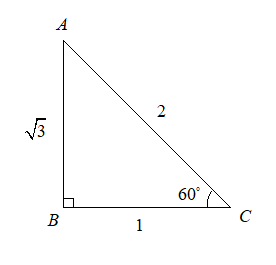
As we know, \[\sin \theta =\dfrac{perpendicular}{hypotenuse}\]
From the triangle, we can figure out the value of \[\sin \left( {{60}^{\circ }} \right)\]
Therefore, we have \[\sin ({{60}^{\circ }})=\dfrac{\sqrt{3}}{2}\]
Note: While converting the angle from radians to degree, \[\pi \] radians can be directly taken or substituted for \[{{180}^{\circ }}\]but for converting into radians do not skip any step as it can lead to wrong answer.
\[1\deg .=\dfrac{\pi }{{{180}^{\circ }}}\] (this formula can be applied)
Complete step by step answer:
The trigonometric functions can have the angle in two forms namely: degrees and radians. We have studied mostly in degrees and it is more convenient. But both these forms are interconvertible. Since radian form is hard to interpret so we generally convert the angle given in radian to degrees so that it becomes much more understandable.
The conversion factor for degrees can be stated as:
\[\pi \] radians \[={{180}^{\circ }}\]
Or \[1rad.=\dfrac{{{180}^{\circ }}}{\pi }\]
We are given the question to solve for \[\sin \left( \dfrac{\pi }{3} \right)\],
Sine function has values ranging from 0 to 1 in the first quadrant(\[{{0}^{\circ }}-{{90}^{\circ }}\]).
To solve \[\sin \left( \dfrac{\pi }{3} \right)\], we first need to solve which angle in degrees is \[\dfrac{\pi }{3}\].
\[\dfrac{\pi }{3}\] is an angle given in radians. Since we now know the relation between degrees and radian, we simply need to convert into the appropriate form (that is into degrees).
Converting \[\dfrac{\pi }{3}\], we have,
\[\dfrac{\pi }{3}=\dfrac{\pi }{3}\times \dfrac{{{180}^{\circ }}}{\pi }\] (as we know \[1rad.=\dfrac{{{180}^{\circ }}}{\pi }\])
\[\pi \] is present both in numerator and denominator and so gets cancelled we now get,
\[\Rightarrow \dfrac{{{180}^{\circ }}}{3}={{60}^{\circ }}\]
So we can conclude that, \[\dfrac{\pi }{3}={{60}^{\circ }}\]
Putting this value in sine function we have,
\[\sin \left( {{60}^{\circ }} \right)\]
We now have to recall the special triangle with the help of which we can find the value of \[\sin \left( {{60}^{\circ }} \right)\].
As we know, \[\sin \theta =\dfrac{perpendicular}{hypotenuse}\]
From the triangle, we can figure out the value of \[\sin \left( {{60}^{\circ }} \right)\]
Therefore, we have \[\sin ({{60}^{\circ }})=\dfrac{\sqrt{3}}{2}\]
Note: While converting the angle from radians to degree, \[\pi \] radians can be directly taken or substituted for \[{{180}^{\circ }}\]but for converting into radians do not skip any step as it can lead to wrong answer.
\[1\deg .=\dfrac{\pi }{{{180}^{\circ }}}\] (this formula can be applied)
Recently Updated Pages
Master Class 11 English: Engaging Questions & Answers for Success

Master Class 11 Social Science: Engaging Questions & Answers for Success
Master Class 11 Maths: Engaging Questions & Answers for Success
Master Class 11 Biology: Engaging Questions & Answers for Success
Master Class 11 Physics: Engaging Questions & Answers for Success
Master Class 11 Chemistry: Engaging Questions & Answers for Success