




How do you evaluate \[\cos \left( {{\tan }^{-1}}\left( \dfrac{1}{2} \right) \right)\] without a calculator?
Answer
 Verified
541.8k+ views
Hint: This question is from the topic of trigonometry. In solving this question, we will equate \[{{\tan }^{-1}}\left( \dfrac{1}{2} \right)\] with \[x\] and solve the further question. After that, we will use a right angled triangle and find the value of \[\cos x\]. After solving the further question, we will get our answer.
Complete step by step solution:
Let us solve this question.
In this question, we have asked to evaluate the given term without using a calculator. The given term is \[\cos \left( {{\tan }^{-1}}\left( \dfrac{1}{2} \right) \right)\]
Let us first use the term \[{{\tan }^{-1}}\left( \dfrac{1}{2} \right)\] and equate this with \[x\].
So, we can write
\[x={{\tan }^{-1}}\left( \dfrac{1}{2} \right)\]
The above equation can also be written as
\[\Rightarrow \tan x=\dfrac{1}{2}\]
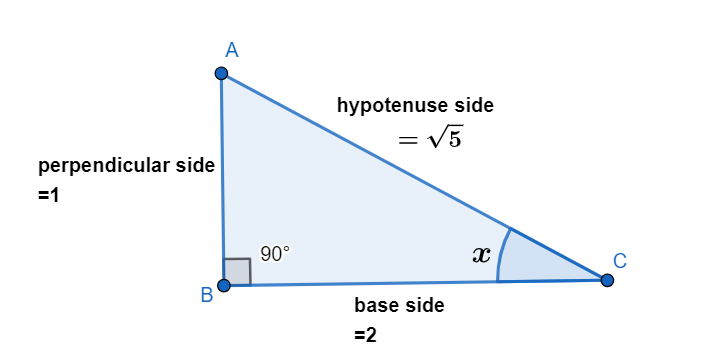
We know that in a right angled triangle, the value of tan is \[\dfrac{\text{perpendicular side}}{\text{base side}}\]
We can understand this from the following figure:
We know that in a right angled triangle,
\[\text{hypotenuse side = }\sqrt{{{\left( \text{perpendicular side} \right)}^{2}}+{{\left( \text{base side} \right)}^{2}}}\]
Putting the values of sides, we can write the above equation as
\[\Rightarrow \text{hypotenuse side = }\sqrt{{{1}^{2}}+{{\text{2}}^{2}}}\]
\[\Rightarrow \text{hypotenuse side = }\sqrt{5}\]
We know that in a right angled triangle, the value of cos is
\[\cos x=\dfrac{\text{base side}}{\text{hypotenuse side}}\]
Putting the values, we can write the above as
\[\Rightarrow \cos x=\dfrac{2}{\sqrt{5}}\]
The above can also be written as
\[\Rightarrow x={{\cos }^{-1}}\left( \dfrac{2}{\sqrt{5}} \right)\]
Now, we can write \[\cos \left( {{\tan }^{-1}}\left( \dfrac{1}{2} \right) \right)\] as
\[\Rightarrow \cos \left( {{\tan }^{-1}}\left( \dfrac{1}{2} \right) \right)=\cos \left( x \right)\]
By putting the value of \[x\] as \[{{\cos }^{-1}}\left( \dfrac{2}{\sqrt{5}} \right)\], we can write
\[\Rightarrow \cos \left( {{\tan }^{-1}}\left( \dfrac{1}{2} \right) \right)=\cos \left( {{\cos }^{-1}}\left( \dfrac{2}{\sqrt{5}} \right) \right)\]
The above can also be written as
\[\Rightarrow \cos \left( {{\tan }^{-1}}\left( \dfrac{1}{2} \right) \right)=\dfrac{2}{\sqrt{5}}\]
As we know that the value of tan is positive from 0 degrees to 90 degrees and from 180 degrees to 270 degrees, but the value of cos is positive from 0 degrees to 90 degrees and negative from 180 degrees to 270 degrees. So, we will have to write
\[\Rightarrow \cos \left( {{\tan }^{-1}}\left( \dfrac{1}{2} \right) \right)=\pm \dfrac{2}{\sqrt{5}}\]
Note: As we can see that this question is from the trigonometry, so we should have a better knowledge in the topic of trigonometry.
We should know everything about the right angled triangle. Let us understand about the same from the following:
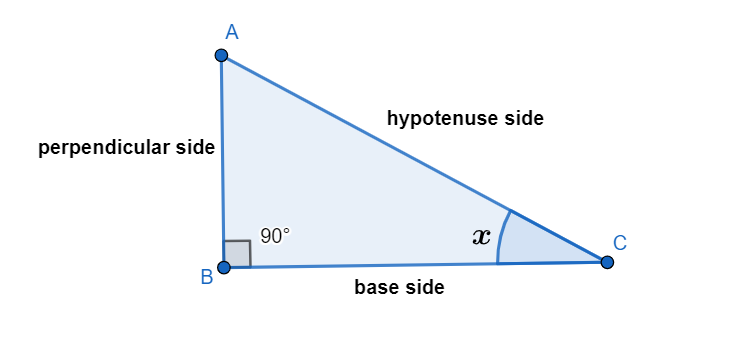
Remember that:
\[\text{hypotenuse side = }\sqrt{{{\left( \text{perpendicular side} \right)}^{2}}+{{\left( \text{base side} \right)}^{2}}}\]
\[\sin x=\dfrac{\text{perpendicular side}}{\text{hypotenuse side}}\]
\[\cos x=\dfrac{\text{base side}}{\text{hypotenuse side}}\]
\[\tan x=\dfrac{\text{perpendicular side}}{\text{base side}}\]
Complete step by step solution:
Let us solve this question.
In this question, we have asked to evaluate the given term without using a calculator. The given term is \[\cos \left( {{\tan }^{-1}}\left( \dfrac{1}{2} \right) \right)\]
Let us first use the term \[{{\tan }^{-1}}\left( \dfrac{1}{2} \right)\] and equate this with \[x\].
So, we can write
\[x={{\tan }^{-1}}\left( \dfrac{1}{2} \right)\]
The above equation can also be written as
\[\Rightarrow \tan x=\dfrac{1}{2}\]
We know that in a right angled triangle, the value of tan is \[\dfrac{\text{perpendicular side}}{\text{base side}}\]
We can understand this from the following figure:
We know that in a right angled triangle,
\[\text{hypotenuse side = }\sqrt{{{\left( \text{perpendicular side} \right)}^{2}}+{{\left( \text{base side} \right)}^{2}}}\]
Putting the values of sides, we can write the above equation as
\[\Rightarrow \text{hypotenuse side = }\sqrt{{{1}^{2}}+{{\text{2}}^{2}}}\]
\[\Rightarrow \text{hypotenuse side = }\sqrt{5}\]
We know that in a right angled triangle, the value of cos is
\[\cos x=\dfrac{\text{base side}}{\text{hypotenuse side}}\]
Putting the values, we can write the above as
\[\Rightarrow \cos x=\dfrac{2}{\sqrt{5}}\]
The above can also be written as
\[\Rightarrow x={{\cos }^{-1}}\left( \dfrac{2}{\sqrt{5}} \right)\]
Now, we can write \[\cos \left( {{\tan }^{-1}}\left( \dfrac{1}{2} \right) \right)\] as
\[\Rightarrow \cos \left( {{\tan }^{-1}}\left( \dfrac{1}{2} \right) \right)=\cos \left( x \right)\]
By putting the value of \[x\] as \[{{\cos }^{-1}}\left( \dfrac{2}{\sqrt{5}} \right)\], we can write
\[\Rightarrow \cos \left( {{\tan }^{-1}}\left( \dfrac{1}{2} \right) \right)=\cos \left( {{\cos }^{-1}}\left( \dfrac{2}{\sqrt{5}} \right) \right)\]
The above can also be written as
\[\Rightarrow \cos \left( {{\tan }^{-1}}\left( \dfrac{1}{2} \right) \right)=\dfrac{2}{\sqrt{5}}\]
As we know that the value of tan is positive from 0 degrees to 90 degrees and from 180 degrees to 270 degrees, but the value of cos is positive from 0 degrees to 90 degrees and negative from 180 degrees to 270 degrees. So, we will have to write
\[\Rightarrow \cos \left( {{\tan }^{-1}}\left( \dfrac{1}{2} \right) \right)=\pm \dfrac{2}{\sqrt{5}}\]
Note: As we can see that this question is from the trigonometry, so we should have a better knowledge in the topic of trigonometry.
We should know everything about the right angled triangle. Let us understand about the same from the following:
Remember that:
\[\text{hypotenuse side = }\sqrt{{{\left( \text{perpendicular side} \right)}^{2}}+{{\left( \text{base side} \right)}^{2}}}\]
\[\sin x=\dfrac{\text{perpendicular side}}{\text{hypotenuse side}}\]
\[\cos x=\dfrac{\text{base side}}{\text{hypotenuse side}}\]
\[\tan x=\dfrac{\text{perpendicular side}}{\text{base side}}\]
Recently Updated Pages
Master Class 10 Computer Science: Engaging Questions & Answers for Success

Master Class 10 General Knowledge: Engaging Questions & Answers for Success
Master Class 10 English: Engaging Questions & Answers for Success
Master Class 10 Social Science: Engaging Questions & Answers for Success
Master Class 10 Maths: Engaging Questions & Answers for Success
Master Class 10 Science: Engaging Questions & Answers for Success
Trending doubts
What is the median of the first 10 natural numbers class 10 maths CBSE
Which women's tennis player has 24 Grand Slam singles titles?
Who is the Brand Ambassador of Incredible India?
Why is there a time difference of about 5 hours between class 10 social science CBSE
Write a letter to the principal requesting him to grant class 10 english CBSE
State and prove converse of BPT Basic Proportionality class 10 maths CBSE