




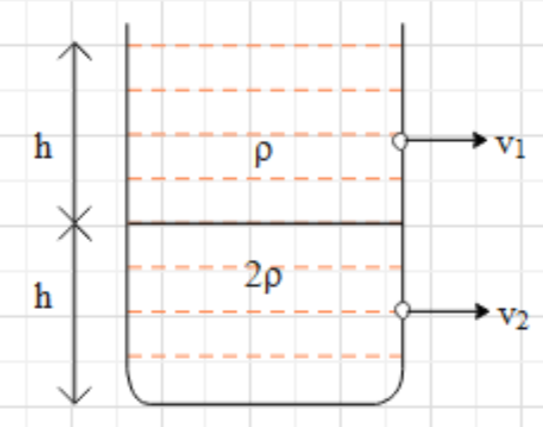
Equal volume of two immiscible liquids of densities $\rho $ and $2\rho $ are filled in a vessel as shown in the figure. Two small holes are made at depth $\dfrac{h}{2}$ and $\dfrac{3h}{2}$ from the surface of the lighter liquid. If ${{v}_{1}}$ and ${{v}_{2}}$ are the velocities of efflux at these two holes, then $\dfrac{{{v}_{1}}}{{{v}_{2}}}$ will be
$\text{A}\text{. }\dfrac{1}{\sqrt{2}}$
$\text{B}\text{. }\dfrac{1}{2\sqrt{2}}$
$\text{C}\text{. }\dfrac{1}{2}$
$\text{D}\text{. }\dfrac{1}{2}$
Answer
 Verified
602.7k+ views
Hint: Use Bernoulli’s theorem to find the two velocities of efflux. The Bernoulli’s theorem for two points A and B is given as ${{\rho }_{A}}g{{h}_{A}}+\dfrac{1}{2}{{\rho }_{A}}v_{A}^{2}={{\rho }_{B}}g{{h}_{B}}+\dfrac{1}{2}{{\rho }_{B}}v_{B}^{2}$, where the pressures at A and B are ${{\rho }_{A}}$ and ${{\rho }_{B}}$, depths of A and B are ${{h}_{A}}$ and ${{h}_{B}}$. ${{v}_{A}}$ and ${{v}_{B}}$ are the velocities of the liquid at the points A and B respectively.
Formula used:
${{\rho }_{A}}g{{h}_{A}}+\dfrac{1}{2}{{\rho }_{A}}v_{A}^{2}={{\rho }_{B}}g{{h}_{B}}+\dfrac{1}{2}{{\rho }_{B}}v_{B}^{2}$
Complete step-by-step solution:
In the given case, there is a container in which two immiscible liquids are present. Since the two liquids are immiscible, they will not interact and mix with each other. Hence, the liquid, which has the least density will be at the top and the liquid with higher density will set down. It is given that the heights of both the liquid layers are equal to h.
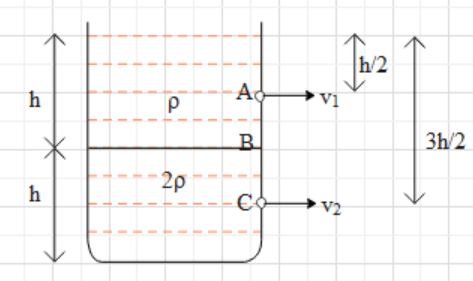
Now, we punch two holes in the container. One hole at a depth of $\dfrac{h}{2}$ and the other at $\dfrac{3h}{2}$, both from the surface of the top liquid (as shown). Due to these holes, the liquids come with velocities ${{v}_{1}}$ and ${{v}_{2}}$.
Therefore, there is a flow of both the liquids. When there is a flow of liquid, Bernoulli's theorem comes into role.
Let us apply Bernoulli's theorem, at the points A and B.
Hence, we get,
$\rho g\left( \dfrac{h}{2} \right)+\dfrac{1}{2}\rho v_{1}^{2}=\rho gh+0$
$\Rightarrow \dfrac{1}{2}v_{1}^{2}=g\left( \dfrac{h}{2} \right)$
$\Rightarrow v_{1}^{2}=gh$
$\Rightarrow {{v}_{1}}=\sqrt{gh}$.
Therefore, the speed of the liquid coming out from point A is ${{v}_{1}}=\sqrt{gh}$.
Now, apply the Bernoulli’s theorem at points B and C.
$\rho gh+0=(2\rho )g\left( \dfrac{3h}{2} \right)+\dfrac{1}{2}(2\rho )v_{2}^{2}$
$\Rightarrow gh=2g\left( \dfrac{3h}{2} \right)+v_{2}^{2}$
$\Rightarrow v_{2}^{2}=2gh$
$\Rightarrow {{v}_{2}}=\sqrt{2gh}$.
Therefore, the speed of the liquid coming out from point C is ${{v}_{2}}=\sqrt{2gh}$.
Therefore, $\dfrac{{{v}_{1}}}{{{v}_{2}}}=\dfrac{\sqrt{gh}}{\sqrt{2gh}}=\dfrac{1}{\sqrt{2}}$
Hence, the correct option is A.
Note: When a liquid comes out of holes made in the container, the velocity of the liquid is called the velocity of efflux and is given as $v=\sqrt{2gH}$,
Where H is the depth of the hole from the top surface where the liquid is in contact with air.
Therefore, ${{v}_{1}}=\sqrt{2g\left( \dfrac{h}{2} \right)}=\sqrt{gh}$.
Then we can find ${{v}_{2}}$ by applying Bernoulli’s theorem at points A and C.
Formula used:
${{\rho }_{A}}g{{h}_{A}}+\dfrac{1}{2}{{\rho }_{A}}v_{A}^{2}={{\rho }_{B}}g{{h}_{B}}+\dfrac{1}{2}{{\rho }_{B}}v_{B}^{2}$
Complete step-by-step solution:
In the given case, there is a container in which two immiscible liquids are present. Since the two liquids are immiscible, they will not interact and mix with each other. Hence, the liquid, which has the least density will be at the top and the liquid with higher density will set down. It is given that the heights of both the liquid layers are equal to h.
Now, we punch two holes in the container. One hole at a depth of $\dfrac{h}{2}$ and the other at $\dfrac{3h}{2}$, both from the surface of the top liquid (as shown). Due to these holes, the liquids come with velocities ${{v}_{1}}$ and ${{v}_{2}}$.
Therefore, there is a flow of both the liquids. When there is a flow of liquid, Bernoulli's theorem comes into role.
Let us apply Bernoulli's theorem, at the points A and B.
Hence, we get,
$\rho g\left( \dfrac{h}{2} \right)+\dfrac{1}{2}\rho v_{1}^{2}=\rho gh+0$
$\Rightarrow \dfrac{1}{2}v_{1}^{2}=g\left( \dfrac{h}{2} \right)$
$\Rightarrow v_{1}^{2}=gh$
$\Rightarrow {{v}_{1}}=\sqrt{gh}$.
Therefore, the speed of the liquid coming out from point A is ${{v}_{1}}=\sqrt{gh}$.
Now, apply the Bernoulli’s theorem at points B and C.
$\rho gh+0=(2\rho )g\left( \dfrac{3h}{2} \right)+\dfrac{1}{2}(2\rho )v_{2}^{2}$
$\Rightarrow gh=2g\left( \dfrac{3h}{2} \right)+v_{2}^{2}$
$\Rightarrow v_{2}^{2}=2gh$
$\Rightarrow {{v}_{2}}=\sqrt{2gh}$.
Therefore, the speed of the liquid coming out from point C is ${{v}_{2}}=\sqrt{2gh}$.
Therefore, $\dfrac{{{v}_{1}}}{{{v}_{2}}}=\dfrac{\sqrt{gh}}{\sqrt{2gh}}=\dfrac{1}{\sqrt{2}}$
Hence, the correct option is A.
Note: When a liquid comes out of holes made in the container, the velocity of the liquid is called the velocity of efflux and is given as $v=\sqrt{2gH}$,
Where H is the depth of the hole from the top surface where the liquid is in contact with air.
Therefore, ${{v}_{1}}=\sqrt{2g\left( \dfrac{h}{2} \right)}=\sqrt{gh}$.
Then we can find ${{v}_{2}}$ by applying Bernoulli’s theorem at points A and C.
Recently Updated Pages
Master Class 11 Social Science: Engaging Questions & Answers for Success

Master Class 11 Physics: Engaging Questions & Answers for Success
Master Class 11 Maths: Engaging Questions & Answers for Success
Master Class 11 Economics: Engaging Questions & Answers for Success
Master Class 11 Computer Science: Engaging Questions & Answers for Success
Master Class 11 Chemistry: Engaging Questions & Answers for Success
Trending doubts
One Metric ton is equal to kg A 10000 B 1000 C 100 class 11 physics CBSE
There are 720 permutations of the digits 1 2 3 4 5 class 11 maths CBSE
1 Quintal is equal to a 110 kg b 10 kg c 100kg d 1000 class 11 physics CBSE
State and prove Bernoullis theorem class 11 physics CBSE
Difference Between Prokaryotic Cells and Eukaryotic Cells
Discuss the various forms of bacteria class 11 biology CBSE