




Why is epidermis considered a protective tissue?
Answer
 Verified
510k+ views
Hint: Tissue is a collection of cells, present in both plants and animals. This group of cells have similar structures and work together as a whole. Epithelial, connective, muscular, and nerve tissues are the four primary forms of tissue in a body as each of these are made for a specific purpose.
Complete answer:
The thin outer layer of the skin which is visible to the naked eye and serves to protect the body is called the epidermis. Since this layer of the skin lacks blood vessels, it completely relies on the dermis which is the layer of the skin lying right underneath the epidermis. It also helps in making provision of nutrition for the skin as well as also helps in disposing the waste produced.
The squamous epithelial cells are stratified in the epidermis. The epidermis is divided into four layers based on the maturity of the cells:
Stratum germinativum: The keratinocyte cells originate in the stratum germinativum, which is the deepest layer of skin that bisects the dermal layer.
Stratum spinosum: The skin's strength and elasticity are mainly due to the stratum spinosum.
Stratum granulosum: Between the stratum corneum and the stratum spinosum is the layer of granulosum, which is also called the granular layer.
Stratum corneum: It is the skin's outermost layer, which is relatively water resistant and prevents germs, viruses, and other external things from entering the body.
Image of an Epidermis and its different layers
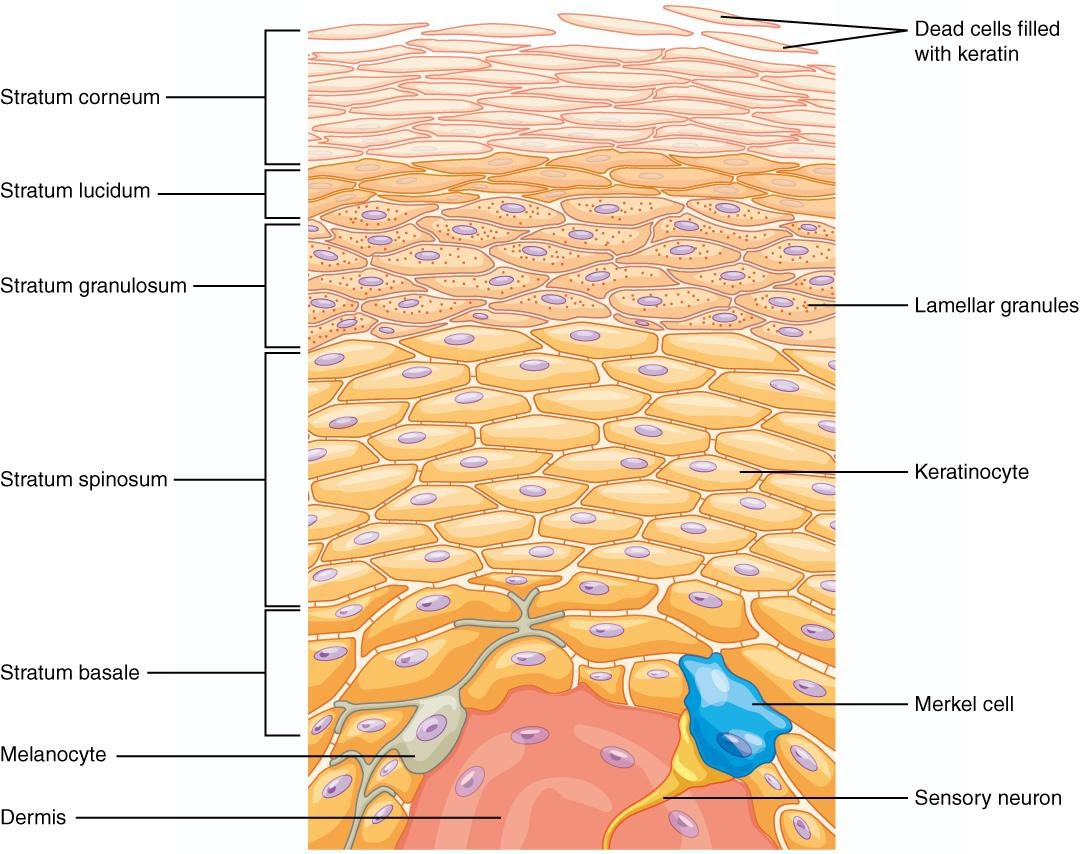
The epidermis, as well as the other layers of the skin, is responsible for protecting the body's interior organs, muscles, nerves, and blood vessels. The epidermis also performs the functions of new skin cell production, production of melanin which gives skin colour to minimise the absorption and impact of UV ray, the body's physical defence and lastly it helps in designing the body's immune system to protect the body. Hence, due to all these functions and also due to its primary function to create a physical barrier between the outside and inside of the body, the epidermis is classified as a protective tissue.
Note:
The epidermis is present in both plants and animals. In botany, the epidermis is the outermost layer of protoderm-derived cells that covers the stem, root, leaf, flower, fruit, and seed sections of a plant. Protection from mechanical injury, water loss, and infection are all functions of the epidermis and its waxy cuticle.
Complete answer:
The thin outer layer of the skin which is visible to the naked eye and serves to protect the body is called the epidermis. Since this layer of the skin lacks blood vessels, it completely relies on the dermis which is the layer of the skin lying right underneath the epidermis. It also helps in making provision of nutrition for the skin as well as also helps in disposing the waste produced.
The squamous epithelial cells are stratified in the epidermis. The epidermis is divided into four layers based on the maturity of the cells:
Stratum germinativum: The keratinocyte cells originate in the stratum germinativum, which is the deepest layer of skin that bisects the dermal layer.
Stratum spinosum: The skin's strength and elasticity are mainly due to the stratum spinosum.
Stratum granulosum: Between the stratum corneum and the stratum spinosum is the layer of granulosum, which is also called the granular layer.
Stratum corneum: It is the skin's outermost layer, which is relatively water resistant and prevents germs, viruses, and other external things from entering the body.
Image of an Epidermis and its different layers
The epidermis, as well as the other layers of the skin, is responsible for protecting the body's interior organs, muscles, nerves, and blood vessels. The epidermis also performs the functions of new skin cell production, production of melanin which gives skin colour to minimise the absorption and impact of UV ray, the body's physical defence and lastly it helps in designing the body's immune system to protect the body. Hence, due to all these functions and also due to its primary function to create a physical barrier between the outside and inside of the body, the epidermis is classified as a protective tissue.
Note:
The epidermis is present in both plants and animals. In botany, the epidermis is the outermost layer of protoderm-derived cells that covers the stem, root, leaf, flower, fruit, and seed sections of a plant. Protection from mechanical injury, water loss, and infection are all functions of the epidermis and its waxy cuticle.
Recently Updated Pages
Master Class 11 Social Science: Engaging Questions & Answers for Success

Master Class 11 Chemistry: Engaging Questions & Answers for Success
Master Class 12 Business Studies: Engaging Questions & Answers for Success
Master Class 12 Chemistry: Engaging Questions & Answers for Success
Master Class 12 Biology: Engaging Questions & Answers for Success
Class 12 Question and Answer - Your Ultimate Solutions Guide
Trending doubts
One Metric ton is equal to kg A 10000 B 1000 C 100 class 11 physics CBSE
Difference Between Prokaryotic Cells and Eukaryotic Cells
How many of the following diseases can be studied with class 11 biology CBSE
Two of the body parts which do not appear in MRI are class 11 biology CBSE
Which of the following enzymes is used for carboxylation class 11 biology CBSE
Explain zero factorial class 11 maths CBSE