




What is enzyme inhibition? How many types of enzyme inhibition are known? Explain how the effect of inhibitors be stopped?
Answer
 Verified
552.3k+ views
Hint: Inhibition is to stop. So, enzyme inhibition refers to the stopping of the enzyme activity. The inhibition is carried out by inhibitors which do not lead to the formation of the product. The inhibitors can affect the substrate as well as the enzyme.
Complete answer:
The enzymes are the biomolecules which increases the rate of forward reaction. The enzymes act on the substrate and brings about the formation of the product. The enzyme is not used up in a bio-chemical reaction. There are certain molecules(inhibitors) which interfere with the enzyme activity and does not lead to the formation of the product. This is known as enzyme inhibition. These inhibitors can bind to the active sites and prevent/interfere with the further activity. This type of binding can be reversible as well as irreversible.
The inhibition is of four types-
1) Competitive- In this type of inhibition, the inhibitor also has the affinity towards the enzyme active site. It competes with the substrate for the active site. If the inhibitor binds the active site, the enzyme activity is stopped.
2) Non-competitive- In this the inhibitor reduces the activity of the enzyme irrespective of whether the substrate bind to the enzyme or not.
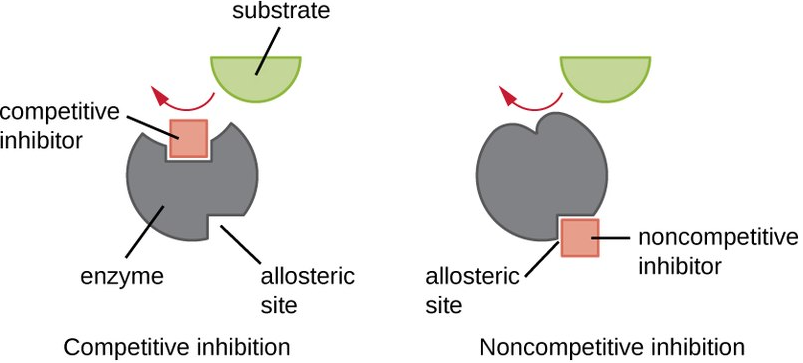
3) Uncompetitive- It is also known as anti-competitive inhibition. The inhibitor binds to the enzyme substrate complex.
4) Allosteric- The inhibitors bind to the allosteric site and change the conformation of the enzymes.
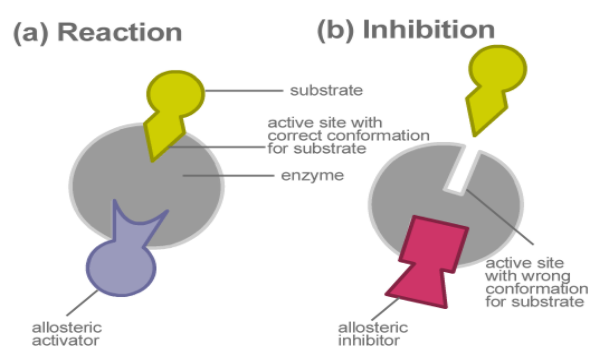
The inhibitors can be stopped by increasing the concentration of the substrate and also use of the molecules which out compete inhibitors.
Note: Inhibition is the mechanism which helps in stopping a biochemical reaction. They act as a cellular control mechanism. The formation of ATP is a mechanism which prevents the break down of too many glucose molecules. The enzyme inhibition mechanism is used for making several potential drugs.
Complete answer:
The enzymes are the biomolecules which increases the rate of forward reaction. The enzymes act on the substrate and brings about the formation of the product. The enzyme is not used up in a bio-chemical reaction. There are certain molecules(inhibitors) which interfere with the enzyme activity and does not lead to the formation of the product. This is known as enzyme inhibition. These inhibitors can bind to the active sites and prevent/interfere with the further activity. This type of binding can be reversible as well as irreversible.
The inhibition is of four types-
1) Competitive- In this type of inhibition, the inhibitor also has the affinity towards the enzyme active site. It competes with the substrate for the active site. If the inhibitor binds the active site, the enzyme activity is stopped.
2) Non-competitive- In this the inhibitor reduces the activity of the enzyme irrespective of whether the substrate bind to the enzyme or not.
3) Uncompetitive- It is also known as anti-competitive inhibition. The inhibitor binds to the enzyme substrate complex.
4) Allosteric- The inhibitors bind to the allosteric site and change the conformation of the enzymes.
The inhibitors can be stopped by increasing the concentration of the substrate and also use of the molecules which out compete inhibitors.
Note: Inhibition is the mechanism which helps in stopping a biochemical reaction. They act as a cellular control mechanism. The formation of ATP is a mechanism which prevents the break down of too many glucose molecules. The enzyme inhibition mechanism is used for making several potential drugs.
Recently Updated Pages
Basicity of sulphurous acid and sulphuric acid are

Master Class 11 English: Engaging Questions & Answers for Success
Master Class 11 Physics: Engaging Questions & Answers for Success
Master Class 11 Computer Science: Engaging Questions & Answers for Success
Master Class 11 Chemistry: Engaging Questions & Answers for Success
Master Class 11 Social Science: Engaging Questions & Answers for Success
Trending doubts
Difference Between Prokaryotic Cells and Eukaryotic Cells
Two of the body parts which do not appear in MRI are class 11 biology CBSE
One Metric ton is equal to kg A 10000 B 1000 C 100 class 11 physics CBSE
10 examples of friction in our daily life
Draw a diagram of nephron and explain its structur class 11 biology CBSE
What will happen if the mucus is not secreted by the class 11 biology CBSE