




Enlist the general characters of pteridophytes with example.
Answer
 Verified
645.3k+ views
Hint: A pteridophyte is a vascular plant (includes xylem and phloem) that scatter spores. Pteridophytes produce neither flowers nor seeds. They are sometimes mentioned as ‘Cryptogams’, which suggests that their means of reproduction are hidden. Ferns and lycophytes all are pteridophytes.
Complete answer:
The general characters of pteridophytes are –
-Pteridophytes are the first true land plants.
-They are seedless, and they procreate through spores.
-A pteridophyte is a vascular plant. The water and minerals flow from the surface of the plant- cell to cell in the plant’s body.
-The sporophyte generation and the gametophyte generation both are seen in Pteridophytes.
-Sporophyte has true roots, stem, and leaves as they contain vascular tissues.
-The sporangium is the structure in which spores are formed. They are usually homosporous (meaning: one sort of spore is produced) and also are heterosporous, (meaning: two sorts of spores are produced.)
-Sporangia are produced in groups on sporophylls:
-The tip of the leaves tends to curl inwards to protect the vulnerable growing parts.
-The male sex organs are called antheridia, while the female sex organs are called archegonia.
-They are found in cool, damp, shady places.
Examples of Pteridophyta are- Man fern, Silver fern, Whisk Fern, Flying Spider, Salvinia natans, Equisetum, selaginella, adiantum, etc.
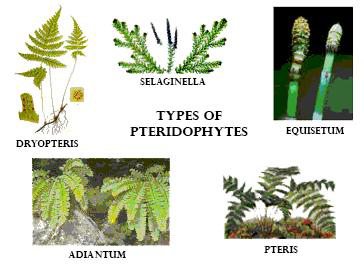
Note: Life cycle of Pteridophytes is almost the same as seed-bearing plants, where alternation of generations is observed. However, pteridophytes don't possess seeds; instead, they use spores. Some groups of pteridophytes are at present extinct and known only from fossils.
Complete answer:
The general characters of pteridophytes are –
-Pteridophytes are the first true land plants.
-They are seedless, and they procreate through spores.
-A pteridophyte is a vascular plant. The water and minerals flow from the surface of the plant- cell to cell in the plant’s body.
-The sporophyte generation and the gametophyte generation both are seen in Pteridophytes.
-Sporophyte has true roots, stem, and leaves as they contain vascular tissues.
-The sporangium is the structure in which spores are formed. They are usually homosporous (meaning: one sort of spore is produced) and also are heterosporous, (meaning: two sorts of spores are produced.)
-Sporangia are produced in groups on sporophylls:
-The tip of the leaves tends to curl inwards to protect the vulnerable growing parts.
-The male sex organs are called antheridia, while the female sex organs are called archegonia.
-They are found in cool, damp, shady places.
Examples of Pteridophyta are- Man fern, Silver fern, Whisk Fern, Flying Spider, Salvinia natans, Equisetum, selaginella, adiantum, etc.
Note: Life cycle of Pteridophytes is almost the same as seed-bearing plants, where alternation of generations is observed. However, pteridophytes don't possess seeds; instead, they use spores. Some groups of pteridophytes are at present extinct and known only from fossils.
Recently Updated Pages
Basicity of sulphurous acid and sulphuric acid are

Master Class 11 English: Engaging Questions & Answers for Success
Master Class 11 Physics: Engaging Questions & Answers for Success
Master Class 11 Computer Science: Engaging Questions & Answers for Success
Master Class 11 Chemistry: Engaging Questions & Answers for Success
Master Class 11 Social Science: Engaging Questions & Answers for Success
Trending doubts
Difference Between Prokaryotic Cells and Eukaryotic Cells
Two of the body parts which do not appear in MRI are class 11 biology CBSE
One Metric ton is equal to kg A 10000 B 1000 C 100 class 11 physics CBSE
10 examples of friction in our daily life
Draw a diagram of nephron and explain its structur class 11 biology CBSE
What will happen if the mucus is not secreted by the class 11 biology CBSE