




Endospore resistance is due to
(a)Dipicolinic acid
(b)Impervious coat
(c)Dehydrated protoplasm
(d)All of the above
Answer
 Verified
636k+ views
Hint: An endospore is a structure produced at unfavorable environmental conditions by some bacteria. Bacterial endospores are immune to antibiotics and most disinfectants as well as to physical agents such as heat, boiling, and drying. Their chemical compound causing dormancy, thick coating, and removal of endospore water are few factors leading to endospore resistance.
Complete answer:
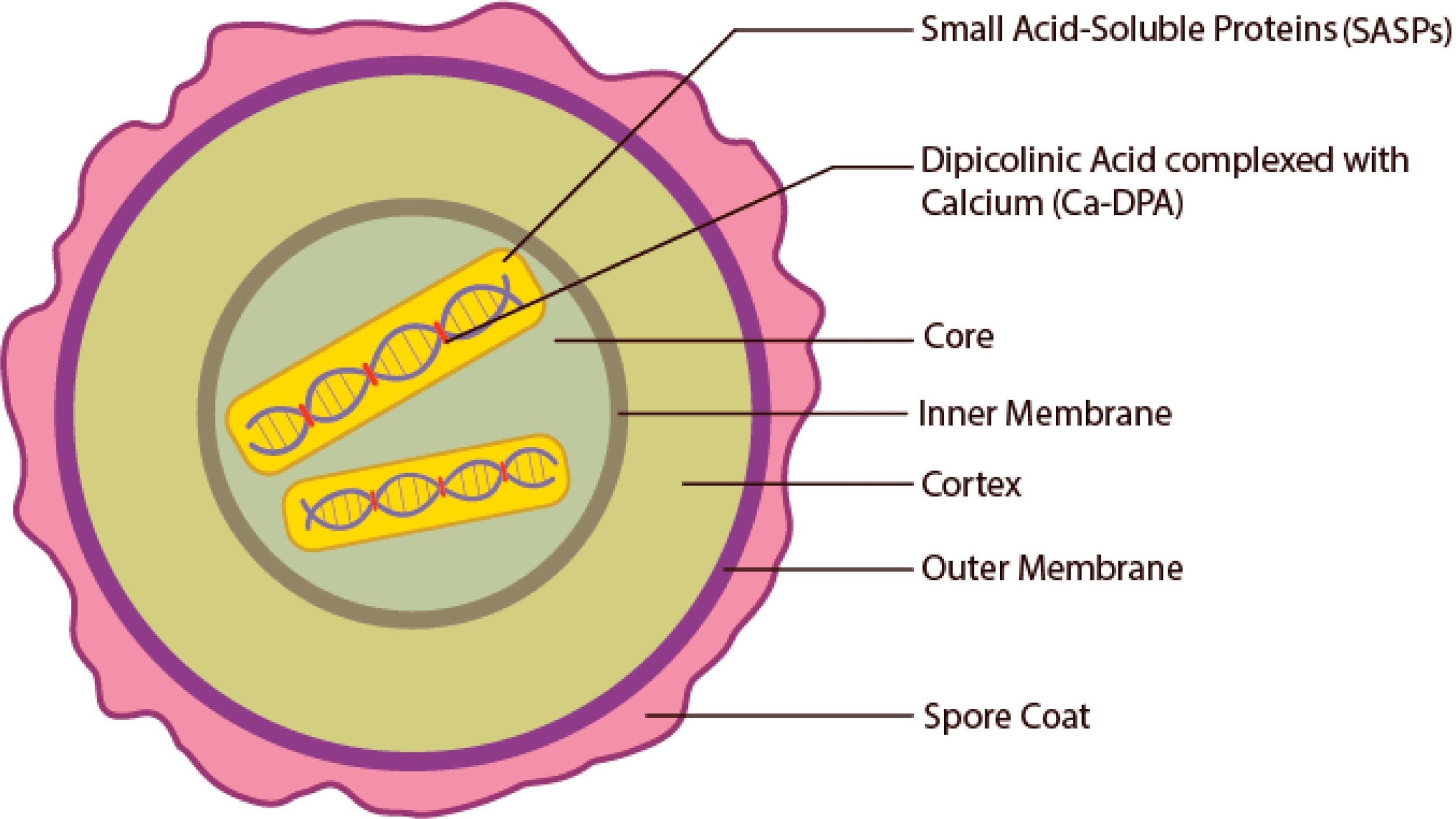
The endospore is composed of DNA, ribosomes, and significant quantities of dipicolinic acid from the bacterium. Dipicolinic acid is a chemical that helps to sustain dormancy and resistance for endospores. 5 to 15 percent of the dry weight of bacterial spores is composed of dipicolinic acid.
Calcium dipicolinate, which is abundant inside the endospore, can stabilize and protect DNA from the endospore. This complex binds molecules of free water, causing spore dehydration. The heat resistance of macromolecules inside the core increases as a consequence. The calcium-dipicolinic acid complex also works by inserting itself between the nucleobases to protect DNA from heat denaturation, thus increasing DNA stability.
Additional Information:
Small acid-soluble proteins (SASPs) saturate the DNA of the endospore and protect it against heat, drying, chemical substances, and radiation. They also work as a source of carbon and energy during germination to form vegetative bacteria.
So, the correct answer is, ‘Dipicolinic acid’.
Note: An endospore is a dormant, tough, and non-reproductive structure that some bacteria make up. Endospore formation is typically caused by a scarcity of nutrients and generally occurs in gram-positive bacteria. Endospores allow bacteria to lie in a dormant position for long periods, even centuries. The endospore can reactivate itself to a vegetative state when the atmosphere becomes more favorable. Examples of endospore-forming bacteria include Bacillus and Clostridium.
Complete answer:
The endospore is composed of DNA, ribosomes, and significant quantities of dipicolinic acid from the bacterium. Dipicolinic acid is a chemical that helps to sustain dormancy and resistance for endospores. 5 to 15 percent of the dry weight of bacterial spores is composed of dipicolinic acid.
Calcium dipicolinate, which is abundant inside the endospore, can stabilize and protect DNA from the endospore. This complex binds molecules of free water, causing spore dehydration. The heat resistance of macromolecules inside the core increases as a consequence. The calcium-dipicolinic acid complex also works by inserting itself between the nucleobases to protect DNA from heat denaturation, thus increasing DNA stability.
Additional Information:
Small acid-soluble proteins (SASPs) saturate the DNA of the endospore and protect it against heat, drying, chemical substances, and radiation. They also work as a source of carbon and energy during germination to form vegetative bacteria.
So, the correct answer is, ‘Dipicolinic acid’.
Note: An endospore is a dormant, tough, and non-reproductive structure that some bacteria make up. Endospore formation is typically caused by a scarcity of nutrients and generally occurs in gram-positive bacteria. Endospores allow bacteria to lie in a dormant position for long periods, even centuries. The endospore can reactivate itself to a vegetative state when the atmosphere becomes more favorable. Examples of endospore-forming bacteria include Bacillus and Clostridium.
Recently Updated Pages
If x a + bt + ct2 where x is in meters and t is in class 11 physics CBSE

A car covers the first half distance between two places class 11 physics CBSE
The resultant of two vectors overrightarrow P and overrightarrow class 11 physics CBSE
Find the value of cos 135 class 11 maths CBSE
A mass M is held in place by an applied force F and class 11 physics CBSE
A solution of glucose in water is labelled as 10 dfracwv class 11 chemistry CBSE
Trending doubts
Find the value of the expression given below sin 30circ class 11 maths CBSE
One Metric ton is equal to kg A 10000 B 1000 C 100 class 11 physics CBSE
Draw a diagram of nephron and explain its structur class 11 biology CBSE
10 examples of friction in our daily life
Proton was discovered by A Thomson B Rutherford C Chadwick class 11 chemistry CBSE
Bond order ofO2 O2+ O2 and O22 is in order A O2 langle class 11 chemistry CBSE