




Why is Endocytosis considered a mode of active transport? What process of active transport is the reverse of Endocytosis?
Answer
 Verified
515.4k+ views
Hint: Living cells require particular substances in concentrations greater than they exist in the extracellular space. Transferring substances up their electrochemical gradients needs energy from the cell. The active mode of transport uses the energy stored in ATP for fueling the transport of substances. Active transport uses integral proteins to move the materials. Some proteins couple directly with ATP to drive the transport of molecules.
Complete answer:
• Endocytosis falls under the category of active transport. It moves particles, like parts of cells, larger substances, and even whole cells into a cell.
• It leads to a particle being enveloped in a newly created intracellular vesicle, which is formed from the plasma membrane. It is a mode of active transport as the cell requires energy.
• Endo means inside. During endocytosis, a cell utilizes the cell membrane for engulfing an object, which is present outside of the cell. This process requires effort by the cell, so it needs to use the energy (ATP).
• Though there are different kinds of endocytosis, all share a common characteristic. Invagination of the plasma membrane happens, forming a pocket around the target molecule.
• The active transport which is the reverse of endocytosis is exocytosis.
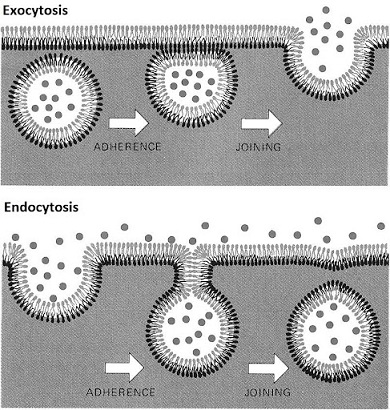
Fig. Endocytosis and Exocytosis
• In Exocytosis mode of transport, materials are expelled from the cell without passing through the membrane as individual particles. It is the exact opposite process of endocytosis.
• A particle existing within the membrane fuses with the inside of the plasma membrane and the membranous envelope is opened to the outside of the cell and this expels the particle into the extracellular space.
Note:
• Phagocytosis is a process, through which larger molecules are taken in by the cell. When the human body is invaded by microorganisms, a kind of white blood cell called neutrophil removes the invader, surrounds and engulfs the microbes, later destroying the same.
• Another variation is pinocytosis, which means cell drinking. In this process, the cell takes in the needed solutes from the extracellular fluid.
• A targeted variation of endocytosis is receptor-mediated endocytosis. Proteins present in the plasma membrane of the cell are specific to some foreign substances. The substances bind to the proteins, leading to the invagination of the plasma membrane, bringing the substances inside the cell.
Complete answer:
• Endocytosis falls under the category of active transport. It moves particles, like parts of cells, larger substances, and even whole cells into a cell.
• It leads to a particle being enveloped in a newly created intracellular vesicle, which is formed from the plasma membrane. It is a mode of active transport as the cell requires energy.
• Endo means inside. During endocytosis, a cell utilizes the cell membrane for engulfing an object, which is present outside of the cell. This process requires effort by the cell, so it needs to use the energy (ATP).
• Though there are different kinds of endocytosis, all share a common characteristic. Invagination of the plasma membrane happens, forming a pocket around the target molecule.
• The active transport which is the reverse of endocytosis is exocytosis.
Fig. Endocytosis and Exocytosis
• In Exocytosis mode of transport, materials are expelled from the cell without passing through the membrane as individual particles. It is the exact opposite process of endocytosis.
• A particle existing within the membrane fuses with the inside of the plasma membrane and the membranous envelope is opened to the outside of the cell and this expels the particle into the extracellular space.
Note:
• Phagocytosis is a process, through which larger molecules are taken in by the cell. When the human body is invaded by microorganisms, a kind of white blood cell called neutrophil removes the invader, surrounds and engulfs the microbes, later destroying the same.
• Another variation is pinocytosis, which means cell drinking. In this process, the cell takes in the needed solutes from the extracellular fluid.
• A targeted variation of endocytosis is receptor-mediated endocytosis. Proteins present in the plasma membrane of the cell are specific to some foreign substances. The substances bind to the proteins, leading to the invagination of the plasma membrane, bringing the substances inside the cell.
Recently Updated Pages
Master Class 11 English: Engaging Questions & Answers for Success

Master Class 11 Social Science: Engaging Questions & Answers for Success
Master Class 11 Maths: Engaging Questions & Answers for Success
Master Class 11 Biology: Engaging Questions & Answers for Success
Master Class 11 Physics: Engaging Questions & Answers for Success
Master Class 11 Chemistry: Engaging Questions & Answers for Success
Trending doubts
One Metric ton is equal to kg A 10000 B 1000 C 100 class 11 physics CBSE
Difference Between Prokaryotic Cells and Eukaryotic Cells
1 ton equals to A 100 kg B 1000 kg C 10 kg D 10000 class 11 physics CBSE
Find the value of the expression given below sin 30circ class 11 maths CBSE
Two of the body parts which do not appear in MRI are class 11 biology CBSE
What are hard magnetic materials class 11 physics CBSE