




Electron $s{{p}^{3}}{{d}^{2}}$ hybridization with suitable example.
Answer
 Verified
612k+ views
Hint: The concept of intermixing of different orbitals of atoms and then redistribution of energy to give equivalent energy of new orbitals, identical shape, and symmetrical orientation in space is hybridization. As a result of hybridization, new orbitals are formed known as hybrid orbitals, and bonds formed by hybrid orbitals are called hybrid bonds.
Complete step by step solution:
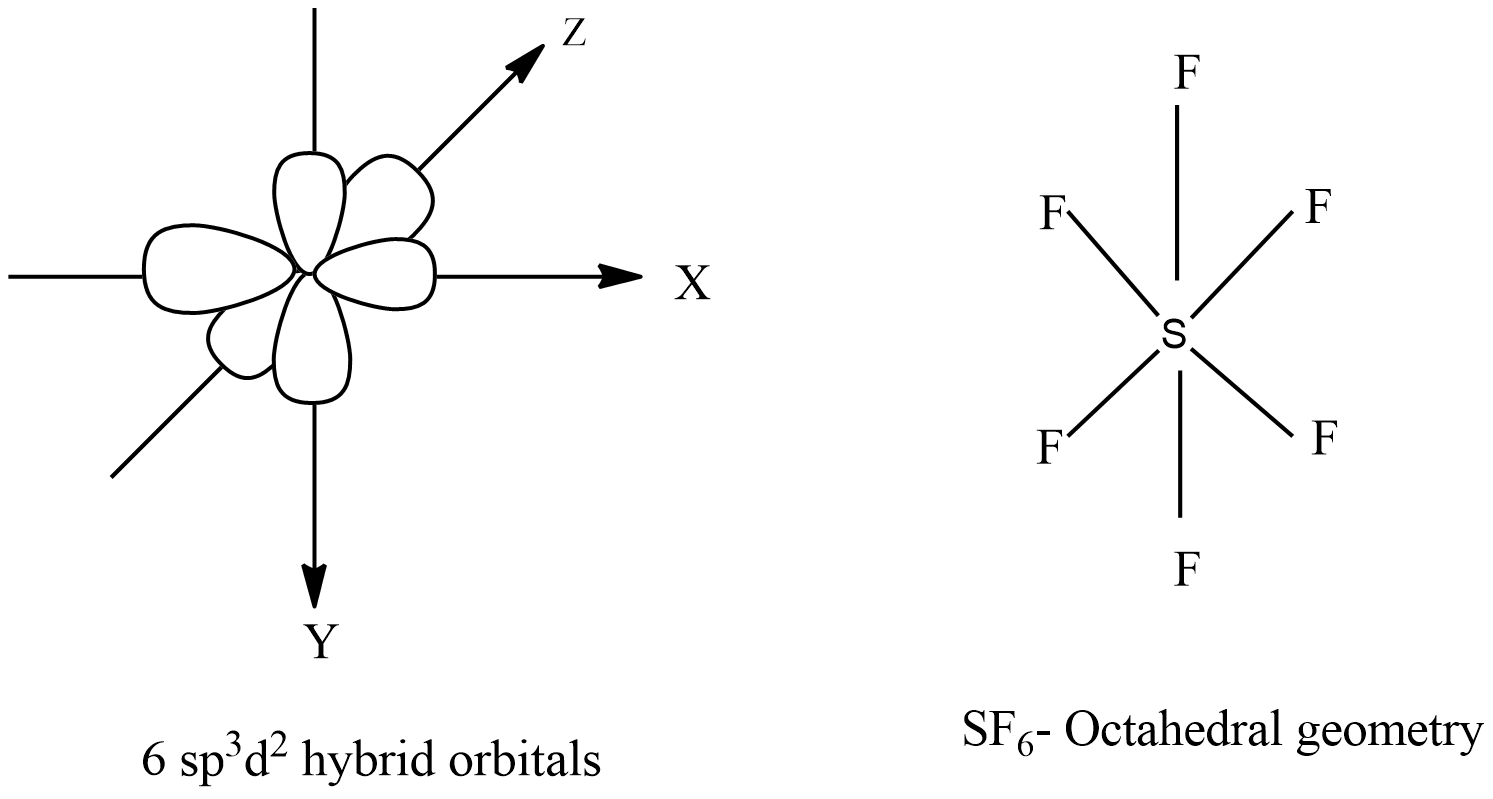
-$s{{p}^{3}}{{d}^{2}}$ Hybridization: When one s-orbital, three p-orbitals, and two d-orbitals hybridize to give six equivalent $s{{p}^{3}}{{d}^{2}}$ hybrid orbitals of equal energy. This hybridization is called $s{{p}^{3}}{{d}^{2}}$ hybridization.
-Properties: six equivalent $s{{p}^{3}}{{d}^{2}}$ hybrid orbitals are directed towards the six corners of a regular octahedron.
-Out of six hybrid orbitals, four are lying in one plane while the remaining two are directed above and below the plane containing four hybrid orbitals.
-Geometry is octahedral and bond angle is ${{90}^{o}}$. For example, sulfur hexafluoride $S{{F}_{6}}$. The central atom of this molecule, which is involved in the $s{{p}^{3}}{{d}^{2}}$ hybridization is sulfur (S). The atomic number of sulfur is 16, and electronic configuration is: $[Ne]3{{s}^{2}}3{{p}^{4}}3{{d}^{0}}$(ground state)
-The outer shell electrons in sulfur excited from the ground state to a higher energy state, then the electronic configuration will be: $[Ne]3{{s}^{1}}3{{p}^{3}}3{{d}^{2}}$ (Higher energy state). The six equivalent $s{{p}^{3}}{{d}^{2}}$ hybrid orbitals of sulfur are bonding with 6 p-orbital of F atoms resulting in the formation of a geometrical shape.
Note: The characteristics of hybridization are the number of hybrid orbitals formed are equal to the number atomic orbitals which orbitals undergo hybridization and these hybrid orbitals are equivalent in energy with shape. The stability of hybrid orbitals more than atomic orbitals and these hybrid orbitals have different orientations in space.
Complete step by step solution:
-$s{{p}^{3}}{{d}^{2}}$ Hybridization: When one s-orbital, three p-orbitals, and two d-orbitals hybridize to give six equivalent $s{{p}^{3}}{{d}^{2}}$ hybrid orbitals of equal energy. This hybridization is called $s{{p}^{3}}{{d}^{2}}$ hybridization.
-Properties: six equivalent $s{{p}^{3}}{{d}^{2}}$ hybrid orbitals are directed towards the six corners of a regular octahedron.
-Out of six hybrid orbitals, four are lying in one plane while the remaining two are directed above and below the plane containing four hybrid orbitals.
-Geometry is octahedral and bond angle is ${{90}^{o}}$. For example, sulfur hexafluoride $S{{F}_{6}}$. The central atom of this molecule, which is involved in the $s{{p}^{3}}{{d}^{2}}$ hybridization is sulfur (S). The atomic number of sulfur is 16, and electronic configuration is: $[Ne]3{{s}^{2}}3{{p}^{4}}3{{d}^{0}}$(ground state)
-The outer shell electrons in sulfur excited from the ground state to a higher energy state, then the electronic configuration will be: $[Ne]3{{s}^{1}}3{{p}^{3}}3{{d}^{2}}$ (Higher energy state). The six equivalent $s{{p}^{3}}{{d}^{2}}$ hybrid orbitals of sulfur are bonding with 6 p-orbital of F atoms resulting in the formation of a geometrical shape.
Note: The characteristics of hybridization are the number of hybrid orbitals formed are equal to the number atomic orbitals which orbitals undergo hybridization and these hybrid orbitals are equivalent in energy with shape. The stability of hybrid orbitals more than atomic orbitals and these hybrid orbitals have different orientations in space.
Recently Updated Pages
Master Class 11 English: Engaging Questions & Answers for Success

Master Class 11 Social Science: Engaging Questions & Answers for Success
Master Class 11 Maths: Engaging Questions & Answers for Success
Master Class 11 Chemistry: Engaging Questions & Answers for Success
Master Class 11 Biology: Engaging Questions & Answers for Success
Master Class 11 Physics: Engaging Questions & Answers for Success
Trending doubts
Find the value of the expression given below sin 30circ class 11 maths CBSE
1 ton equals to A 100 kg B 1000 kg C 10 kg D 10000 class 11 physics CBSE
1 Quintal is equal to a 110 kg b 10 kg c 100kg d 1000 class 11 physics CBSE
Difference between physical and chemical change class 11 chemistry CBSE
What organs are located on the left side of your body class 11 biology CBSE
Which of the following is the hottest month AMay BJune class 11 social science CBSE