




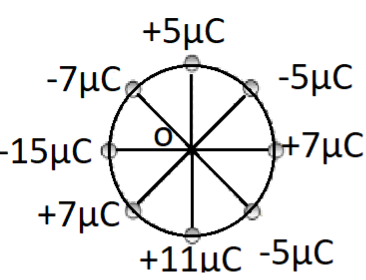
Eight charges having the values as shown in the figure are arranged symmetrically on a circle of radius 0.1 m. Potential at centre O will be
1) $252\times {{10}^{10}}V$
2) $252\times {{10}^{4}}V$
3) $252\times {{10}^{6}}V$
4) Zero
Answer
 Verified
588.6k+ views
Hint: In this question, all the charges are arranged symmetrically on the border of a circle of radius 0.1 m. So, we can apply the formula for the electric potential energy directly. Also, the net charge will be the direct sum of all the charges (with signs) due the symmetry.
Complete step by step answer:
By the formula for the electric potential energy at a pint
We have
Total potential at the centre O of the circle.
\[V=k\dfrac{q}{r}\]
Where, K is the Coulomb’s Constant, it is named after the scientist and founder of the electric potential, Charles-Augustin de Coulomb, a French military engineer and physicist
q is the net charge of the system
And, r is the distance
Here, q will be the sum of all the charges give to us
So,
\[V=\dfrac{1}{4\pi {{\in }_{0}}}\dfrac{{{q}_{net}}}{r}\]
Using the given charge values,
We have
$\Rightarrow V=\dfrac{1}{4\pi {{\in }_{0}}}\dfrac{(5-5+7-5+11+7+15-7)}{0.1}$
$\Rightarrow V=\dfrac{1}{4\pi {{\in }_{0}}}\dfrac{28}{0.1}$
$\Rightarrow V=9\times {{10}^{9}}\dfrac{28}{0.1}$
$\Rightarrow V=252\times {{10}^{10}}$
But,
The charges are given on micro scale
So,
$\Rightarrow V=252\times {{10}^{10}}\times {{10}^{-6}}$
$\Rightarrow V=252\times {{10}^{4}}V$
So, the correct answer is “Option 2”.
Note: In this question, we have the charges that are given to us in the micro scale, but the options that are given to us are not in the micro scale. This can lead to the common misunderstanding or mistake that a student may make. Always pay attention to the units and make the correct conversion to get the correct answer. For example, for this case
$1\mu C={{10}^{-6}}C$
Complete step by step answer:
By the formula for the electric potential energy at a pint
We have
Total potential at the centre O of the circle.
\[V=k\dfrac{q}{r}\]
Where, K is the Coulomb’s Constant, it is named after the scientist and founder of the electric potential, Charles-Augustin de Coulomb, a French military engineer and physicist
q is the net charge of the system
And, r is the distance
Here, q will be the sum of all the charges give to us
So,
\[V=\dfrac{1}{4\pi {{\in }_{0}}}\dfrac{{{q}_{net}}}{r}\]
Using the given charge values,
We have
$\Rightarrow V=\dfrac{1}{4\pi {{\in }_{0}}}\dfrac{(5-5+7-5+11+7+15-7)}{0.1}$
$\Rightarrow V=\dfrac{1}{4\pi {{\in }_{0}}}\dfrac{28}{0.1}$
$\Rightarrow V=9\times {{10}^{9}}\dfrac{28}{0.1}$
$\Rightarrow V=252\times {{10}^{10}}$
But,
The charges are given on micro scale
So,
$\Rightarrow V=252\times {{10}^{10}}\times {{10}^{-6}}$
$\Rightarrow V=252\times {{10}^{4}}V$
So, the correct answer is “Option 2”.
Note: In this question, we have the charges that are given to us in the micro scale, but the options that are given to us are not in the micro scale. This can lead to the common misunderstanding or mistake that a student may make. Always pay attention to the units and make the correct conversion to get the correct answer. For example, for this case
$1\mu C={{10}^{-6}}C$
Recently Updated Pages
Basicity of sulphurous acid and sulphuric acid are

Master Class 12 English: Engaging Questions & Answers for Success
Master Class 12 Social Science: Engaging Questions & Answers for Success
Master Class 12 Maths: Engaging Questions & Answers for Success
Master Class 12 Economics: Engaging Questions & Answers for Success
Master Class 12 Physics: Engaging Questions & Answers for Success
Trending doubts
Which are the Top 10 Largest Countries of the World?
Draw a labelled sketch of the human eye class 12 physics CBSE
Draw ray diagrams each showing i myopic eye and ii class 12 physics CBSE
Give 10 examples of unisexual and bisexual flowers
Give simple chemical tests to distinguish between the class 12 chemistry CBSE
Define Vant Hoff factor How is it related to the degree class 12 chemistry CBSE