




Effective capacitance of parallel combination of two capacitors ${{\text{C}}_1}$ and ${{\text{C}}_2}$ is 10μF. When these capacitors are individually connected to a voltage source of 1V, the energy stored in the capacitor ${{\text{C}}_2}$ is 4 times that of ${{\text{C}}_1}$. If these capacitors are connected in series, their effective capacitance will be:
A. 8.4μF
B. 3.2μF
C. 1.6μF
D. 4.2μF
Answer
 Verified
625.5k+ views
Hint: Proceed the solution of this question first by finding the value of capacitors ${{\text{C}}_1}$ and ${{\text{C}}_2}$ which we can find by given conditions of parallel combination of two capacitors and energy stored condition later on using effective capacitance of series combination of two capacitor we can find the required result.
Complete Step-by-Step solution:
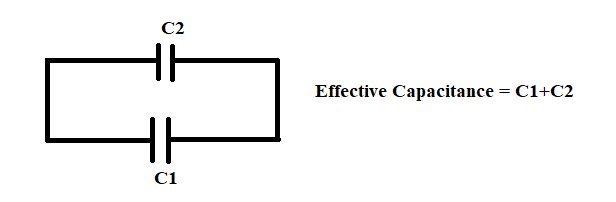
In the question it is given the effective capacitance of parallel combination of two capacitors ${{\text{C}}_1}$ and ${{\text{C}}_2}$ as shown in below figure that is equal to \[{{\text{C}}_1} + {{\text{C}}_2}\] which is given by 10μF
Hence ${{\text{C}}_1} + {{\text{C}}_2} = 10$ μF ...(1)
They are now connected to the same voltage source of 1V.
The energy stored in the two capacitors are given by ${{\text{E}}_1}{\text{& }}{{\text{E}}_2}$
And we know that Energy stored in any capacitor is equal to $\dfrac{1}{2}{\text{C}}{{\text{V}}^2}$
Therefore, energy stored in first and second capacitor ${{\text{E}}_1} = \dfrac{1}{2}{{\text{C}}_1}{{\text{V}}^2}{\text{ & }}{{\text{E}}_2} = \dfrac{1}{2}{{\text{C}}_2}{{\text{V}}^2}$
Given that the energy stored in the capacitor ${{\text{C}}_2}$ is 4 times that of ${{\text{C}}_1}$.
$ \Rightarrow {{\text{E}}_2} = {\text{4}}{{\text{E}}_1}$
$ \Rightarrow \dfrac{1}{2}{{\text{C}}_2}{{\text{V}}^2} = 4 \times \dfrac{1}{2}{{\text{C}}_1}{{\text{V}}^2}$
On further solving
$ \Rightarrow {{\text{C}}_2} = 4{{\text{C}}_1}$
∴${{\text{C}}_2}{\text{ = 4}}{{\text{C}}_1}$………………(2)
So on putting the value of ${{\text{C}}_2}{\text{ from equation (2) in equation (1)}}$
$ \Rightarrow {{\text{C}}_1} + 4{{\text{C}}_1} = 10{\mu\text{ F}}$
$ \Rightarrow 5{{\text{C}}_1} = 10{\mu\text{F}}$
$ \Rightarrow {{\text{C}}_1} = 2{\mu\text{F}}$
Now on putting the value of \[{{\text{C}}_2}{\text{ in equation (2) }}\]
∴${{\text{C}}_2}{\text{ = 4}} \times {\text{2 = 8}}\mu {\text{F}}$
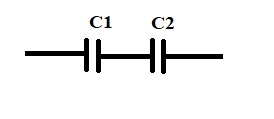
When ${{\text{C}}_1}$and ${{\text{C}}_2}$are connected in series as shown in below figure, the equivalent capacitance of the combination is given by
${{\text{C}}_{{\text{series}}}} = \dfrac{{{{\text{C}}_1} \times {{\text{C}}_2}}}{{{{\text{C}}_1}{\text{ + }}{{\text{C}}_2}}}$
Hence on putting the value of ${{\text{C}}_1}$ and ${{\text{C}}_2}$
${{\text{C}}_{{\text{series}}}} = \dfrac{{2 \times 8}}{{{\text{2 + 8}}}}{\mu\text{ F = }}\dfrac{{16}}{{10}}{\text{ = 1}}{.6\mu\text{ F}}$
Therefore, If capacitors ${{\text{C}}_1}$and ${{\text{C}}_2}$ are connected in series, their effective capacitance will be ${\text{1}}{.6\mu\text{F}}$
Note- In this particular question we should know that the energy stored in a capacitor is the work required to charge the capacitor, beginning with no charge on its plates. The energy is stored in the electrical field in the space between the two capacitor plates. It depends on the amount of electrical charge on capacitors plates and on the potential difference between the plates.
Complete Step-by-Step solution:
In the question it is given the effective capacitance of parallel combination of two capacitors ${{\text{C}}_1}$ and ${{\text{C}}_2}$ as shown in below figure that is equal to \[{{\text{C}}_1} + {{\text{C}}_2}\] which is given by 10μF
Hence ${{\text{C}}_1} + {{\text{C}}_2} = 10$ μF ...(1)
They are now connected to the same voltage source of 1V.
The energy stored in the two capacitors are given by ${{\text{E}}_1}{\text{& }}{{\text{E}}_2}$
And we know that Energy stored in any capacitor is equal to $\dfrac{1}{2}{\text{C}}{{\text{V}}^2}$
Therefore, energy stored in first and second capacitor ${{\text{E}}_1} = \dfrac{1}{2}{{\text{C}}_1}{{\text{V}}^2}{\text{ & }}{{\text{E}}_2} = \dfrac{1}{2}{{\text{C}}_2}{{\text{V}}^2}$
Given that the energy stored in the capacitor ${{\text{C}}_2}$ is 4 times that of ${{\text{C}}_1}$.
$ \Rightarrow {{\text{E}}_2} = {\text{4}}{{\text{E}}_1}$
$ \Rightarrow \dfrac{1}{2}{{\text{C}}_2}{{\text{V}}^2} = 4 \times \dfrac{1}{2}{{\text{C}}_1}{{\text{V}}^2}$
On further solving
$ \Rightarrow {{\text{C}}_2} = 4{{\text{C}}_1}$
∴${{\text{C}}_2}{\text{ = 4}}{{\text{C}}_1}$………………(2)
So on putting the value of ${{\text{C}}_2}{\text{ from equation (2) in equation (1)}}$
$ \Rightarrow {{\text{C}}_1} + 4{{\text{C}}_1} = 10{\mu\text{ F}}$
$ \Rightarrow 5{{\text{C}}_1} = 10{\mu\text{F}}$
$ \Rightarrow {{\text{C}}_1} = 2{\mu\text{F}}$
Now on putting the value of \[{{\text{C}}_2}{\text{ in equation (2) }}\]
∴${{\text{C}}_2}{\text{ = 4}} \times {\text{2 = 8}}\mu {\text{F}}$
When ${{\text{C}}_1}$and ${{\text{C}}_2}$are connected in series as shown in below figure, the equivalent capacitance of the combination is given by
${{\text{C}}_{{\text{series}}}} = \dfrac{{{{\text{C}}_1} \times {{\text{C}}_2}}}{{{{\text{C}}_1}{\text{ + }}{{\text{C}}_2}}}$
Hence on putting the value of ${{\text{C}}_1}$ and ${{\text{C}}_2}$
${{\text{C}}_{{\text{series}}}} = \dfrac{{2 \times 8}}{{{\text{2 + 8}}}}{\mu\text{ F = }}\dfrac{{16}}{{10}}{\text{ = 1}}{.6\mu\text{ F}}$
Therefore, If capacitors ${{\text{C}}_1}$and ${{\text{C}}_2}$ are connected in series, their effective capacitance will be ${\text{1}}{.6\mu\text{F}}$
Note- In this particular question we should know that the energy stored in a capacitor is the work required to charge the capacitor, beginning with no charge on its plates. The energy is stored in the electrical field in the space between the two capacitor plates. It depends on the amount of electrical charge on capacitors plates and on the potential difference between the plates.
Recently Updated Pages
Master Class 10 Social Science: Engaging Questions & Answers for Success

Master Class 10 Science: Engaging Questions & Answers for Success
Master Class 10 Maths: Engaging Questions & Answers for Success
Master Class 10 General Knowledge: Engaging Questions & Answers for Success
Master Class 10 Computer Science: Engaging Questions & Answers for Success
Class 10 Question and Answer - Your Ultimate Solutions Guide
Trending doubts
What is the full form of PNG A Petrol Natural Gas B class 10 chemistry CBSE
Explain the Treaty of Vienna of 1815 class 10 social science CBSE
In cricket, how many legal balls are there in a standard over?
Why is there a time difference of about 5 hours between class 10 social science CBSE
Who Won 36 Oscar Awards? Record Holder Revealed
What is the median of the first 10 natural numbers class 10 maths CBSE