




Ecotone is
(a) A zone between two ecosystems
(b) An ecological study
(c) Vertical zonation of an ecosystem
(d) Horizontal zonation of an ecosystem
Answer
 Verified
612.3k+ views
Hint: An ecotone is an area where communities can meet and integrate. Marshlands and estuaries are a few examples of ecotones. They are regions with higher biodiversity than a normal ecosystem. They are the buffer zones for the protection of an ecosystem.
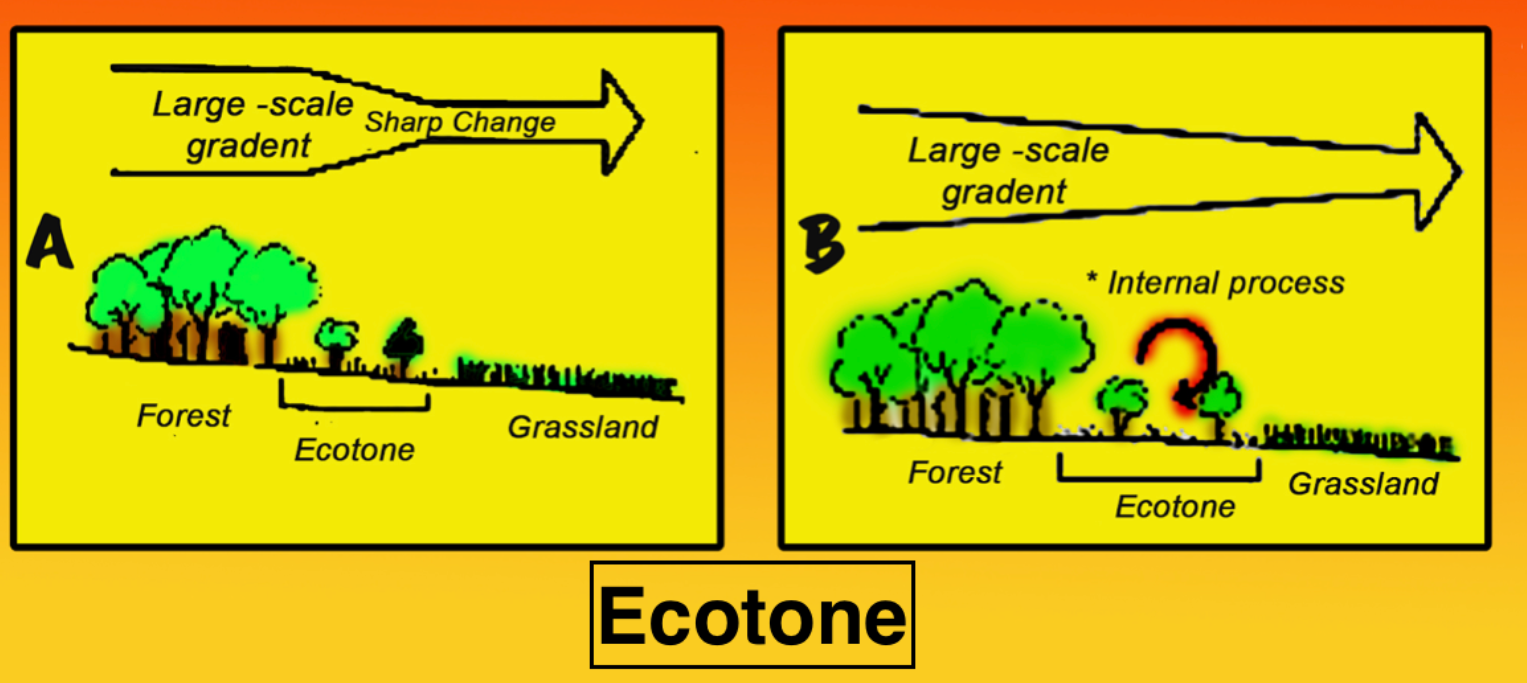
An ecotone is defined as a transitional area or zone present between two different ecosystems, or biomes such as forests and grasslands. In landscape ecology, ecotones are seen as the border areas, where two patches meet or integrate and interact, which have different ecological compositions.
Additional Information: An ecotone fundamentally contains the elements that belong to both the bordering communities as well as organisms that are characteristic and restricted to the ecotone thus showing greater biodiversity. Ecotones can be seen as wide zones, where the two communities slowly and gradually change from one to the other or may also be present as a more abrupt boundary, where the change from one association to the other is abrupt and sharply defined. There can be local ecotones such as the zone between a field and a forest or it may be regional for example the transition between a forest and a grassland ecosystem.
So, the correct answer is, “A zone between two ecosystems”.
Note:
- St. Lawrence River which forms the world’s largest estuary connecting the great lakes to the Atlantic ocean is an example of ecotones. -Ecotones are important because they form a bridge for the gene flow from one population to another because of the huge amount of genetic diversity. -They are also believed to be a sensitive indicator of climate change, as the shifting of boundaries between ecosystems is thought to have a strong environmental cause.
An ecotone is defined as a transitional area or zone present between two different ecosystems, or biomes such as forests and grasslands. In landscape ecology, ecotones are seen as the border areas, where two patches meet or integrate and interact, which have different ecological compositions.
Additional Information: An ecotone fundamentally contains the elements that belong to both the bordering communities as well as organisms that are characteristic and restricted to the ecotone thus showing greater biodiversity. Ecotones can be seen as wide zones, where the two communities slowly and gradually change from one to the other or may also be present as a more abrupt boundary, where the change from one association to the other is abrupt and sharply defined. There can be local ecotones such as the zone between a field and a forest or it may be regional for example the transition between a forest and a grassland ecosystem.
So, the correct answer is, “A zone between two ecosystems”.
Note:
- St. Lawrence River which forms the world’s largest estuary connecting the great lakes to the Atlantic ocean is an example of ecotones. -Ecotones are important because they form a bridge for the gene flow from one population to another because of the huge amount of genetic diversity. -They are also believed to be a sensitive indicator of climate change, as the shifting of boundaries between ecosystems is thought to have a strong environmental cause.
Recently Updated Pages
Master Class 11 English: Engaging Questions & Answers for Success

Master Class 11 Social Science: Engaging Questions & Answers for Success
Master Class 11 Maths: Engaging Questions & Answers for Success
Master Class 11 Chemistry: Engaging Questions & Answers for Success
Master Class 11 Biology: Engaging Questions & Answers for Success
Master Class 11 Physics: Engaging Questions & Answers for Success
Trending doubts
One Metric ton is equal to kg A 10000 B 1000 C 100 class 11 physics CBSE
Difference Between Prokaryotic Cells and Eukaryotic Cells
Find the value of the expression given below sin 30circ class 11 maths CBSE
1 ton equals to A 100 kg B 1000 kg C 10 kg D 10000 class 11 physics CBSE
Two of the body parts which do not appear in MRI are class 11 biology CBSE
Draw a diagram of nephron and explain its structur class 11 biology CBSE