




What is the eccentricity of a hyperbola?
Answer
 Verified
586.8k+ views
Hint: Eccentricity of a hyperbola is defined as $e=\sqrt{1+\dfrac{{{b}^{2}}}{{{a}^{2}}}}$ , where a is the length of semi major axis and b is the length of semi minor axis. For a hyperbola, the value of eccentricity e is always greater than 1, that is, e > 1.
Complete step by step solution:
We know that hyperbola is a collection of a set of points, whose difference of distances from two fixed points is a positive constant. These fixed points are called foci, and are shown as A and A’ in the figure below. Here, the origin is the centre of the hyperbola, and the intersecting points of the line joining the two foci and the conic section are called vertices of the hyperbola.
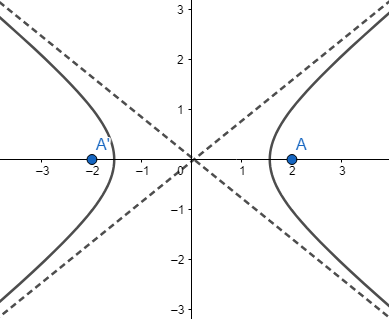
We are well aware that hyperbola is a conic section, and has two branches.
Hyperbola can also be defined in terms of eccentricity, but for that, we first need to understand what eccentricity means.
Eccentricity is a measure of the deviation occurred in the circularity of any conic section.
So mathematically, we can define eccentricity of any conic section as
$e=\dfrac{c}{a}$
Where e is the eccentricity of the conic section,
c is the distance between centre and the focus, and
a is the distance between centre and the vertex.
Now, we can define hyperbola in terms of eccentricity as the conic section whose eccentricity is greater than 1, that is, e > 1.
We know that the general equation of a hyperbola is
$\dfrac{{{x}^{2}}}{{{a}^{2}}}-\dfrac{{{y}^{2}}}{{{b}^{2}}}=1$ ,
where, a is the length of semi major axis,
and b is the length of semi minor axis.
So, in other words we can define hyperbola as a conic section in which the distance from a fixed point is greater than the distance from a fixed line, called the directrix.
Hence, for a hyperbola, eccentricity e > 1.
We know that eccentricity for a hyperbola is expressed as
$e=\sqrt{1+\dfrac{{{b}^{2}}}{{{a}^{2}}}}$
Note: We should not consider the a in eccentricity $e=\dfrac{c}{a}$ and the a in general equation of hyperbola $\dfrac{{{x}^{2}}}{{{a}^{2}}}-\dfrac{{{y}^{2}}}{{{b}^{2}}}=1$ as two different quantities. They both represent the same quantity.
We must also note that the above general equation of hyperbola is valid when the centre of the hyperbola is the origin (0,0).
Complete step by step solution:
We know that hyperbola is a collection of a set of points, whose difference of distances from two fixed points is a positive constant. These fixed points are called foci, and are shown as A and A’ in the figure below. Here, the origin is the centre of the hyperbola, and the intersecting points of the line joining the two foci and the conic section are called vertices of the hyperbola.
We are well aware that hyperbola is a conic section, and has two branches.
Hyperbola can also be defined in terms of eccentricity, but for that, we first need to understand what eccentricity means.
Eccentricity is a measure of the deviation occurred in the circularity of any conic section.
So mathematically, we can define eccentricity of any conic section as
$e=\dfrac{c}{a}$
Where e is the eccentricity of the conic section,
c is the distance between centre and the focus, and
a is the distance between centre and the vertex.
Now, we can define hyperbola in terms of eccentricity as the conic section whose eccentricity is greater than 1, that is, e > 1.
We know that the general equation of a hyperbola is
$\dfrac{{{x}^{2}}}{{{a}^{2}}}-\dfrac{{{y}^{2}}}{{{b}^{2}}}=1$ ,
where, a is the length of semi major axis,
and b is the length of semi minor axis.
So, in other words we can define hyperbola as a conic section in which the distance from a fixed point is greater than the distance from a fixed line, called the directrix.
Hence, for a hyperbola, eccentricity e > 1.
We know that eccentricity for a hyperbola is expressed as
$e=\sqrt{1+\dfrac{{{b}^{2}}}{{{a}^{2}}}}$
Note: We should not consider the a in eccentricity $e=\dfrac{c}{a}$ and the a in general equation of hyperbola $\dfrac{{{x}^{2}}}{{{a}^{2}}}-\dfrac{{{y}^{2}}}{{{b}^{2}}}=1$ as two different quantities. They both represent the same quantity.
We must also note that the above general equation of hyperbola is valid when the centre of the hyperbola is the origin (0,0).
Recently Updated Pages
Basicity of sulphurous acid and sulphuric acid are

Master Class 11 English: Engaging Questions & Answers for Success
Master Class 11 Physics: Engaging Questions & Answers for Success
Master Class 11 Computer Science: Engaging Questions & Answers for Success
Master Class 11 Chemistry: Engaging Questions & Answers for Success
Master Class 11 Social Science: Engaging Questions & Answers for Success
Trending doubts
Difference Between Prokaryotic Cells and Eukaryotic Cells
Two of the body parts which do not appear in MRI are class 11 biology CBSE
One Metric ton is equal to kg A 10000 B 1000 C 100 class 11 physics CBSE
10 examples of friction in our daily life
Draw a diagram of nephron and explain its structur class 11 biology CBSE
What will happen if the mucus is not secreted by the class 11 biology CBSE