




Earthworm respires by -
(a) Clitellum
(b) Ctenidia
(c) Moist skin
(d) Typhlosole
Answer
 Verified
630k+ views
Hint: Earthworms live in moist soils as it is necessary for their movement and other processes. It is also observed that earthworms die in dry weather as they need to be surrounded by moisture and humidity for an important process for survival.
Complete answer:
- Earthworms do not have lungs and they breathe through their skin.
- The respiration occurs by the diffusion of gases through the skin. For this to occur, the skin has to remain moist. The earthworm produces body fluids and mucus to maintain the skin moisture and it also has to live in damp or moist soil.
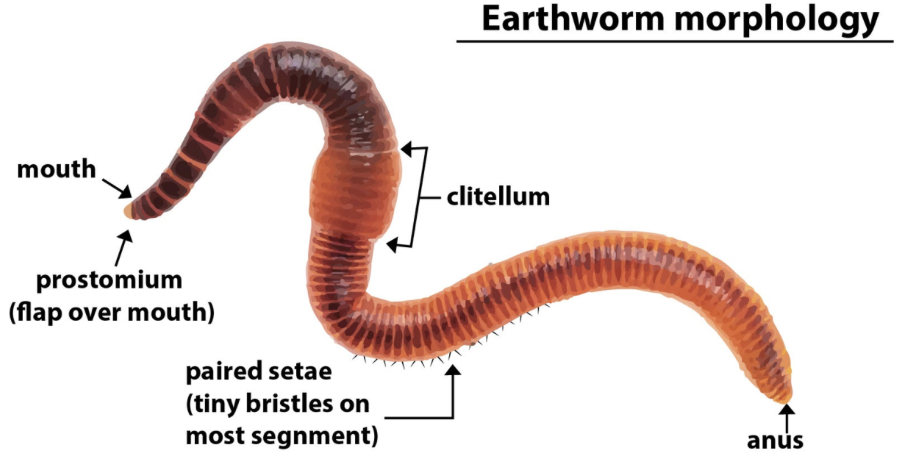
- Earthworms also have light-sensitive tissue on their head that detects whether it is daytime so they do not arise from the soil as the chance of the moisture getting evaporated is high.
- Both oxygen and carbon dioxide pass through the skin. The gas dissolves in the blood plasma and is oxygenated by the circulatory system. Obtaining oxygen from the soil requires the movement of the earthworm.
Additional Information:
- Clitellum is a non-segmented and glandular part in earthworms that is required for the storage of eggs.
- Ctenidia (or singular Ctenidium) are respiratory organs or gills present in molluscs.
- Typhlosole is an intestinal organ in earthworms that digests food and increases the surface area of the intestines.
- Water and salts also pass through the skin through active transport.
So, the correct answer is ‘(c) Moist skin’.
Note:
- If the skin of the earthworm dries out, the earthworm suffocates due to lack of oxygen.
- Earthworms appear on the surfaces during the rainy season as the soils they inhabit become waterlogged and block the diffusion of gases.
Complete answer:
- Earthworms do not have lungs and they breathe through their skin.
- The respiration occurs by the diffusion of gases through the skin. For this to occur, the skin has to remain moist. The earthworm produces body fluids and mucus to maintain the skin moisture and it also has to live in damp or moist soil.
- Earthworms also have light-sensitive tissue on their head that detects whether it is daytime so they do not arise from the soil as the chance of the moisture getting evaporated is high.
- Both oxygen and carbon dioxide pass through the skin. The gas dissolves in the blood plasma and is oxygenated by the circulatory system. Obtaining oxygen from the soil requires the movement of the earthworm.
Additional Information:
- Clitellum is a non-segmented and glandular part in earthworms that is required for the storage of eggs.
- Ctenidia (or singular Ctenidium) are respiratory organs or gills present in molluscs.
- Typhlosole is an intestinal organ in earthworms that digests food and increases the surface area of the intestines.
- Water and salts also pass through the skin through active transport.
So, the correct answer is ‘(c) Moist skin’.
Note:
- If the skin of the earthworm dries out, the earthworm suffocates due to lack of oxygen.
- Earthworms appear on the surfaces during the rainy season as the soils they inhabit become waterlogged and block the diffusion of gases.
Recently Updated Pages
Master Class 11 English: Engaging Questions & Answers for Success

Master Class 11 Social Science: Engaging Questions & Answers for Success
Master Class 11 Maths: Engaging Questions & Answers for Success
Master Class 11 Biology: Engaging Questions & Answers for Success
Master Class 11 Physics: Engaging Questions & Answers for Success
Master Class 11 Chemistry: Engaging Questions & Answers for Success
Trending doubts
Difference Between Prokaryotic Cells and Eukaryotic Cells
Find the value of the expression given below sin 30circ class 11 maths CBSE
One Metric ton is equal to kg A 10000 B 1000 C 100 class 11 physics CBSE
Two of the body parts which do not appear in MRI are class 11 biology CBSE
10 examples of friction in our daily life
Draw a diagram of nephron and explain its structur class 11 biology CBSE