




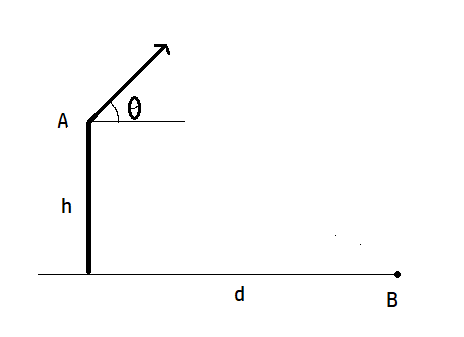
During volcanic eruptions, chunks of solid rock can be blasted out of the volcano; these projectiles are called volcanic bombs. Figure shows a cross section of Mt. Fuji, in Japan.
(a) At what initial speed would a bomb have to be ejected, at angle θ = 35 to the horizontal, from the vent at A in order to fall at the foot of the volcano at B, at vertical distance h=3.30km and horizontal distance d=9.40km? Ignore, for the moment, the effects of air on the bombs.
(b) What would be the time of flight?
(c) Would the effect of the air increase or decrease your answer in (a)?
Answer
 Verified
591k+ views
Hint: after the volcanic eruption the rocks fly away making some angle with the horizontal and there is no external force acting on the system and the only force acting on the system is the force of gravity acting downwards and so there is constant acceleration in he downward direction, so, this is an example of projectile motion.
Complete step by step answer:
A- For projectile motion,
Horizontal component of velocity,
$
{{u}_{x}}=u\cos \theta \\
\implies {{u}_{x}}=u\cos 35 \\
\implies {{u}_{x}}=0.81u \\
$
Vertical component of initial velocity,
$
{{u}_{y}}=u\sin \theta \\
\implies {{u}_{y}}=u\sin 35 \\
\implies {{u}_{y}}=0.57u \\
$
There is no acceleration in horizontal direction, so horizontal velocity remains constant throughout the motion.
For projectile motion v is given by formula, \[v=\dfrac{x}{\cos \theta }\sqrt{\dfrac{g}{2(x\tan \theta -y)}}\]
Here y=-3300 m
Also, X= 9400 m
So,
\[\begin{align}
& v=\dfrac{9400}{\cos 35}\sqrt{\dfrac{9.8}{2(9400\times \tan 35+3300)}} \\
& v=255.5m{{s}^{-1}} \\
\end{align}\]
B- we have found the initial velocity and now we need to find the time, we can use the formula
\[t=\dfrac{x}{{{u}_{x}}}=\dfrac{x}{v\cos 35}=\dfrac{9400}{255.5\times \cos 35}=45s\]
C-Air resistance will be negligible but to achieve the same height in presence of such resistance we need higher initial velocity.
Note:
The value of y is taken negative, although it is height and that is distance and we know distance can never be negative we had taken the origin at the point from where the rock shoots and so while using newton’s equation of motion the distance comes out to be negative
Complete step by step answer:
A- For projectile motion,
Horizontal component of velocity,
$
{{u}_{x}}=u\cos \theta \\
\implies {{u}_{x}}=u\cos 35 \\
\implies {{u}_{x}}=0.81u \\
$
Vertical component of initial velocity,
$
{{u}_{y}}=u\sin \theta \\
\implies {{u}_{y}}=u\sin 35 \\
\implies {{u}_{y}}=0.57u \\
$
There is no acceleration in horizontal direction, so horizontal velocity remains constant throughout the motion.
For projectile motion v is given by formula, \[v=\dfrac{x}{\cos \theta }\sqrt{\dfrac{g}{2(x\tan \theta -y)}}\]
Here y=-3300 m
Also, X= 9400 m
So,
\[\begin{align}
& v=\dfrac{9400}{\cos 35}\sqrt{\dfrac{9.8}{2(9400\times \tan 35+3300)}} \\
& v=255.5m{{s}^{-1}} \\
\end{align}\]
B- we have found the initial velocity and now we need to find the time, we can use the formula
\[t=\dfrac{x}{{{u}_{x}}}=\dfrac{x}{v\cos 35}=\dfrac{9400}{255.5\times \cos 35}=45s\]
C-Air resistance will be negligible but to achieve the same height in presence of such resistance we need higher initial velocity.
Note:
The value of y is taken negative, although it is height and that is distance and we know distance can never be negative we had taken the origin at the point from where the rock shoots and so while using newton’s equation of motion the distance comes out to be negative
Recently Updated Pages
Basicity of sulphurous acid and sulphuric acid are

Master Class 11 Business Studies: Engaging Questions & Answers for Success
Master Class 11 Computer Science: Engaging Questions & Answers for Success
Master Class 11 Economics: Engaging Questions & Answers for Success
Master Class 11 Social Science: Engaging Questions & Answers for Success
Master Class 11 English: Engaging Questions & Answers for Success
Trending doubts
One Metric ton is equal to kg A 10000 B 1000 C 100 class 11 physics CBSE
The largest wind power cluster is located in the state class 11 social science CBSE
Explain zero factorial class 11 maths CBSE
State and prove Bernoullis theorem class 11 physics CBSE
Which among the following are examples of coming together class 11 social science CBSE
Can anyone list 10 advantages and disadvantages of friction