




Draw the structure and functions of the neurons.
Answer
 Verified
627k+ views
Hint: Neurons or the neuronal cells are the structural and functional unit of the nervous system. The other type of cells in the nervous system are glial cells that form a synapse with the neurons.
Complete answer:
Neurons or the neuronal cells make the central nervous system and the peripheral nervous system. The main role of neurons is to communicate and send electrochemical signals to other nerve cells.
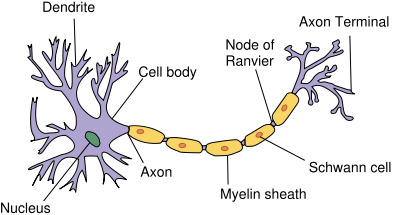
The main structures of the neuron are as follows: It consists mainly of a cell body, axon and dendrites.
i. The cell body of the neuron or commonly called the soma has several organelles in the cell body that help in the structure and formation of the neuron-like nucleus, ribosomes, mitochondria, endoplasmic reticulum, etc. The cell body thus contains the genetic material inside the nucleus enclosed by a membrane.
ii. The axon originates from the axon hillock and joins the cell body. It is a long tail-like structure which is mainly myelinated that helps in the electrical conduction of the signals and thus pass on the information to the next nerve cell coming from the cell body or the dendrites. The nodes of Ranvier are the regions where there is no myelination and a high number of sodium channels. This allows fast conduction of the electrical signals called the saltatory movement. The Schwann cell myelinates the axon in the peripheral nervous system and the oligodendrocytes myelinate the axons in the central nervous system. The axon terminal from the synapse with the surrounding cells.
iii. The dendrites are more in numbers compared to the axon. These are the structures that receive signals from the axon of the other nerve cell. Based on the number of the extensions neurons are divided into unipolar, bipolar, multipolar, and pseudo polar.
The main function of the neuron is to transmit the electrochemical signals and release neurotransmitters in the synapse that are taken up by the postsynaptic neuron which can show an inhibitory or excitatory
neuronal transmission of signals in the nervous system and give a response from the target for the stimuli. Based on the functions the neurons are divided into sensory neurons, motor neurons and interneurons.
Note: The motor neurons help in the voluntary and involuntary functions. The sensory neurons help in perceiving the taste, smell, touch, light, and such other senses. Interneurons form a complex circuit to pass a signal from the motor and sensory neurons.
Complete answer:
Neurons or the neuronal cells make the central nervous system and the peripheral nervous system. The main role of neurons is to communicate and send electrochemical signals to other nerve cells.
The main structures of the neuron are as follows: It consists mainly of a cell body, axon and dendrites.
i. The cell body of the neuron or commonly called the soma has several organelles in the cell body that help in the structure and formation of the neuron-like nucleus, ribosomes, mitochondria, endoplasmic reticulum, etc. The cell body thus contains the genetic material inside the nucleus enclosed by a membrane.
ii. The axon originates from the axon hillock and joins the cell body. It is a long tail-like structure which is mainly myelinated that helps in the electrical conduction of the signals and thus pass on the information to the next nerve cell coming from the cell body or the dendrites. The nodes of Ranvier are the regions where there is no myelination and a high number of sodium channels. This allows fast conduction of the electrical signals called the saltatory movement. The Schwann cell myelinates the axon in the peripheral nervous system and the oligodendrocytes myelinate the axons in the central nervous system. The axon terminal from the synapse with the surrounding cells.
iii. The dendrites are more in numbers compared to the axon. These are the structures that receive signals from the axon of the other nerve cell. Based on the number of the extensions neurons are divided into unipolar, bipolar, multipolar, and pseudo polar.
The main function of the neuron is to transmit the electrochemical signals and release neurotransmitters in the synapse that are taken up by the postsynaptic neuron which can show an inhibitory or excitatory
neuronal transmission of signals in the nervous system and give a response from the target for the stimuli. Based on the functions the neurons are divided into sensory neurons, motor neurons and interneurons.
Note: The motor neurons help in the voluntary and involuntary functions. The sensory neurons help in perceiving the taste, smell, touch, light, and such other senses. Interneurons form a complex circuit to pass a signal from the motor and sensory neurons.
Recently Updated Pages
Master Class 11 Social Science: Engaging Questions & Answers for Success

Master Class 11 English: Engaging Questions & Answers for Success
Master Class 11 Accountancy: Engaging Questions & Answers for Success
Master Class 11 Physics: Engaging Questions & Answers for Success
Master Class 11 Computer Science: Engaging Questions & Answers for Success
Master Class 11 Business Studies: Engaging Questions & Answers for Success
Trending doubts
One Metric ton is equal to kg A 10000 B 1000 C 100 class 11 physics CBSE
Find the value of the expression given below sin 30circ class 11 maths CBSE
Draw a diagram of nephron and explain its structur class 11 biology CBSE
10 examples of friction in our daily life
Proton was discovered by A Thomson B Rutherford C Chadwick class 11 chemistry CBSE
The teeth used for biting and cutting food are called class 11 biology CBSE