




Draw the shape of the distance-time graph for uniform motion of objects. A bus starting from rest moves with uniform acceleration of$0.1\dfrac {m} {{{s} ^ {2}}} $ for 2 minutes. Find
(a) the speed acquired.
(b)the distance travelled.
Answer
 Verified
564.6k+ views
Hint: When we draw a distance-time graph then, we know that it can be of two types i.e. uniform and non-uniform distance-time graph. The shape of the uniform motion is always straight. For the numerical part, we should know the basic formulas of motion in physics. We will first calculate the speed of the object and then we will find the distance travelled by it.
Complete answer:
For the first part of the question, we will draw the shape of the distance-time graph of uniform motion of objects.
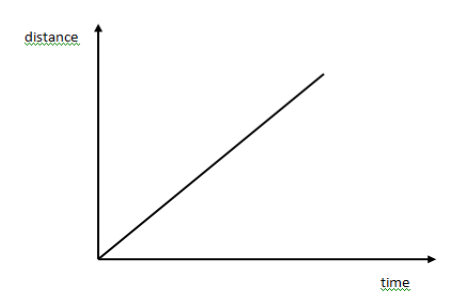
Here, the graph is a straight line because in uniform motion the object covers equal distance in equal time intervals. The slope of this curve tells us about the speed of the body. If the slope is steeper than the speed of the object will be higher.
(a) As the bus is starting from rest so, we know that its initial speed will be 0,
$u=0$ where, u = initial speed
It is given in question that acceleration is$0.1\dfrac {m} {{{s} ^ {2}}} $so,
$a=0.1\dfrac {m} {{{s} ^ {2}}} $ where, a = acceleration
As, time is given as 2 minutes,
$t=2\times 60=120\sec $ where, t = time taken
Now, using the basic formula of motion we will find the value of speed acquired i.e.
$v=u+at$ here, v =final speed
$\begin {align}
& \Rightarrow v=0+0.1\times 120 \\
& \therefore v=12m {{s} ^ {-1}} \\
\end{align}$
Therefore, the speed acquired by bus is$12m {{s} ^ {-1}} $.
(b)Now, we will apply another formula of motion,
$s=ut+\dfrac {1} {2} a {{t} ^ {2}} $ here, s = distance travelled
$\begin {align}
& \Rightarrow s=0\times 120+\dfrac {1} {2} (0.1) {{(120)} ^ {2}} \\
& \Rightarrow s=0+720 \\
& \therefore s=720m \\
\end{align}$
Therefore, the distance travelled will be $720m$.
Note:
There is motion in everything which is happening around us. Such as, an ant travelling in a lane. There are two types of motion, one is uniform motion and another is non-uniform motion. In non-uniform motion, the graph is curved because in non-uniform motion the object does not travel an equal distance in equal interval of time.
Complete answer:
For the first part of the question, we will draw the shape of the distance-time graph of uniform motion of objects.
Here, the graph is a straight line because in uniform motion the object covers equal distance in equal time intervals. The slope of this curve tells us about the speed of the body. If the slope is steeper than the speed of the object will be higher.
(a) As the bus is starting from rest so, we know that its initial speed will be 0,
$u=0$ where, u = initial speed
It is given in question that acceleration is$0.1\dfrac {m} {{{s} ^ {2}}} $so,
$a=0.1\dfrac {m} {{{s} ^ {2}}} $ where, a = acceleration
As, time is given as 2 minutes,
$t=2\times 60=120\sec $ where, t = time taken
Now, using the basic formula of motion we will find the value of speed acquired i.e.
$v=u+at$ here, v =final speed
$\begin {align}
& \Rightarrow v=0+0.1\times 120 \\
& \therefore v=12m {{s} ^ {-1}} \\
\end{align}$
Therefore, the speed acquired by bus is$12m {{s} ^ {-1}} $.
(b)Now, we will apply another formula of motion,
$s=ut+\dfrac {1} {2} a {{t} ^ {2}} $ here, s = distance travelled
$\begin {align}
& \Rightarrow s=0\times 120+\dfrac {1} {2} (0.1) {{(120)} ^ {2}} \\
& \Rightarrow s=0+720 \\
& \therefore s=720m \\
\end{align}$
Therefore, the distance travelled will be $720m$.
Note:
There is motion in everything which is happening around us. Such as, an ant travelling in a lane. There are two types of motion, one is uniform motion and another is non-uniform motion. In non-uniform motion, the graph is curved because in non-uniform motion the object does not travel an equal distance in equal interval of time.
Recently Updated Pages
Master Class 12 Economics: Engaging Questions & Answers for Success

Master Class 12 English: Engaging Questions & Answers for Success
Master Class 12 Social Science: Engaging Questions & Answers for Success
Master Class 12 Maths: Engaging Questions & Answers for Success
Master Class 12 Physics: Engaging Questions & Answers for Success
Master Class 9 General Knowledge: Engaging Questions & Answers for Success
Trending doubts
One Metric ton is equal to kg A 10000 B 1000 C 100 class 11 physics CBSE
Difference Between Prokaryotic Cells and Eukaryotic Cells
Two of the body parts which do not appear in MRI are class 11 biology CBSE
1 ton equals to A 100 kg B 1000 kg C 10 kg D 10000 class 11 physics CBSE
10 examples of friction in our daily life
DNA is not present in A Nucleus B Mitochondria C Chloroplast class 11 biology CBSE