




Draw the pattern of magnetic field lines for a bar magnet.
Answer
 Verified
666.3k+ views
Hint: A bar magnet consists of both North and South Pole at its either ends. It is a magnet with circular or rectangular cross section. Magnetic field lines are imaginary lines used to represent direction of magnetic fields. They are said to emerge from the North pole and enter via the South Pole.
Complete step by step answer:
A magnet is a material that has both attractive and directive properties associated with it. The property of a magnet to attract small pieces of iron, nickel, cobalt etc is known as magnetism.
When a thin long magnet is suspended freely, it tends to come at rest by aligning towards the geographical North-South direction of earth.
A bar magnet is an artificial magnet which has either a circular or a rectangular cross section. The ends of the bar magnet shows greater magnetic attraction. These ends are known as the pole of the magnet. Every magnet has two poles, namely North pole and South pole.
According to the law of magnetic poles like magnetic poles repel each other, and unlike magnetic poles attract each other. Additionally, unlike electric charges, a magnetic monopole does not exist. Every magnet exists as dipole.
The space around the magnet within which its magnetic influence can be experienced is known as its magnetic field. Magnetic field is represented using magnetic field lines which are imaginary lines used only for the sake of visual cue.
The following diagram shows the pattern of magnetic field lines around a bar magnet:
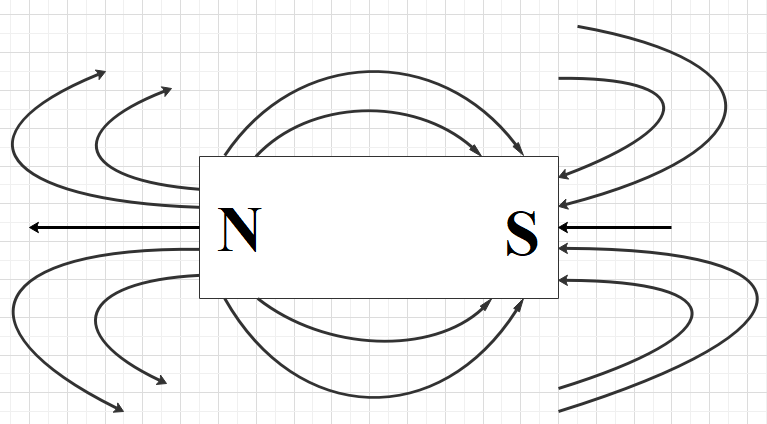
Note: Magnetic poles are the regions of apparently concentrated magnetic strength in a magnet. In other words these are the regions where magnetic attraction is maximum. Thus the magnetic field lines in these regions are highly concentrated as well.
Complete step by step answer:
A magnet is a material that has both attractive and directive properties associated with it. The property of a magnet to attract small pieces of iron, nickel, cobalt etc is known as magnetism.
When a thin long magnet is suspended freely, it tends to come at rest by aligning towards the geographical North-South direction of earth.
A bar magnet is an artificial magnet which has either a circular or a rectangular cross section. The ends of the bar magnet shows greater magnetic attraction. These ends are known as the pole of the magnet. Every magnet has two poles, namely North pole and South pole.
According to the law of magnetic poles like magnetic poles repel each other, and unlike magnetic poles attract each other. Additionally, unlike electric charges, a magnetic monopole does not exist. Every magnet exists as dipole.
The space around the magnet within which its magnetic influence can be experienced is known as its magnetic field. Magnetic field is represented using magnetic field lines which are imaginary lines used only for the sake of visual cue.
The following diagram shows the pattern of magnetic field lines around a bar magnet:
Note: Magnetic poles are the regions of apparently concentrated magnetic strength in a magnet. In other words these are the regions where magnetic attraction is maximum. Thus the magnetic field lines in these regions are highly concentrated as well.
Recently Updated Pages
Write any three differences between metals and nonmetals class 10 social science CBSE

Amit standing on a horizontal plane finds a bird flying class 10 maths CBSE
Two circles of radii 5 cm and 3 cm intersect at two class 10 maths CBSE
Solve the following i John and Jivanti together have class 10 maths CBSE
What is the relation between orthocenter circumcentre class 10 maths CBSE
Two plane mirrors are inclined at 70circ A ray incident class 10 physics CBSE
Trending doubts
Explain the Treaty of Vienna of 1815 class 10 social science CBSE
1 GB equals how many MB?
10 examples of evaporation in daily life with explanations
What is the full form of POSCO class 10 social science CBSE
Which is the hottest planet in the Solar system A Earth class 10 social science CBSE
Name any four life processes in living things class 10 biology CBSE