




Draw the lines of symmetry of the following capital letters of the English alphabet:
(i)A
(ii)D
(iii)T
Answer
 Verified
609.6k+ views
Hint: We will define symmetry and the line of symmetry. We will identify a line that satisfies the definition for each of the capital letters. Then we will draw the letters with the line of symmetry.
Complete step-by-step answer:
We know that something can be called symmetrical when it is the same on both sides. We know that a shape is said to have symmetry if a central dividing line can be drawn on it, to show that both sides of the shape are exactly the same. This line is called the line of symmetry or the axis of symmetry.
We know that the line of symmetry is imaginary and that it must pass through the centre of the shape or object and divide it into 2 identical halves.
If we fold an image along its line of symmetry, both halves will overlap perfectly.
(i)We will find the line of symmetry of A :
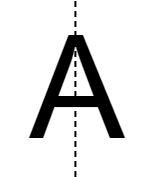
We can see that A has a vertical line of symmetry. The portions to the left and right of the line of symmetry are identical.
(ii)We will find the line of symmetry of D :
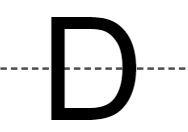
We can see that D has a horizontal line of symmetry. The portions on the upper and lower sides of the line of symmetry are identical.
(iii)We will find the line of symmetry of T :

We can see that T has a vertical line of symmetry. The portions to the left and right of the line of symmetry are identical.
Note: We should know that mirror symmetry is also known as bilateral symmetry. It is the symmetry where an object is symmetrical with respect to its reflection. There are many examples of symmetrical figures in nature; for example, a butterfly is symmetrical along its main body axis. Geometrical figures like squares and other regular polygons have multiple lines of symmetry.
Complete step-by-step answer:
We know that something can be called symmetrical when it is the same on both sides. We know that a shape is said to have symmetry if a central dividing line can be drawn on it, to show that both sides of the shape are exactly the same. This line is called the line of symmetry or the axis of symmetry.
We know that the line of symmetry is imaginary and that it must pass through the centre of the shape or object and divide it into 2 identical halves.
If we fold an image along its line of symmetry, both halves will overlap perfectly.
(i)We will find the line of symmetry of A :
We can see that A has a vertical line of symmetry. The portions to the left and right of the line of symmetry are identical.
(ii)We will find the line of symmetry of D :
We can see that D has a horizontal line of symmetry. The portions on the upper and lower sides of the line of symmetry are identical.
(iii)We will find the line of symmetry of T :
We can see that T has a vertical line of symmetry. The portions to the left and right of the line of symmetry are identical.
Note: We should know that mirror symmetry is also known as bilateral symmetry. It is the symmetry where an object is symmetrical with respect to its reflection. There are many examples of symmetrical figures in nature; for example, a butterfly is symmetrical along its main body axis. Geometrical figures like squares and other regular polygons have multiple lines of symmetry.

Recently Updated Pages
Master Class 11 English: Engaging Questions & Answers for Success

Master Class 11 Social Science: Engaging Questions & Answers for Success
Master Class 11 Maths: Engaging Questions & Answers for Success
Master Class 11 Chemistry: Engaging Questions & Answers for Success
Master Class 11 Biology: Engaging Questions & Answers for Success
Master Class 11 Physics: Engaging Questions & Answers for Success
Trending doubts
100 million is equal to begingathered A 1 crore B -class-7-maths-CBSE
Full Form of IASDMIPSIFSIRSPOLICE class 7 social science CBSE
Write in numerals Ten lakh ninety thousand nine hundred class 7 maths CBSE
How many crores make 10 million class 7 maths CBSE
List of coprime numbers from 1 to 100 class 7 maths CBSE
What is a subcontinent class 7 social science CBSE