




Draw the diagram of a nuclear power plant and label the following parts.
A) Control rods
B) Radiation shield.
Answer
 Verified
606.9k+ views
Hint: Nuclear Power Plants use the process of fission to generate electricity. Nuclei of heavy atoms such as uranium are bombarded with neutrons in a cyclic process and the energy released is used to convert water into steam which drives the turbines and the generator.
Complete step by step answer:
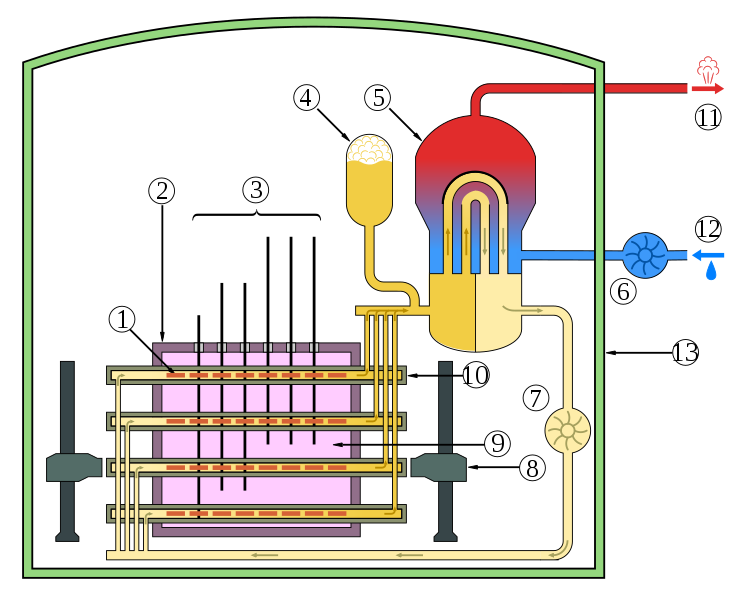
Control rods offer real-time control of the reaction process in a nuclear power plant. They absorb the neutrons produced from the fission and are crucial for keeping the fission chain reaction active while at the same time preventing it from spiralling out of control. If the control rods are inserted further into the core, the reaction slows down and eventually stops; if the control rods are removed or withdrawn slightly, the reaction accelerates.
In the above figure, cadmium rods labelled as 3 function as control rods as cadmium is a good neutron absorbent.
In a nuclear power plant, a massive amount of energy is produced along with very high-frequency ionizing radiations which can cause severe irradiation damage to living tissue. To prevent the exposure of humans to such ionizing radiations, radioactive shielding is necessary. Radiation sources can be shielded with material that absorbs radiation energy. These materials can be liquid (such as heavy water as indicated in the figure) or solid (concrete and lead shields of appropriate thickness (indicated in the figure) surrounding the reactor core. The part labelled 13 functions as radiation shielding.
Note: Although nuclear energy is referred to as clean energy, the radioactive waste disposal from power plants can lead to various environmental issues if not properly overseen. Moreover, marine life may get affected due to local thermal pollution as the water used in the reactor is released into water bodies.
Complete step by step answer:
Control rods offer real-time control of the reaction process in a nuclear power plant. They absorb the neutrons produced from the fission and are crucial for keeping the fission chain reaction active while at the same time preventing it from spiralling out of control. If the control rods are inserted further into the core, the reaction slows down and eventually stops; if the control rods are removed or withdrawn slightly, the reaction accelerates.
In the above figure, cadmium rods labelled as 3 function as control rods as cadmium is a good neutron absorbent.
In a nuclear power plant, a massive amount of energy is produced along with very high-frequency ionizing radiations which can cause severe irradiation damage to living tissue. To prevent the exposure of humans to such ionizing radiations, radioactive shielding is necessary. Radiation sources can be shielded with material that absorbs radiation energy. These materials can be liquid (such as heavy water as indicated in the figure) or solid (concrete and lead shields of appropriate thickness (indicated in the figure) surrounding the reactor core. The part labelled 13 functions as radiation shielding.
Note: Although nuclear energy is referred to as clean energy, the radioactive waste disposal from power plants can lead to various environmental issues if not properly overseen. Moreover, marine life may get affected due to local thermal pollution as the water used in the reactor is released into water bodies.
Recently Updated Pages
Master Class 12 Business Studies: Engaging Questions & Answers for Success

Master Class 12 Biology: Engaging Questions & Answers for Success
Master Class 12 Chemistry: Engaging Questions & Answers for Success
Class 12 Question and Answer - Your Ultimate Solutions Guide
Master Class 11 Social Science: Engaging Questions & Answers for Success
Master Class 11 English: Engaging Questions & Answers for Success
Trending doubts
Which are the Top 10 Largest Countries of the World?
Draw a labelled sketch of the human eye class 12 physics CBSE
Name the crygenes that control cotton bollworm and class 12 biology CBSE
Differentiate between homogeneous and heterogeneous class 12 chemistry CBSE
Ribosomal RNA is actively synthesised in A Nucleoplasm class 12 biology CBSE
How many molecules of ATP and NADPH are required information class 12 biology CBSE