




Draw graph of $x-2y=4,\text{ }2x-4y=12$ on the same coordinate plane. Observe it, think of the relation between coefficient of x, coefficient of y and the constant teams and draw the inference.
Answer
 Verified
627.3k+ views
Hint: To solve this type of question we can use the following points. If $ax+by+c=0$ and $px+qy+r=0$are the two given equations of lines then,
1. Lines are intersecting is $\dfrac{a}{p}\ne \dfrac{b}{q}$
2. Lines are parallel and intersecting if $\dfrac{a}{p}=\dfrac{b}{q}=\dfrac{c}{r}$
3. Lines are parallel and non – consisting if $\dfrac{a}{p}=\dfrac{b}{q}\ne \dfrac{c}{r}$
Complete step-by-step answer:
The two linear equation in two variables are:
1. $x-2y=4$
2. $2x-4y=12$
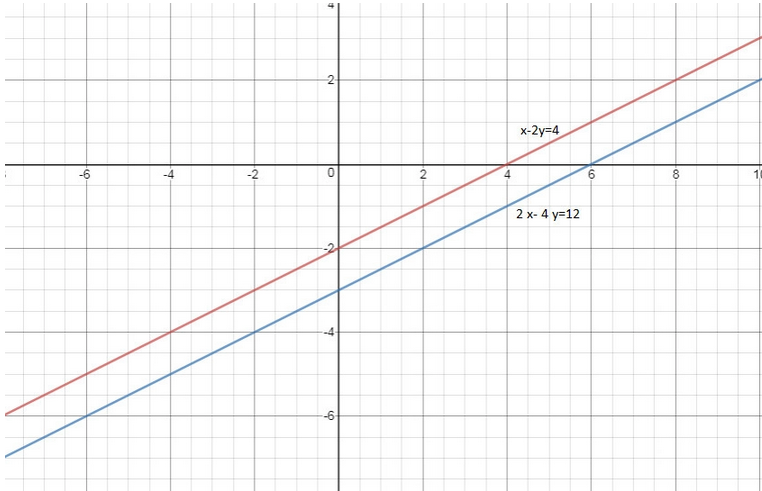
So, if the two lines are parallel their slopes should be equal.
And if they are coincident a intersecting
$\dfrac{a}{b}\ne \dfrac{p}{q}$
Comparing the given equations with
$ax+by+c=0$ and$px+qy+r=0$
We get,
$a=1\text{ }p=2$
$b=-2\text{ q}=-4$
$c=-4\text{ }r=-12$
.Here $\dfrac{1}{2}=\dfrac{-2}{-4}\ne \dfrac{-4}{-12}$
Hence these lines are parallel and not coincident. Also, parallel lines have equal slopes.
Line 1 = $x-2y=4$ transposing x we get,
$-2y=4-x$ dividing whole equation
$y=\dfrac{x}{2}-2$ by $-2$ we get,
Comparing with standard equation of time we get
$y=mx+c\text{ }m=\text{slope = }\dfrac{1}{2}$
Line 2 = $2x-4y=12$ transposing $2x$ we get,
$-4y=12-2x$ dividing whole equation by -4 we get
$y=\dfrac{1}{2}x-3$.
Comparing with standard question of line $y=mx+c$
We get,
$m=\dfrac{1}{2}$.
As the slopes of both lines are equal these given lines are parallel.
Note: If we have parallel lines which are also coincident. In that case, the lines are multiples of each other,
$ax+by+c=m\left( px+qy+r \right)$ where $m\varepsilon R$
For eg. $2x+4y+6=2\left( x+2y+3 \right)$
Нence, $2x+4y+6$ and $x+2y+3$.are parallel and coincident lines.
1. Lines are intersecting is $\dfrac{a}{p}\ne \dfrac{b}{q}$
2. Lines are parallel and intersecting if $\dfrac{a}{p}=\dfrac{b}{q}=\dfrac{c}{r}$
3. Lines are parallel and non – consisting if $\dfrac{a}{p}=\dfrac{b}{q}\ne \dfrac{c}{r}$
Complete step-by-step answer:
The two linear equation in two variables are:
1. $x-2y=4$
2. $2x-4y=12$
So, if the two lines are parallel their slopes should be equal.
And if they are coincident a intersecting
$\dfrac{a}{b}\ne \dfrac{p}{q}$
Comparing the given equations with
$ax+by+c=0$ and$px+qy+r=0$
We get,
$a=1\text{ }p=2$
$b=-2\text{ q}=-4$
$c=-4\text{ }r=-12$
.Here $\dfrac{1}{2}=\dfrac{-2}{-4}\ne \dfrac{-4}{-12}$
Hence these lines are parallel and not coincident. Also, parallel lines have equal slopes.
Line 1 = $x-2y=4$ transposing x we get,
$-2y=4-x$ dividing whole equation
$y=\dfrac{x}{2}-2$ by $-2$ we get,
Comparing with standard equation of time we get
$y=mx+c\text{ }m=\text{slope = }\dfrac{1}{2}$
Line 2 = $2x-4y=12$ transposing $2x$ we get,
$-4y=12-2x$ dividing whole equation by -4 we get
$y=\dfrac{1}{2}x-3$.
Comparing with standard question of line $y=mx+c$
We get,
$m=\dfrac{1}{2}$.
As the slopes of both lines are equal these given lines are parallel.
Note: If we have parallel lines which are also coincident. In that case, the lines are multiples of each other,
$ax+by+c=m\left( px+qy+r \right)$ where $m\varepsilon R$
For eg. $2x+4y+6=2\left( x+2y+3 \right)$
Нence, $2x+4y+6$ and $x+2y+3$.are parallel and coincident lines.
Recently Updated Pages
Master Class 12 Business Studies: Engaging Questions & Answers for Success

Master Class 12 Biology: Engaging Questions & Answers for Success
Master Class 12 Chemistry: Engaging Questions & Answers for Success
Class 12 Question and Answer - Your Ultimate Solutions Guide
Master Class 11 Social Science: Engaging Questions & Answers for Success
Master Class 11 English: Engaging Questions & Answers for Success
Trending doubts
Explain the Treaty of Vienna of 1815 class 10 social science CBSE
Which Indian city is known as the "City of Victory"?
Which instrument is used to measure the Blood Pressure?
Who Won 36 Oscar Awards? Record Holder Revealed
What is the median of the first 10 natural numbers class 10 maths CBSE
Why is it 530 pm in india when it is 1200 afternoon class 10 social science CBSE